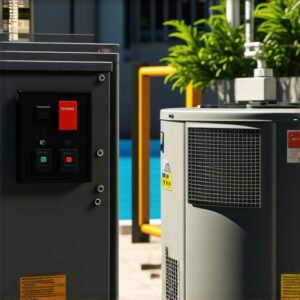

You wake up at 3:00 AM in a house that feels more like a meat locker than a home. You shuffle over to the baseboard heater, expecting that familiar hum or the gentle radiating warmth, but when you touch the metal casing, it’s stone cold. As a tech who has spent thirty years crawling through spider-infested crawlspaces and diagnosing systems in the middle of a Chicago polar vortex, I can tell you that a cold baseboard is more than just a nuisance; it’s a failure of physics. My old mentor used to scream at me, ‘You can’t cool what you can’t touch, and you can’t heat what you can’t move!’ He was obsessed with the idea that HVAC isn’t about the box you buy, but the energy you manage. That lesson rings true every time I walk into a multi-family heating upgrade project where half the units are freezing because some ‘Tin Knocker’ didn’t understand flow dynamics. If your heater is cold, we are going to perform a forensic diagnosis to find the break in the chain.
The Anatomy of Silence: Why the Heat Stopped
Whether you are dealing with electric resistance baseboards or a hydronic (hot water) system, the silence is your first clue. In the North, where the mercury regularly drops into the negatives, we don’t play games with heating. We look at the AFUE ratings and we look at the thermodynamic convective loop. A baseboard heater works on a simple principle: cool air is drawn in from the floor, heated by the fins, and rises. If that fin is cold, the loop is broken. The most common culprit in electric units is a tripped high-limit switch or a dead thermostat. In hydronic systems, it’s usually an air lock.
“The most expensive equipment in the world cannot overcome a bad duct system.” – Industry Axiom
This axiom applies to baseboards too; if the water can’t circulate or the electrons can’t flow, the most expensive boiler or 2025-ready electrical panel is just a heavy paperweight. If you’re wondering how to fix this, you might need to look at how to identify when furnace repair is urgent and why, especially if your baseboards are tied into a central boiler system.
Step 1: The Electrical Ghost Hunt
If you have an electric baseboard, the ‘Sparky’ who wired it is the first person I’m suspicious of. We start at the breaker. Don’t just look at it; flip it off and back on. I’ve seen breakers that looked fine but were ‘half-tripped.’ If the breaker holds, we move to the thermostat. These aren’t the fancy smart thermostats you see in heating service innovations transforming 2025 climate control; often, they are high-voltage line-stat units. If the internal bellows have leaked their gas, the switch won’t close. I’ve seen ‘Sales Techs’ try to sell a whole new heating system for $12,000 when the fix was a $40 thermostat. It’s a scam I see too often. Check for 240 volts at the heater. If you have power but no heat, your high-limit safety—a small disc designed to prevent fires if a curtain falls over the heater—might be stuck open. It’s a sensory experience; if you smell a faint ‘ozone’ scent, you might have a charred wire nut inside the end-cap. [IMAGE_PLACEHOLDER]
Step 2: Hydronic Hangups and Air Locks
In a hydronic system, a cold heater usually means there is a bubble of air trapped in the copper line. Water is lazy; it won’t push past a large air pocket. This is where school boiler maintenance protocols come in handy. In large buildings, we use automatic air vents, but in your home, you likely have a small ‘bleeder’ valve on the end of the baseboard. You’ll need a radiator key or a flathead screwdriver. When you open it, you should hear a hiss. If no water follows the hiss, you’ve found the air lock. This is common after a heat pump replacement or when the system has been drained for repairs.
“Hydronic systems must be properly balanced to ensure that the furthest terminal unit receives the design flow rate.” – ASHRAE Standard 90.1
If the water is hot at the boiler but cold at the baseboard, your zone valve might be the ‘traitor.’ These motorized valves fail more than I’d like to admit. You can usually manually override them to get through a cold night.
Step 3: The 2025 Efficiency Pivot
Sometimes, a cold baseboard isn’t ‘broken’—it’s just outmatched. If you’ve recently upgraded to MERV filter upgrades in a separate AC system but left your old heating as-is, you might be noticing the inefficiency more. Many homeowners are now looking at cold climate heat pumps as a supplement or replacement. These units can pull heat from the air even at -15°F. If your baseboard is part of a dual fuel heat pump system, the logic board might be confused about when to switch from the heat pump to the backup baseboard heat. This is where HVAC load calculation services (Manual J) become critical. Most older homes have heaters that were ‘guesstimated.’ If your attic has poor attic insulation for heating, that baseboard is trying to heat the whole neighborhood. You can find more tips on this in our heating service hacks for comfort and savings in 2025. We also see solar thermal heating integration becoming a factor in multi-family heating upgrades, where the baseboards are just the final stage of a much larger, greener loop.
The Cost of Neglect vs. The Price of Progress
I’ve seen compressors burn out and boilers crack because people ignored the small signs. A cold baseboard today is a frozen pipe tomorrow. Repairing a zone valve or a thermostat might cost you $300 to $600, but a burst pipe in the wall? You’re looking at five figures. If your system is over 20 years old, it might be time to stop throwing ‘juice’ (refrigerant) at problems or replacing heating elements. Consider a full heat pump replacement. It’s cleaner, and with modern IAQ improvement services, you can keep your air scrubbed while you stay warm. For those in the thick of it, check out top hvac repair strategies to extend your system’s life to see if you can squeeze a few more years out of that old iron. Remember, comfort is a matter of physics. If the delta-T (temperature difference) isn’t there, something is blocking the energy. Don’t let a ‘Sales Tech’ tell you that you need a whole new house; find the tech who knows how to use a multimeter and a manometer. Stay warm, keep your ‘pookie’ tight on your ductwork (if you have it), and never trust a system that hasn’t been load-calculated.