The Forensic Diagnosis: Why Your Pellet Stove is Gagging on Its Own Waste
I remember my old mentor, a grizzly veteran who could smell a cracked heat exchanger from the driveway, used to grab me by the collar of my Dickies work shirt and scream, ‘You can’t transfer heat through a blanket of filth! You can’t cool what you can’t touch!’ He was talking about evaporator coils back then, but the physics of biomass boiler services and fireplace insert services are exactly the same. In the frozen trenches of a Northern winter, where the wind bites through your coveralls, a pellet stove isn’t just a luxury; it is a thermodynamic machine that demands respect. When homeowners ignore ash removal, they aren’t just being messy—they are actively suffocating the heat transfer process and inviting a blower motor replacement or worse.
Let’s talk Thermodynamic Zooming. Your pellet stove works by combustion, yes, but the real magic happens at the heat exchanger. The goal is to move sensible heat from the firebox into the room air. Ash is a phenomenal insulator. In the HVAC world, we fight for every BTU. When a layer of fine particulate—ash—coats the interior of your burn pot and heat exchanger tubes, it creates a thermal barrier. This increases the R-value of the metal surfaces. Instead of the heat moving into your home, it stays trapped in the combustion chamber, eventually venting out the flue. You are literally burning money because the heat can’t ‘touch’ the metal. This is the same principle I explain during a furnace repair call: if the medium is blocked, the machine is useless.
“Failure to maintain proper clearance and cleanliness in solid-fuel burning appliances is the leading cause of residential chimney fires and equipment failure.” – NFPA 211: Standard for Chimneys, Fireplaces, Vents, and Solid Fuel-Burning Appliances
The Mechanical Anatomy: Anatomy of a Choked System
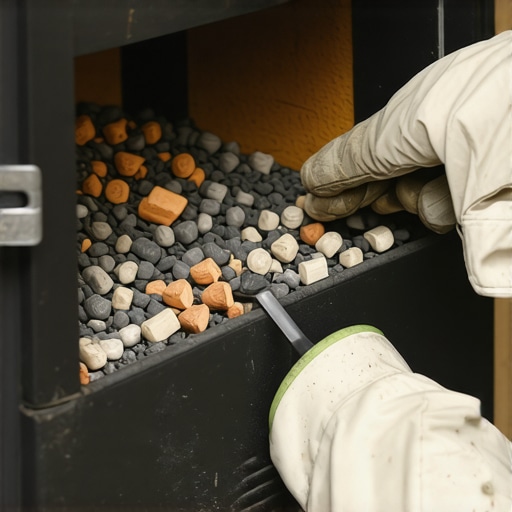
When I crack open a stove that hasn’t been cleaned in a month, I’m looking at the ‘organs’ of the system. First, there’s the burn pot. If the air holes are clogged with ‘clinkers’—those hard, glassy chunks of fused ash—the oxygen-to-fuel ratio goes haywire. This is basic combustion science. Without enough air, the fire burns ‘dirty,’ producing more creosote and carbon monoxide. I’ve seen commercial furnace repair jobs where entire biomass systems were bricked because the ‘Tin Knockers’ who installed the venting didn’t account for the static pressure of a soot-laden pipe. If you want to avoid a costly repair myth, you start by vacuuming out the belly of the beast.
Then there’s the blower motor. Your pellet stove has two: a combustion blower and a room air blower. The combustion blower is the lungs; it pulls the ‘juice’ (the air/oxygen) through the fire. If ash builds up in the housing, it puts an imbalanced load on the bearings. You’ll start to hear that high-pitched screech—the death rattle of a bearing. Replacing that motor isn’t cheap. While you’re at it, you should be looking into efficient HVAC repairs to see how modern inverter-driven compressors and high-efficiency motors are changing the game, but for a pellet stove, the ‘tech’ is simpler: keep it clean or pay the price.
The Math: The $30 Vacuum vs. The $8,000 Replacement
I’ve walked into homes where the owner is complaining that their ‘smart’ remote thermostat access or geofencing temperature control isn’t working. They think it’s a software glitch. I look at the stove, and it’s buried in ash. No amount of ‘Sparky’ (electrician) magic or high-end MERV filter upgrades can fix a stove that can’t breathe. You are looking at a $30 ash vacuum versus the $1,500 to $3,000 cost of a full internal rebuild if the over-temp sensors fail and the unit warps. I hate ‘Sales Techs’ who try to sell a whole new AC installation or furnace when the real issue is just a lack of basic maintenance. When you allow ash to accumulate, you are inviting acidic corrosion. Ash plus moisture equals a slow death for the steel in your stove. This is why preventative maintenance strategies are the only way to survive a winter without a breakdown.
“Effective heat transfer in biomass systems requires the minimization of soot and fly ash accumulation on all convective surfaces.” – ASHRAE Handbook – HVAC Systems and Equipment
Beyond the Stove: The Total Home Climate
Don’t think for a second that your stove exists in a vacuum. In a Northern climate, your pellet stove or fireplace insert is part of a delicate pressure balance. If you have an evaporative cooler service setup for the summer, you know about airflow, but in the winter, it’s all about the draft. A clogged stove can lead to ‘back-puffing,’ where smoke and fine ash enter the living space. This is where MERV filter upgrades in your central air system become mandatory just to scrub the air of your own neglect. If you’re looking for heating service hacks for 2025, the biggest hack is simply following the manufacturer’s cleaning schedule. No ‘Pookie’ (mastic) on a duct joint can save you if your primary heat source is choking on ash.
I once followed a ‘Sales Tech’ who told a family they needed a whole new biomass boiler because the ‘inverter-driven compressor’ on their backup heat pump was the problem. I went in, pulled the baffles out of their pellet stove, and dumped two gallons of ash into a bucket. Suddenly, the house was 75 degrees again. The ‘scam tune-up’ is real, folks. Don’t let someone talk you into an expensive replacement when your stove just needs a thorough scrubbing. Keep that suction line clear, keep the burn pot holes open, and for heaven’s sake, empty the ash pan before it reaches the grate. If you need a pro who actually knows the difference between a bad sensor and a dirty pot, you know where to contact us. Comfort isn’t magic; it’s just physics, and the physics of ash is simple: it’s the enemy of heat.