The Ghost of Airflow Past: A Lesson in Thermodynamic Reality
My old mentor, a grease-stained veteran we called ‘Grizzly’ Bob, used to scream at me until his face matched the color of a glowing heat exchanger: ‘You can’t cool what you can’t touch!’ He’d stand there over a frozen evaporator coil, pointing his stubby finger at the layer of grey felt that used to be air. He was right. In thirty years of crawling through spider-infested attics and humping tools onto frozen rooftops, I’ve learned that HVAC isn’t about ‘blowing cold air.’ It’s about heat transfer. If your mini-split is choking on its own filth, that heat transfer dies, and your compressor is next in line for the graveyard. We’re talking about the physics of the evaporator coil dropping below the dew point to strip latent heat from the air. When that air is blocked by a carpet of skin cells and pet dander, the moisture doesn’t just drain away; it turns your indoor unit into a petri dish.
“The most expensive equipment in the world cannot overcome a bad duct system—or a complete lack of airflow maintenance.” – Industry Axiom
The Anatomy of a Choked Mini-Split: A Forensic Diagnosis
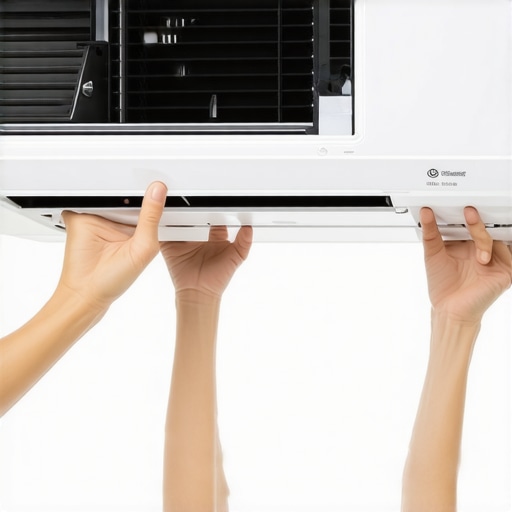
When a client calls me because their high-tech, app-controlled heating systems are throwing a ‘low flow’ error code, they usually think it’s a computer glitch. It rarely is. I start the forensic diagnosis by listening. A healthy mini-split should have a faint, rhythmic whir. If I hear a ‘wooshing’ sound that fluctuates, I know the blower wheel is so caked with ‘pookie’ and dust that it’s lost its aerodynamic profile. People think the only filters are those two plastic screens under the front cover. Wrong. Most modern units, especially those integrated with HEPA filter systems, have secondary enzyme filters, photocatalytic deodorizers, and sometimes even ionizers tucked behind the primary mesh. If you don’t clean these, your static pressure climbs, the transformer replacement becomes inevitable because of the strain on the control board, and you end up calling for top HVAC repair strategies just to keep the unit from seizing up.
The North Climate Reality: When Ice Becomes the Enemy
In our neck of the woods, where the polar vortex turns your driveway into a skating rink, the physics of a mini-split change. We aren’t just fighting humidity; we’re fighting the ‘defrost cycle.’ In heating mode, the outdoor unit becomes the evaporator. If your indoor filters are clogged, the unit can’t dissipate the heat it’s pulling from the outside. This leads to high head pressure and short-cycling. I’ve seen wall furnace installation jobs where people switched to mini-splits but kept their old habits of ‘set it and forget it.’ In a cold climate, neglect leads to ice bridging. When the unit can’t breathe, the defrost cycle fails, and suddenly your outdoor unit is a solid block of ice. This is why airflow measurement services are critical; if your CFM (Cubic Feet per Minute) drops, your efficiency goes into the gutter. Proper duct design services are vital for larger homes, but even in a ductless setup, the ‘duct’ is the space between the intake and the louvers. Block that, and you’re toast.
“Effective ventilation must be provided to maintain indoor air quality levels as required by local codes and ASHRAE 62.2.” – ASHRAE Standards
The Hidden Filters: Beyond the Plastic Mesh
Let’s talk about the filters you didn’t know existed. Behind those primary screens are often thin strips of blue or green material. These are your ‘active’ filters. They aren’t just there for show; they handle the microscopic junk that the mesh misses. In industrial heater services or even shop heater services, these filters get hammered by fine particulates. If you’re running a wood shop or a craft room, those filters are likely ‘loaded’ within a month. When they load up, the velocity of the air across the coil drops. This causes the refrigerant—the ‘juice’—to stay in a liquid state longer than it should. Instead of boiling off into a gas and absorbing heat, it slugs back to the compressor. That’s how you kill a $4,000 inverter board and a compressor in one shot. Using preventative HVAC repair tips is the only way to avoid the ‘Sales Tech’ who will try to sell you a whole new system when you just needed a deep coil cleaning.
Crawl Spaces and Demand-Controlled Ventilation
I’ve been in crawl space heating solutions where the homeowner wondered why their floors were still cold despite the mini-split running full blast. The answer is usually demand-controlled ventilation issues and, you guessed it, airflow. If the return air path is blocked by furniture or dust, the unit can’t ‘sample’ the room air correctly. It thinks the room is warm because the air sitting inside the chassis is stagnant. This is where airflow measurement services come in handy. We use an anemometer to prove to the customer that their ‘quiet’ unit is actually ‘silent’ because it’s not moving any air at all. It’s not magic; it’s manometers and physics. Don’t be fooled by the ‘gas-and-go’ guys who tell you the unit needs more refrigerant without checking the static pressure first. A sealed system doesn’t just ‘lose’ juice unless there is a leak, and 90% of the time, the problem is just a dirty ‘tin knocker’s’ nightmare.
The Cost of Neglect vs. The Price of Maintenance
Is it worth it? A mini-split deep clean takes time. You have to pull the ‘brain’ (the control board), drop the drain pan, and sometimes even pull the blower wheel. But compare that $300-$500 service to the $8,000 bill for a new high-efficiency heat pump. When you look at efficient HVAC repairs, maintenance is always the winner. If you’re managing app-controlled heating systems, use the app to monitor your energy spikes. If you see the wattage climbing while the temp stays the same, your filters are likely the culprit. Don’t wait for the screech of a failing bearing or the acidic smell of a compressor burnout. Clean the filters, check the secondary HEPA strips, and for heaven’s sake, make sure the ‘sparky’ who wired the unit didn’t leave a loose connection that’s going to fry your new transformer replacement. Comfort isn’t a setting on a thermostat; it’s the result of clean coils and unobstructed physics.