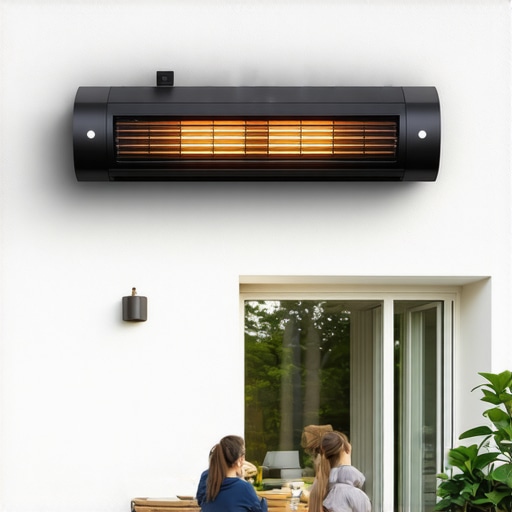
The Physics Lesson: Why You Can’t Heat What You Can’t Reach
My old mentor, a man who had more soot in his lungs than a 19th-century chimney sweep, used to bark at me every time I picked up a drill: ‘You can’t heat what you can’t touch!’ It sounds simple, but in the world of high-intensity infrared heating, it’s the difference between a cozy workshop and a giant, expensive glowing rod that does nothing but waste gas. I remember a job at a local cathedral—one of those massive church heating systems where the ceilings are forty feet high and the congregants were shivering despite a massive heating bill. A ‘Sales Tech’ had sold them six high-intensity units but mounted them at the very peak. The heat was there, technically, but it was dissipating long before it hit a single pew. Infrared isn’t like your standard forced-air furnace; it’s electromagnetic radiation. If you mess up the mounting height, you’re essentially trying to light a cigarette with a flashlight.
Thermodynamics of the Infrared Footprint
When we talk about infrared heating, we are dealing with sensible heat—the kind you feel on your skin when you step into the sun on a winter day. Unlike a commercial furnace repair where we focus on moving air through a heat exchanger, infrared heaters emit waves that vibrate the molecules of the objects they strike. This is why mounting height is the king of the install. If the unit is too high, the intensity drops off following the inverse square law—double the distance, and you get one-fourth of the heat. If it’s too low, you create ‘hot spots’ that can actually damage equipment or make it unbearable for anyone standing underneath. This is where manual J calculations become vital, even for radiant systems. We aren’t just looking at BTUs; we are looking at the radiant flux and the angle of incidence.
“Radiant heating systems shall be installed in accordance with the manufacturer’s instructions and the specific height-to-intensity ratios required to maintain floor-level comfort.” – ASHRAE Standards
In cold climates, like we see during a brutal Northeast winter, the air is naturally thirsty. This is where whole-home humidifiers come into play for residential settings, but in a commercial bay or a church, we rely on the thermal mass of the floor. By mounting the heater at the ‘sweet spot’—usually between 12 and 20 feet depending on the wattage—we turn the concrete slab into a giant radiator. That slab stays warm even if a bay door opens, which is why infrared is the gold standard for efficiency in drafty environments. It’s also why I always tell folks to look into heating service innovations transforming 2025 climate control to see how modern reflectors are changing the game.
The Cold Zone: Northern Climate Challenges
In the North, we deal with the ‘Cold Wall’ effect. When you have a massive warehouse or a church with stone walls, the radiant heat is your only defense against the creeping chill. This is the same logic used in snow melt systems installation; we are heating the surface, not the sky. If you’re trying to heat a space with a twenty-foot ceiling using a standard heat pump, you’re going to be disappointed unless you’re using hyper-heat heat pumps designed for low-ambient performance. Even then, for those truly massive volumes, the infrared tube heater or high-intensity ceramic heater is the specialized tool for the job. But I see ‘Sparkies’ and ‘Tin Knockers’ slap these things up all the time without checking the clearance to combustibles. You can’t just put ‘Pookie’ (mastic) on a joint and hope for the best when you’re dealing with 400-degree exhaust temperatures.
Maintenance and the Longevity of Radiant Systems
I’ve walked into too many shops where the infrared heaters look like they’ve been through a war. Dust on the reflectors is the silent killer of efficiency. If the reflector is dull, the heat stays in the unit, cooking the internal components instead of reflecting it down to the floor. This leads to premature electric heater services or, worse, cracked burner manifolds. Every solid HVAC maintenance plans should include a ‘wipe down’ of those reflectors and a check of the gas pressure. Low gas pressure leads to incomplete combustion and soot buildup, which turns your high-tech heater into a dirty candle. If you smell something sour—that acidic tang of a bad burn—you’ve likely got a combustion issue that needs refrigerant leak detection style precision but for the fuel rail.
“Properly designed radiant systems can reduce building heat loss by up to 20% compared to convective systems by reducing air temperature stratification.” – ACCA Manual J
Whether you are dealing with boiler maintenance services for a radiant floor or hanging a new gas-fired infrared unit, the goal is the same: stay ahead of the failure. I always tell my clients that preventative HVAC repair tips for year-round efficiency aren’t just suggestions; they are the laws of the trade. If you ignore the mounting height or the cleaning schedule, you’re just waiting for a mid-January breakdown that will cost you three times as much in emergency labor fees.
Conclusion: The Blueprint for Radiant Success
To maximize your infrared heater installation, you have to respect the physics of the ‘throw.’ It’s about the footprint of the heat on the floor. Don’t trust a ‘Sales Tech’ who just wants to sell you the biggest unit they have. You need a tech who understands the math of the mounting height. If you’re struggling with a cold building, check out the top HVAC repair strategies to extend your systems life or reach out for a professional assessment. Remember, the ‘Suction Line’ should be ‘beer can cold’ on an AC, but on a heater, the floor should be ‘barefoot warm.’ That’s the mark of a pro install. Don’t let your heat disappear into the rafters because someone was too lazy to pull out a tape measure and a level. Physics doesn’t care about your feelings, but it definitely cares about your mounting height.