The Ghost of Physics Past: Why Airflow is King
My old mentor, a man whose lungs were 40% insulation and 60% grit, used to scream at me over the roar of a 5-ton blower: ‘You can’t heat what you can’t touch!’ This wasn’t just old-man rambling; it was a fundamental lesson in thermodynamics that most of these modern ‘Sales Techs’ forget the moment they put on a clean polo shirt. He knew that the biggest, baddest furnace in the world is just a high-priced paperweight if the ductwork is undersized or the Manual J calculations were faked on a napkin. In the old days, we just shoved a 100,000 BTU beast into a crawlspace and called it a day. But those days are dead. Today, high-efficiency furnace installation isn’t just a suggestion; it’s a technological necessity driven by tightening regulations and the simple physics of heat transfer.
“The most expensive equipment in the world cannot overcome a bad duct system.” – Industry Axiom
The Thermodynamic Zoom: Secondary Heat Exchangers and Latent Heat
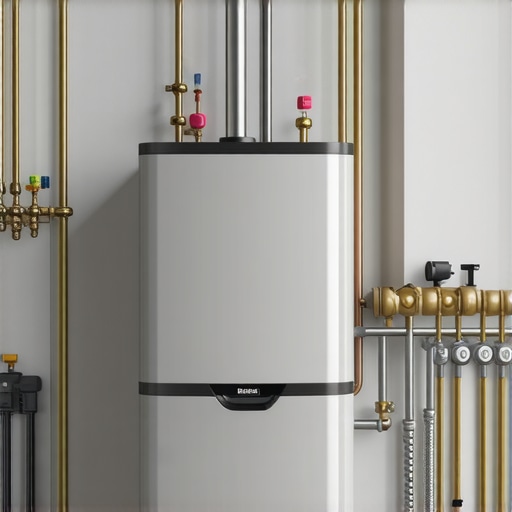
To understand why a 96% AFUE (Annual Fuel Utilization Efficiency) furnace is the baseline now, you have to look at the secondary heat exchanger. Standard 80% furnaces are ‘non-condensing.’ They burn gas, send the heat through a primary exchanger, and then let the exhaust gases—which are still 400°F—scream right out the chimney. That’s literally throwing money into the sky. A high-efficiency unit, however, forces those combustion gases through a second, stainless steel exchanger. This is where the magic (and the chemistry) happens. We drop the temperature of those gases so low that the water vapor in the exhaust condenses into liquid water. This phase change releases latent heat. By capturing that latent heat, we extract every possible BTU out of the fuel before the exhaust is cool enough to be vented through a piece of PVC pipe. If your ‘Tin Knocker’ isn’t explaining the importance of proper drainage for this condensate, they aren’t doing their job.
The 2025 Regulatory Cliff: R-454B and the A2L Transition
We are currently standing at the edge of the biggest shift in HVAC history since the phase-out of R-22. As we move into 2025, the industry is transitioning to A2L refrigerants like R-454B. While this primarily affects the cooling side, it’s fundamentally changed how we handle furnace installations because of leak detector integration. These new refrigerants are ‘mildly flammable,’ which means the indoor coil and the furnace blower unit must now communicate with sophisticated sensors. If a leak is detected, the system has to be smart enough to shut down the compressor and crank the blower to dilute any gas buildup. This isn’t just about ‘Juice’ anymore; it’s about life safety. Buying a bottom-barrel furnace now is a mistake because the older, simpler boards won’t play nice with the mandatory safety protocols coming down the pike. You want to make sure you’re looking at heating service innovations transforming 2025 climate control to stay ahead of these mandates.
The Manual J: Why Your ‘Guess’ is Costing You Thousands
I’ve walked into too many homes where a ‘Sales Tech’ quoted a system based on the square footage alone. That’s amateur hour. A real professional performs manual J calculations. We look at the R-value of your walls, the orientation of your windows, and the specific infiltration rates of your home. If you oversize a furnace, it ‘short cycles’—it slams on, heats the air near the thermostat too fast, and shuts off before the back bedrooms even feel a breeze. This destroys the heat exchanger and leaves your home feeling like a series of micro-climates. It’s also why we’re seeing a massive rise in radiant floor heating installation as a supplement; it provides that consistent, low-grade thermal mass that a cycling furnace just can’t match.
Total Indoor Air Quality: Beyond the Burner
High efficiency isn’t just about the gas valve. In a sealed, modern home, you’re breathing the same ‘dead’ air over and over. This is where heat recovery ventilators (HRVs) and UV light installation for HVAC come into play. An HRV swaps out stale indoor air for fresh outdoor air while transferring the heat between the two streams so you don’t lose that energy. Meanwhile, UV lights at the coil prevent the ‘dirty sock’ smell caused by microbial growth. For those of us in the cold North, the winter air is bone-dry, leading to static shocks and cracked skin. A steam humidifier integrated directly into the supply plenum is the only way to maintain a comfortable 40% humidity level when it’s sub-zero outside. If you’re curious about how these components work together, check out this blueprint for cooler summers and warmer winters.
The Technical Trap: Gas Lines and Venting
When you switch from an old 80% unit to a high-efficiency beast, you can’t just slap it in the same spot. The gas line installation for furnaces needs to be re-verified for proper pressure drops. More importantly, you can’t use the old B-vent chimney. High-efficiency units require dedicated PVC intake and exhaust pipes. I’ve seen ‘trunk-slammers’ vent these units improperly, leading to ‘flame rollout’—where the fire literally reaches back out of the burner because it can’t breathe. That’s a one-way ticket to a cracked heat exchanger and a Carbon Monoxide alarm at 3 AM. This is why identifying when furnace repair is urgent is a skill every homeowner needs. If you smell something sour or acidic, that’s not just ‘old furnace smell’—that’s the scent of a failing system or a refrigerant leak detection sensor tripping.
“Standard 62.2 defines the roles of mechanical systems in maintaining acceptable indoor air quality in residential buildings.” – ASHRAE Standards
The Verdict: Future-Proofing Your Castle
We’re even seeing solar thermal heating integration and wood burning stove installation being used as secondary backups for when the grid fails during a polar vortex. But for the primary source of heat, a high-efficiency furnace remains the champion. Don’t let a tech talk you into an ‘easy’ 80% swap. Between the energy savings, the tax credits for leak detector integration, and the sheer comfort of variable-speed airflow, the high-efficiency path is the only one that makes sense in 2025. Stop looking for the cheapest quote and start looking for the tech who actually pulls out a flow hood and a manometer. Because at the end of the day, physics doesn’t care about your budget, and neither does the cold. For professional help, feel free to contact us today.