The Physics Lesson: Why Airflow is King in the Arctic
My old mentor, a guy who could smell a burnt contactor from the driveway before even getting out of his truck, used to scream at me, ‘You can’t heat what you can’t touch!’ He wasn’t talking about the furniture; he was talking about the molecular dance of air. This is the bedrock of the Airflow Manifesto. Most tech-school graduates walk into a house that feels like an icebox and immediately start looking for the gas valve or checking the contactor repair history. They’re looking at the symptoms, not the physics. In the North, where the wind bites through the pookie on your ductwork, the real battle isn’t just about sensible heat—the stuff you feel on a thermometer—it’s about latent heat and the preservation of moisture. When we talk about whether energy recovery ventilators (ERVs) work in extreme cold, we are really asking if the machine can handle a phase change without turning into a solid block of ice.
ERVs vs. HRVs: The Sub-Zero Showdown
In the trade, we see people confuse Heat Recovery Ventilators (HRVs) and Energy Recovery Ventilators (ERVs) all the time. An HRV is a simple beast; it swaps sensible heat between the outgoing stale air and the incoming arctic blast. But an ERV? It’s trying to be a magician. It attempts to transfer moisture—latent energy—back into the building. In a dry winter, that’s the holy grail. Nobody wants their skin cracking like a dry lakebed because the furnace has cooked all the humidity out of the air. This is why heat recovery ventilators are often the default choice in the deepest frost zones, but ERVs have their place if you know the math. Modern AI-driven HVAC optimization is starting to bridge this gap, allowing systems to modulate based on real-time enthalpy calculations rather than just a dumb mercury switch on the wall.
“The most expensive equipment in the world cannot overcome a bad duct system.” – Industry Axiom
The Latent Heat Paradox and the Frozen Core
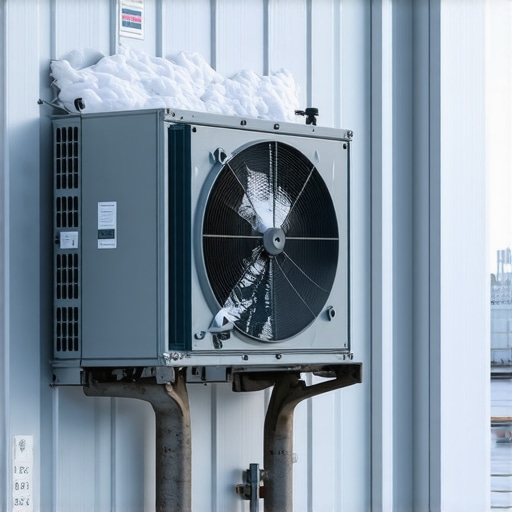
Let’s perform some thermodynamic zooming. When it’s -10°F outside and 70°F inside, the temperature delta is massive. Inside that ERV core—that desiccant-infused matrix—the moisture in your exhaust air is looking for a way out. As that warm, moist air hits the freezing surface of the core being chilled by the intake, the dew point is reached instantly. If the air is wet enough, it doesn’t just condense; it frosts. This is the ‘Death Spiral’ for an ERV in a northern climate. Without a proper defrost cycle or a pre-heater, that core becomes a brick of ice, and your airflow drops to zero. This is why preventative maintenance contracts are non-negotiable for high-performance ventilation. If you aren’t checking those drains and sensors, you’re just running a very expensive, very loud box of ice. For those dealing with larger structures, like church heating systems, the volume of air is so high that a frozen core can lead to massive pressure imbalances that literally whistle through the doors.
The Tech Stack: From Fireplaces to Voice Control
We’ve come a long way from just kicking the furnace. Today, I’m seeing WiFi thermostat integration and voice control setup Alexa Google in houses that still have 1950s gravity furnaces. It’s a weird mix of tech. But here’s the pro tip: if you’re running a heat pump installation in a cold climate, you need that ERV to be smart. You want it talking to your thermostat so it knows when to shut down the fresh air intake during a polar vortex. If you’re using fireplace insert services to supplement your heat, remember that a roaring fire is a giant vacuum, sucking air out of the house. Without a balanced ventilator, that air is coming back in through the cracks in your windows, bypassing any filtration or heat exchange you’ve paid for. It’s the ultimate airflow sin.
“Ventilation systems shall be designed to provide outdoor air at a rate not less than that specified in Table 6.2.1.” – ASHRAE Standard 62.1
Solving the Cold Weather Puzzle
Does the ERV work? Yes, but only if the tin knocker who installed it knew what they were doing. You need a defrost strategy. Some units use a recirculating defrost, where they close the outdoor air damper and just move indoor air through the core to thaw it out. Others use electric pre-heaters. If you’re looking at efficient HVAC repairs or a new system, don’t let a sales tech talk you into an ERV without a cold-weather kit. You’ll be calling for furnace repair or a contactor repair when the system starts short-cycling because it can’t breathe. For those truly committed to the arctic lifestyle, combining these systems with snow melt systems installation for the driveway and a properly calibrated heat pump installation is the blueprint for 2025. Just make sure your WiFi thermostat integration is actually monitoring the outdoor ambient temp, or you’re just guessing in the dark. For more on how to keep your system breathing, check out these preventative hvac repair tips for year-round efficiency and learn about heating service innovations transforming 2025 climate control.