The Sound of a Silent Basement: A Forensic Diagnosis
You walk down the stairs into your newly finished basement, expecting a sanctuary, but instead, you are greeted by the cold, damp smell of stagnant air and a wall furnace that refuses to kick over. It is a specific kind of silence that haunts every veteran technician. I remember my old mentor, Pete, standing over a dead unit in a cramped utility closet in 1994. He used to scream, ‘You can’t cool what you can’t touch, and you can’t heat what you won’t feed!’ He was talking about airflow and combustion air. Most homeowners treat a basement as a separate planet, forgetting that physics does not change just because you are below grade. If you are struggling with a unit that won’t stay lit, you might need to look into furnace repair is urgent if you smell that sour, metallic tang of a failing heat exchanger.
Thermodynamic Zooming: How the Basement Heat Sink Works
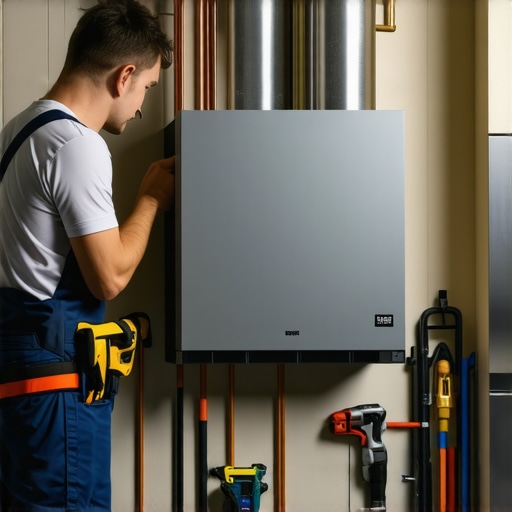
A basement is effectively a massive concrete heat sink. The thermal mass of the foundation walls is constantly sucking energy away from your living space. When we talk about wall furnace installation, we are not just hanging a box on the wall; we are trying to overcome the latent heat of the earth itself. The evaporator coil on a standard AC removes humidity, but in a basement during winter, the wall furnace must fight the dew point creep on the cold concrete. Without proper hvac repair strategies, you will end up with condensation behind your drywall, leading to mold before the season is over.
“The most expensive equipment in the world cannot overcome a bad duct system or improper venting.” – Industry Axiom
The Mechanical Anatomy: Why Transformers and Pilots Fail
Inside that wall furnace, there is a delicate dance between the gas valve and the control board. Often, a finished basement puts extra strain on the electrical components. If your ‘Sparky’ (electrician) didn’t pull a dedicated circuit, you might find yourself needing a transformer replacement sooner than expected. The transformer is the heart of the low-voltage system; if it’s struggling to push the 24 volts needed to snap that contactor shut, the whole system stalls. Then there is the issue of pilot light relighting. In a basement, drafts from poorly sealed rim joists can blow out a standing pilot. If you are constantly hitting that piezo igniter, you have a pressure imbalance. I have seen guys try to fix this with a ‘Sales Tech’ mentality—quoting a whole new unit—when the real issue is just a $40 thermocouple or a dirty orifice.
Combustion Air and The ‘Death by Enclosure’ Trap
One of the biggest mistakes in finished basements is ‘choking’ the furnace. You build a beautiful closet around the unit to hide it, but you forget that fire needs oxygen. If you do not provide enough ‘make-up air,’ the furnace will start pulling air down the chimney (backdrafting). This is how you get carbon monoxide poisoning. According to ASHRAE Standards, ‘Combustion air must be provided in a quantity sufficient for the complete combustion of the fuel and the ventilation of the space.’ This is where duct design services become critical, even for wall furnaces. You need louvered doors or dedicated intake pipes. If you are noticing soot around the vent, stop immediately and look at furnace repair myths debunked to understand why ‘it just needs a cleaning’ is often a lie for a dangerous venting issue.
Strategic Alternatives: Radiant Floors and Energy Star
Sometimes a wall furnace isn’t the best tool for the job. If you are still in the framing stage, radiant floor heating installation is the gold standard for basement comfort. It addresses the ‘cold toe’ syndrome by heating the slab directly. However, if you stick with the wall unit, ensure it carries an Energy Star heating certification. This isn’t just a sticker; it means the heat exchanger is efficient enough to squeeze every BTU out of the gas (or ‘juice’) before it exits the flue. For those looking at off-grid or rural basement setups, biomass boiler services can be integrated into a radiant loop, though they require significantly more maintenance than a standard natural gas wall furnace.
“Design for the worst-case scenario, and the best-case takes care of itself.” – ACCA Manual J Principle
Maintenance and Predictive Technology
We are moving into the era of the ‘smart basement.’ Predictive maintenance alerts can now tell you if your inducer motor is drawing too many amps before it actually dies on a Friday night. While you’re at it, don’t forget the humidity. A bypass humidifier repair is often necessary in the winter to keep the air from becoming a desert, which actually makes the basement feel colder than it is. And for those using portable heater safety checks as a backup—don’t. Those things are ‘tin knocker’ nightmares that lead to tripped breakers and melted outlets. If you’re serious about comfort, check out these heating service hacks for 2025 to get your system optimized. Finally, if your basement serves a business or a large multi-family space, commercial furnace repair protocols apply, which means stricter venting and fire suppression codes.
The Verdict: Repair ($500) vs. Replace ($8,000)
When do you pull the plug? If your wall furnace has a cracked heat exchanger—identifiable by that sour, acidic smell or a flickering yellow flame—it is a paperweight. If it is just a transformer replacement or a gummed-up burner, fix it. But if you are putting ‘pookie’ (mastic) on a rusted-out vent pipe to stop leaks, you are just delaying the inevitable. Modern units are safer, quieter, and won’t turn your basement into a CO trap. Proper installation means checking gas pressure, verifying the vent termination, and ensuring that your ‘gas’ is flowing at the right manifold pressure. Comfort is physics, not magic. Keep your sensors clean, your filters fresh, and never ignore a screeching bearing.