The Death of the ‘Emergency Heat’ Panic
My old mentor, a grizzled lead tech who could identify a refrigerant leak by the sound of the bubbles, used to scream at me during my first winter in the field: ‘You can’t cool what you can’t touch, and you can’t heat with a ghost!’ He was talking about the old-school heat pumps of the 90s—those R-22 dinosaurs that would give up the ghost the second the mercury dropped below 35°F. Back then, if it got cold, you were relying on the ‘toaster wires’ (electric heat strips) that spun your electric meter like a top. But the physics of the game has changed. We aren’t in the era of ’emergency heat’ panic anymore. We are in the era of the hyper-heat inverter, a piece of engineering that defies what most homeowners think they know about thermodynamics.
“Heat pumps shall be sized to meet the heating load at the design temperature, or supplemental heat shall be provided to ensure comfort is maintained without excessive cycling.” – ACCA Manual J, 10th Edition
Thermodynamic Zooming: How Flash Injection Beats the Freeze
To understand how a hyper-heat system keeps your house at a cozy 72°F when it’s -13°F outside, you have to look at the vapor injection cycle. In a standard compressor, the harder it works to squeeze the gas (the ‘juice’), the hotter it gets. In extreme cold, the density of the refrigerant returning from the outdoor coil is too low. Hyper-heat systems solve this by taking a portion of the liquid refrigerant, flashing it into a gas to cool the compressor, and injecting it directly into the scroll. This allows the system to ramp up its speed without melting the internals. It’s like a turbocharger for your HVAC. This technology is a cornerstone of heating service innovations transforming 2025 climate control, moving us away from the inefficient propane conversion services of the past.
The Airflow Manifesto: Why Your Ductwork is Probably Killing Your Efficiency
You can buy the most expensive variable-speed hyper-heat unit on the market, but if your tin knocker (duct guy) was lazy, you’re just throwing money into the attic. Airflow is king. I’ve walked into dozens of ‘cold house’ calls where the homeowner thought they needed a commercial furnace repair or a two-stage furnace installation, only to find the static pressure was so high the blower motor was screaming for mercy. If your return air drop is undersized, that hyper-heat unit can’t move the BTUs into the living space. We use airflow measurement services to ensure the static pressure isn’t choking the life out of your compressor. Proper heat exchanger cleaning and crawl space heating solutions only matter if the air actually has a path to travel. I’ve seen pookie (mastic) slapped over holes that were sucking in 20-degree air from the crawlspace, neutralizing every bit of heat the pump was trying to generate.
The 2025 Regulatory Cliff and the A2L Transition
We are currently standing at the edge of a massive shift. The EPA is phasing out R-410A in favor of A2L refrigerants like R-454B. These are ‘mildly flammable,’ which sounds scary but really just means we’re installing more sensors and more sophisticated controls. This is why ultimate guide to ac installation expert tips for 2025 success is required reading for any homeowner. If a sales tech tries to sell you an old R-410A unit at a ‘discount’ right now, he’s just trying to clear his inventory before the parts become legacy items. You want the new tech, the stuff that handles the industrial heater services level of demand with residential efficiency. We even offer rebate application assistance because the government is practically begging people to switch to these high-efficiency heat pumps.
“The most expensive equipment in the world cannot overcome a bad duct system; comfort is a product of distribution, not just generation.” – Industry Axiom
The Anatomy of a Cold-Climate Install
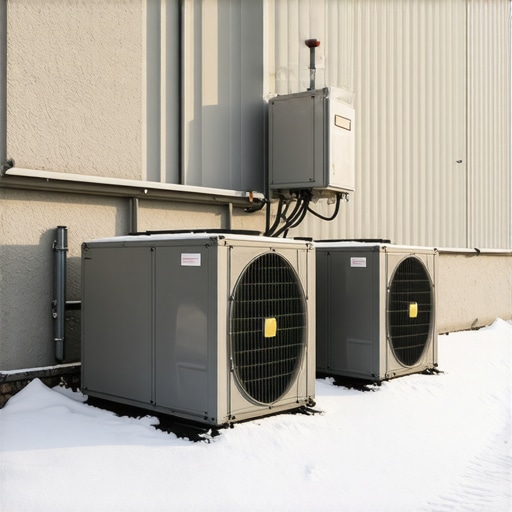
When we do a boiler repair services or a new heat pump install in a northern climate, we don’t just bolt it to a pad. We use ‘snow legs’ to lift the unit 12 inches off the ground. Why? Because when that unit goes into defrost mode, it melts the frost off the coils. If that water has nowhere to go, it freezes into an ice block at the base, eventually crushing the bottom fins. It’s the small details—like programmable thermostat programming to prevent huge temperature swings—that keep a system running for 20 years instead of ten. If you aren’t sure where your system stands, check out how to identify when furnace repair is urgent and why to avoid a midnight service call on the coldest night of the year. Whether it’s a commercial furnace repair or a residential heat pump, the physics of heat transfer remain the same: if you can’t move the air, you can’t move the heat.