The Airflow Manifesto: Why Horsepower is Secondary to Physics
My old mentor, a man who spent more time in crawlspaces than in his own living room, used to scream at me every time I reached for a manifold gauge set before checking the return air. ‘You can’t cool what you can’t touch!’ he’d bellow over the screech of a failing blower motor. It took me a decade of sweating through Michigan winters and sweltering summers to realize he wasn’t just being a cranky old-timer. He was talking about the fundamental law of thermodynamics that most ‘Sales Techs’ ignore: if your air handler isn’t moving the right volume of air across the evaporator coil, the most expensive heat pump replacement in the world is just a giant, humming paperweight. Most guys in this trade want to sell you a five-ton unit because ‘bigger is better,’ but in a climate where we deal with both the biting frost of a polar vortex and the humid soup of July, an oversized unit is a death sentence for your comfort. This is where HVAC load calculation services come in. It’s not about a rule of thumb; it’s about the math of your home’s footprint. If you don’t get the Manual J right, you’re just guessing with your wallet.
—The most expensive equipment in the world cannot overcome a bad duct system.— Industry Axiom
The Thermodynamic Zoom: Sensible vs. Latent Heat
When we talk about ‘cooling,’ we aren’t actually adding cold to a room. Cold doesn’t exist; it’s just the absence of heat. We are performing a heat transfer. In our northern climate, your system has to handle two distinct loads. First, there is ‘sensible heat’ — the actual temperature on the thermometer. Then, there’s ‘latent heat’ — the moisture in the air. If your system is oversized because a tech didn’t perform a proper footprint calculation, it will ‘short cycle.’ It hits the thermostat setpoint so fast that it never has time to drop the evaporator coil below the dew point for long enough to actually wring the water out of the air. You end up with a house that’s 72 degrees but feels like a damp basement. Proper air handler repair or replacement requires understanding the static pressure of your ductwork. If your ducts are too small (a common issue with ‘Tin Knockers’ who cut corners), your blower motor has to work twice as hard, leading to premature contactor repair needs or even a fried control board. We use control board diagnostics to see if the system is fighting against its own ‘lungs’ (the ducts). Without duct cleaning services to maintain clear pathways and a proper Manual D calculation for duct sizing, you’re just burning ‘juice’ (refrigerant) for nothing.
The North Climate Reality: From Chimneys to Heat Pumps
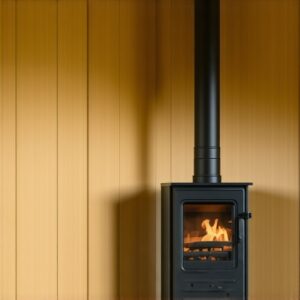
Up here, we don’t just worry about the AC. We have to look at the whole envelope. If you’re considering a wood burning stove installation or have an existing fireplace, you need to understand how that affects the pressure of the house. I’ve seen chimney liner installation jobs that were botched, causing back-drafting because the HVAC system was pulling a vacuum on the house. This is why HVAC maintenance plans are critical; we check the combustion safety as much as the cooling. For those moving toward a heat pump replacement, the math gets even tighter. In 2025, with the transition to A2L refrigerants like R-454B, the physics of refrigerant leak detection changes. These new gases are ‘mildly flammable,’ meaning your installation needs to be precise. You can’t just ‘top off the gas’ like the old days. If you have a leak, you find it, you seal it with ‘Pookie’ (mastic) where applicable on the ducts, and you fix the braze joint on the suction line until it’s ‘beer can cold’ only by the book, not by feel. For more on the technical shifts, check out heating service innovations transforming 2025 climate control. We are seeing a massive shift in how we handle indoor air quality too, with UV light installation for HVAC becoming a standard to prevent the ‘dirty sock syndrome’ on coils that stay damp due to poor drainage or sizing.
—Equipment shall be sized in accordance with ACCA Manual S based on loads calculated with ACCA Manual J.— ACCA Standard 5
Static Pressure and the ‘Pookie’ Factor
I followed a guy last week who told a homeowner she needed a whole new system because her compressor was ‘tripping on high head pressure.’ I looked at the unit, and the ‘Sparky’ (electrician) had wired it right, but the ‘Sales Tech’ hadn’t noticed that the customer had closed off half the vents in the guest rooms. In the HVAC world, closing vents doesn’t save money; it kills the compressor. It increases the static pressure, making the blower motor hunt for air that isn’t there. We performed a deep duct cleaning services run and found a literal bird’s nest in the return air drop. After cleaning and applying some high-grade mastic (‘Pookie’) to the plenum leaks, the system pressure dropped back to factory specs. No $10,000 replacement needed—just a $200 service call and some honest physics. If you are struggling with a system that won’t keep up, you should read about choosing the right HVAC fixes before signing a contract for new equipment. Understanding control board diagnostics is another area where ‘Sales Techs’ fail. They see a blinking LED and immediately condemn the whole unit. Most of the time, it’s a simple contactor repair or a flame sensor that needs a five-minute cleaning. Whether you are looking at ultimate guide to ac installation expert tips for 2025 success or just trying to survive a heatwave, remember: if the tech doesn’t pull out a laptop or a tablet to run a load calculation on your home’s square footage, window U-values, and insulation R-values, they aren’t an architect; they’re a parts changer. Demand a Manual J. Your comfort, and your utility bill, depend on that footprint being accurate. If you suspect your furnace is on its last legs, learn how to identify when furnace repair is urgent before the first frost hits and you’re stuck in an emergency situation. Real HVAC work is about the invisible movement of energy, and we make sure that energy goes exactly where it’s supposed to.