The Sound of Silence: A Winter Mechanical Autopsy
It usually starts at 3 AM. That is the hour when the silence in a house becomes heavy, almost physical. You hear the thermostat click—a tiny, hopeful sound of a relay closing—followed by nothing. No rush of air, no roar of the burner, just the metallic ticking of expanding ductwork that is quickly losing its fight against the thermal sink of a 15-degree night. I have spent three decades crawling into crawlspaces and balancing on frozen joists to solve that silence. Most homeowners think their furnace is a magic box that produces heat; I see it as a complex thermodynamic exchange system that is constantly trying to destroy itself through vibration, oxidation, and thermal stress. If you are waiting for the first polar vortex to hit before checking your system, you are not just procrastinating; you are inviting a mechanical catastrophe that could cost you five times more than a simple tune-up.
The Physics Lesson: Heat Moves to Cold
My old mentor, a grizzled tin knocker who could measure static pressure by the way a door whistled, used to scream at me, ‘You can’t heat what you can’t touch!’ He was talking about the boundary layer of air on a heat exchanger. This is the core of high-efficiency furnace installation and maintenance. In a furnace, we are not ‘creating’ heat so much as we are facilitating a chemical reaction to transfer energy into a moving column of air. If that air cannot touch the metal because of a layer of dust, or if the metal is failing because of acidic condensate, the physics of your home fall apart. This is why airflow is the absolute king of the HVAC world. A furnace with a restricted return is like a marathon runner trying to breathe through a cocktail straw; eventually, the heart—the blower motor replacement being the inevitable surgery—is going to give out.
“The most expensive equipment in the world cannot overcome a bad duct system.” – Industry Axiom
The Anatomy of a Heating Inspection: The Forensic Diagnosis
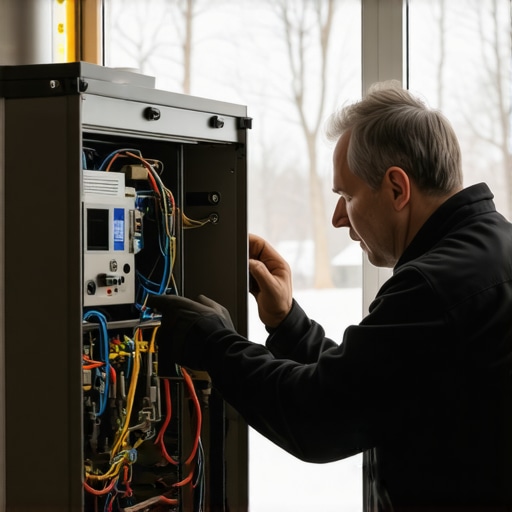
A real heating inspection is not a ‘blow and go’ service where a ‘Sales Tech’ wipes a rag over the cabinet and tries to sell you a $15,000 system. It is a forensic deep-dive into the mechanical anatomy of your unit. We start with control board diagnostics. Modern boards are the brains of the operation, monitoring everything from flame rectification to limit switches. If the board sees a millivolt drop that shouldn’t be there, it locks out. I have seen homeowners spend hundreds on a contactor repair when the real issue was a loose communication wire on the board that a simple vibration caused over time. We look at the ‘heart’—the heat exchanger. In the North, where the ‘Polar Vortex’ is a seasonal guest, the constant expansion and contraction of metal often lead to hairline fractures. This isn’t just an efficiency issue; it is a life-safety issue involving Carbon Monoxide (CO). If your heat exchanger is cracked, the ‘juice’ (fuel) is burning, but the exhaust is mixing with your breathable air. That is why a combustion analysis is non-negotiable.
The Move to High Efficiency and Energy Star Heating Certification
For those living in multi-family units or older homes, multi-family heating upgrades are becoming the standard as fuel costs skyrocket. When we talk about Energy Star heating certification, we are looking at AFUE (Annual Fuel Utilization Efficiency). An old 80% ‘standard’ furnace loses 20 cents of every dollar up the chimney. A high-efficiency unit, often hitting 96% or higher, uses a secondary heat exchanger to capture the latent heat of vaporization—turning exhaust steam back into liquid water to squeeze out every last BTU. This process is acidic, which is why we use PVC venting instead of metal. If you are tired of the ‘Tin Knocker’ coming out every year for repairs, moving to a modern system is the only logical path. You can learn more about making these transitions in our heating service innovations guide.
The Draft Inducer and the Sequence of Operations
One of the most common failure points I see is the draft inducer motor repair. This little motor is the first thing that turns on. Its job is to clear the heat exchanger of any residual gases and create a vacuum to prove the chimney is clear. If this motor has a failing bearing—that high-pitched screech you hear in the basement—the pressure switch won’t close, and the ‘Sparky’ (electrician) or the gas valve won’t even get the signal to start. It is a safety chain. If one link is weak, the whole system stays cold. During an inspection, we check the amp draw on that motor. If it is pulling more than its rated ‘juice,’ it is telling us it’s about to die. Proactive replacement is the difference between a $300 part on a Tuesday and a $1,200 emergency call on Christmas Eve. You can find more on identifying these moments in our article on identifying urgent furnace repairs.
Air Quality: HEPA Filter Systems and Humidifier Installation
Winter air in cold climates is notoriously dry. As the temperature drops, the air’s capacity to hold moisture plummets. This is where humidifier installation becomes a matter of health, not just comfort. Dry air leaches moisture from your skin, your sinuses, and even your hardwood floors. By integrating a whole-home humidifier, we can make 68 degrees feel like 72 degrees because the moisture on your skin isn’t evaporating as fast. Furthermore, adding HEPA filter systems during your winter prep ensures that as you seal your home tight against the cold, you aren’t just recycling dander and dust. However, a word of caution: you cannot just slap a thick HEPA filter on a system designed for a thin fiberglass pleated filter. The ‘Static Pressure’ will skyrocket, and you’ll end up needing a blower motor replacement within a year. It is all about the ‘Pookie’ (mastic) and proper duct sizing.
“Standard 62.1-2022 – Ventilation for Acceptable Indoor Air Quality defines the minimum requirements for ventilation and air cleaning to provide indoor air quality that is acceptable to human occupants.” – ASHRAE Standards
The Rise of the Ductless Mini-Split Installation
I am seeing more homeowners opt for ductless mini-split installation as a supplement to their main furnace, especially for ‘bonus rooms’ or additions where the original ‘Tin Knocker’ didn’t run enough ductwork. These systems are incredibly efficient heat pumps that work even in sub-zero temperatures. They allow for ‘zoning,’ meaning you aren’t heating the guest room to 72 degrees when nobody is in it. This is a key part of modern heating service hacks that we recommend for 2025 and beyond.
Repair vs. Replace: The Cold Hard Math
When I find a failing component, I give it to the homeowner straight. If you have a 15-year-old unit and the contactor repair is just the tip of the iceberg, I’m going to tell you to look at a new system. If you spend $800 a year on various repairs, you’ve paid for a new furnace in six years but you’re still stuck with 80% efficiency. We debunk many of these dilemmas in our guide on furnace repair myths. Real maintenance—cleaning the flame sensor, checking gas pressure, and verifying the ‘suction line’ equivalent for heating (the manifold pressure)—extends life. Ignoring it is just a slow-motion mechanical suicide.
Conclusion: Don’t Be the 3 AM Emergency
Preparing for winter is more than just turning the dial on the wall. It is about respecting the thermodynamics of your home. Whether it’s a high-efficiency furnace installation or just a routine control board diagnostics check, the goal is reliability. Don’t let a ‘Sales Tech’ scare you, but don’t ignore the physics of a system that is under constant stress. Get an expert out there who knows the difference between a real repair and a sales pitch, and keep your home’s heartbeat steady all winter long. For more tips on maintaining your system throughout the year, check out our preventative repair tips.”,”image”:{“imagePrompt”:”A professional HVAC technician in a dark basement using a digital combustion analyzer on a modern high-efficiency furnace, with copper pipes and PVC venting visible, technical and realistic style.”,”imageTitle”:”Professional Furnace Inspection in Progress”,”imageAlt”:”HVAC technician performing a combustion analysis on a high-efficiency furnace for winter preparation.”},”categoryId”:1,”postTime”:”2024-10-30T12:00:00Z”}