The Thermodynamics of a Dying Industry Standards
My old mentor used to scream at me in the middle of a crawlspace, ‘You can’t cool what you can’t touch, and you can’t heat what you can’t move!’ He was a lead-solder-eating fossil, but he was right. Airflow is the soul of every machine. Most homeowners get lost in the alphabet soup of SEER, AFUE, and Energy Star ratings, but as a guy who’s spent 30 years pulling ‘pookie’ (mastic) off of leaking plenums, I can tell you that the numbers on the sticker don’t mean a lick if the physics isn’t sound.
“The most expensive equipment in the world cannot overcome a bad duct system.” – Industry Axiom
We are standing on a regulatory cliff. As we move into 2025, the R-410A refrigerant we’ve used for decades—what we call ‘the gas’—is being phased out for A2L refrigerants like R-454B. This means prices are about to jump, and the complexity of a heat pump replacement is going to double because of new leak sensors and mildly flammable safety protocols. If you’re looking at a new system, you need to understand the difference between a raw efficiency rating and a government-backed certification.
SEER2 vs. Energy Star: The Measurement vs. The Medal
SEER (Seasonal Energy Efficiency Ratio) is a raw calculation: cooling output divided by total electric energy input. In 2023, we moved to SEER2, which uses a higher external static pressure to better mimic real-world ductwork (or the lack thereof). It’s a lab test. Energy Star, however, is a certification awarded to the top 25% of those units. While a SEER2 rating tells you how much ‘juice’ the compressor drinks, an Energy Star badge tells you the system has passed rigorous EPA standards for performance and climate resilience.
In our northern climate, where we deal with the ‘Polar Vortex’ every few years, SEER is only half the story. You need to look at AFUE (Annual Fuel Utilization Efficiency). If you’re running a standard gas furnace, a two-stage furnace installation with a 96% AFUE rating means 96 cents of every dollar goes into your vents, and only 4 cents goes out the flue. Combine this with demand-controlled ventilation, and you stop wasting money heating air that nobody is breathing. When the temperature drops below zero, a high-efficiency heat pump with a high HSPF2 (Heating Seasonal Performance Factor) is critical, or you’ll be burning through heat strips and watching your electric meter spin like a ceiling fan.
The North: Where Sensible Heat Meets Cracked Metal
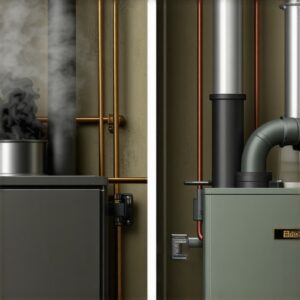
In the North, the enemy isn’t just the heat; it’s the thermal stress of metal expanding and contracting. This is why annual heating inspection isn’t a luxury—it’s a survival tactic. I’ve seen 20-year-old steam boilers that look like they belong in a museum, requiring specialized steam boiler repair to keep the radiators from clanging like a drum set. But more often, I see modern furnaces with a furnace flame sensor cleaning issue that shuts the whole house down at 3 AM. Even worse, I see cracked heat exchangers that turn a house into a gas chamber. This is why carbon monoxide detector installation is the first thing I check before I even touch my manifold gauges.
“Energy efficiency is not just a number on a sticker; it is the result of a perfectly balanced thermodynamic cycle.” – HVAC Fundamentals
If your system is short-cycling, it’s not just annoying; it’s a death sentence for the compressor. This usually happens because some ‘sales tech’ oversized the unit to make a bigger commission. An oversized unit hits the thermostat setpoint too fast, never removing the latent heat (humidity), and leaves your house feeling like a cold, damp basement. Proper expert tips for 2025 success include performing a Manual J load calculation to ensure the tonnage matches the square footage and the insulation. If your upstairs is a furnace while your downstairs is an igloo, you don’t need a bigger AC; you need a zoning system installation to balance the static pressure.
The 2025 Regulatory Shift: The A2L Transition
Why is everyone talking about the ‘Regulatory Cliff’? Because the EPA is mandating the move to low-GWP (Global Warming Potential) refrigerants. The new units hitting the market in 2025 will require more sensors and specialized training. If you are debating a repair versus a replacement, consider this: an old R-22 or R-410A system will become increasingly expensive to maintain as the ‘gas’ becomes scarce. Sometimes urgent furnace repair is just a band-aid on a gunshot wound.
For those sticking with their current systems, preventative maintenance contracts are the only way to dodge the $15,000 bullet of a full system failure. A simple HVAC repair like replacing a $50 capacitor can save a $3,000 compressor. If you aren’t getting your coils washed and your amps checked every year, you’re just waiting for the hottest day of July to find out your system is dead. Check out these heating service hacks to stay ahead of the curve. At the end of the day, comfort isn’t magic—it’s physics. And physics doesn’t care about your budget when the high-limit switch trips on a frozen January night.