
The Forensic Diagnosis: Why Your Commercial HVAC Is Screaming for Help
I was standing in the back of a bustling local bakery last February when the owner, a frantic woman named Elena, showed me a quote for twenty-two thousand dollars. A ‘Sales Tech’ from a big-box franchise had told her that her furnace was a ticking time bomb and that the heat exchanger was cracked wide open. He’d red-tagged it and left her in the 15-degree Chicago frost. I pulled my combustion analyzer and a simple flashlight. The ‘crack’ was a smudge of soot from a misaligned burner, and the ‘lethal’ CO levels were non-existent. For the cost of furnace repair services and a deep cleaning of the flame sensor, she was back in business. That tech wasn’t a mechanic; he was a shark in a polo shirt. This is why a real preventative maintenance contract for your small business isn’t about a clipboard and a smile; it’s about the physics of airflow and the brutal reality of mechanical wear.
The Anatomy of a Commercial System: More Than Just a Box
When you own a small business, your HVAC system is the lungs of your operation. If those lungs fail, the business stops breathing. We aren’t just talking about comfort; we are talking about the thermodynamic reality of latent heat removal and sensible heat ratios. In our cold northern climates, the enemy isn’t just the temperature—it’s the dry, biting air that cracks heat exchangers and the ice that chokes out heat pumps. A solid contract must address the high-efficiency furnace installation nuances, specifically the secondary heat exchanger where the latent heat of vaporization is captured. If that condensate line freezes, your system is a giant paperweight. This is why preventative HVAC repair tips for year-round efficiency are non-negotiable for any commercial property manager.
“The most expensive equipment in the world cannot overcome a bad duct system.” – Industry Axiom
Your contract should start with the electrical vitals. I’ve seen more compressors killed by a five-dollar relay than by actual age. Relay services and capacitor replacement services are the low-hanging fruit that ‘Sales Techs’ ignore because they want the big replacement commission. A capacitor is like a battery for your motor; once it loses its ‘juice,’ the motor starts drawing high amps, heating up the windings until the insulation melts and the whole thing shorts to ground. That sour, acidic smell of a burnt-out compressor is the smell of a business owner losing five figures because they skipped a fifty-dollar part replacement during a spring checkup.
The Thermodynamic Deep Dive: Humidity and Heat
In the North, we fight the battle of the dew point. When the air gets too dry, your customers’ skin starts to itch and your wood fixtures shrink. That’s where humidifier installation comes into play. But it’s a double-edged sword. Too much moisture and you’re growing a science project in the ductwork. A real pro checks the static pressure of the system before adding a humidifier. If the ‘Tin Knocker’ who installed your ducts didn’t size them right, that extra resistance will kill your blower motor faster than you can say ‘warranty claim.’ This is exactly why choosing the right HVAC fixes matters; you can’t just slap parts onto a system with bad bones.
For those still running on old heating oil, the conversation usually turns to oil to gas conversion. The physics are simple: natural gas is cleaner and easier on the equipment, but the venting is a different beast. You can’t just vent a high-efficiency gas furnace into a masonry chimney without a liner, or the acidic condensate will eat your mortar from the inside out. I’ve seen chimneys collapse because a ‘sparky’ or a general handyman tried to play HVAC tech. You need a pro who knows the efficient HVAC repairs blueprint for these transitions.
Safety and Predictive Tech: The New Standard
If your maintenance contract doesn’t include carbon monoxide detector installation and testing, fire the company immediately. In a commercial setting, CO is a silent killer that can be triggered by something as simple as a blocked flue or a cracked heat exchanger. We look for ‘flame rollout’—where the fire literally reaches out of the burner box because the heat exchanger is so clogged it can’t draw air. It’s a terrifying sight, and it’s avoidable.
“Ventilation systems shall be designed and installed to provide the required outdoor air as specified in Table 6.2.2.1.” – ASHRAE Standard 62.1
We are also moving into the era of the ‘Smart Shop.’ Predictive maintenance alerts are no longer science fiction. By installing sensors that monitor the vibration of bearings and the amp draw of motors, we can catch a failure before it happens. It’s the difference between a planned ductless mini-split installation on a Tuesday morning and an emergency 2 AM rooftop repair in a blizzard. If your tech isn’t talking about IoT monitoring, they are stuck in the 1990s.
The Airflow Manifesto: Zones and Specialized Heat
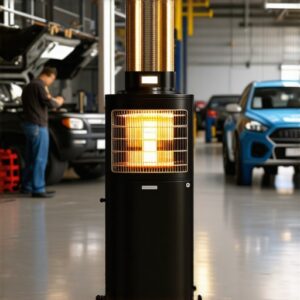
For small warehouses or open-concept shops, infrared heater installation is the gold standard. Instead of heating the air—which just rises to the ceiling and wastes your money—infrared heats the objects. It’s like standing in the sun on a cold day. But these units need regular ‘pookie’ (mastic) checks on their gas connections and reflector cleanings to stay efficient. If you’re seeing uneven temperatures, don’t just turn up the thermostat. Check the top HVAC repair strategies to see if your zoning is the issue. Often, a ductless mini-split installation is the perfect ‘band-aid’ for a hot or cold spot that the main system can’t reach, especially in server rooms or offices tucked away from the main trunk line.
Finally, let’s talk about the 2025 regulatory cliff. The ‘Gas’ (refrigerant) we’ve used for years, R-410A, is being phased out for A2L refrigerants like R-454B. These are ‘mildly flammable,’ which sounds scary but just means your tech needs to be more than a ‘parts swapper.’ They need to understand leak detection sensors and the specific spark-proof tools required for these systems. If your maintenance provider hasn’t mentioned the A2L transition, they aren’t prepared for the next three years of your business’s life. Check our ultimate guide to AC installation for the 2025 updates to see how this affects your bottom line.
Don’t let a ‘Sales Tech’ talk you into a new unit when yours has life left. Use how to identify when furnace repair is urgent as your guide. Real maintenance is about the grind: cleaning the coils until they shine, checking every electrical termination for tightness, and ensuring the airflow is ‘beer can cold’ in the summer and ‘toasty’ in the winter without blowing out your bank account.