The Sound of a Choking Kitchen
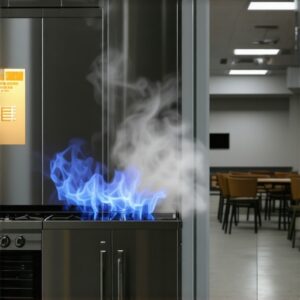
You walk into your restaurant and the first thing you notice isn’t the aroma of your signature garlic butter shrimp; it’s a haze. Your eyes sting, and the hostess at the front is coughing. You look at the thermostat, and despite it being set to 68°F, the dining room feels like a humid jungle. Most owners think they need a bigger AC. They call a ‘Sales Tech’ who tries to push a 10-ton unit they don’t need. But as someone who has spent three decades on scorched rooftops, I can tell you: your problem isn’t cooling capacity. It’s physics. Specifically, it’s the delicate, often ignored dance between exhaust and makeup air. In the HVAC world, we call this the Airflow Manifesto.
‘The most expensive equipment in the world cannot overcome a bad duct system.’ – Industry Axiom’s Law of Practical Thermodynamics
My old mentor, a man who could smell a bad compressor from three blocks away, used to scream at me, ‘You can’t cool what you can’t touch!’ He wasn’t just talking about the evaporator coil; he was talking about air molecule density. If your kitchen hood is sucking 4,000 CFM (Cubic Feet per Minute) out of the building but your Makeup Air Unit (MAU) is only putting 1,000 CFM back in, the building goes into a massive negative pressure state. You aren’t just fighting smoke; you’re fighting the vacuum of the building itself. This is why doors are hard to open and why your ‘Sparky’ is constantly replacing exhaust fan motors that have burned out trying to pull air through a brick wall.
The Thermodynamic Zoom: Why Smoke Lingers
To understand a smoke-free kitchen, we have to look at the latent heat and the dew point. In a commercial kitchen, you aren’t just dealing with sensible heat (the temperature you read on a thermometer). You are dealing with a massive moisture load. When the air is saturated, smoke particles have something to cling to. It becomes heavy. If your efficient HVAC repairs aren’t addressing the dehumidification services required for high-volume kitchens, the smoke stays trapped in a bubble of stagnant, humid air. In high-desert climates where swamp cooler maintenance is the norm, this becomes a nightmare during the monsoon season when the high head pressure cooks your capacitors and the humidity spikes. You can’t just throw ‘juice’ (refrigerant) at the problem and hope it goes away.
The Static Pressure Deep Dive
Static pressure is the resistance to airflow in your ductwork. Think of it like blood pressure for your building. If the Tin Knocker who installed your grease duct used too many 90-degree elbows or didn’t apply enough ‘Pookie’ (mastic) to the joints, your exhaust fan is working 30% harder than it should. This leads to what I call the ‘Screech of Death’—the sound of a bearing failing because the fan is spinning at high RPMs but moving zero air. This is why choosing the right HVAC fixes involves measuring static pressure with a manometer, not just guessing based on the age of the unit. Whether you are dealing with school boiler maintenance or complex hotel boiler services, the fluid dynamics of moving hot air or steam follow the same uncompromising rules of nature.
‘ASHRAE Standard 62.1: Ventilation for Acceptable Indoor Air Quality requires that pressure relationships in buildings be managed to prevent the infiltration of contaminants.’ – ASHRAE Standards
The Anatomy of a Failing System
When I go into a restaurant with a smoke problem, I look at the components like organs in a body. The exhaust hood is the lungs, the MAU is the intake, and the RTU is the heart. If the furnace ignition repair on your MAU failed last winter, someone likely bypassed the safety and now your unit isn’t tempering the air. This means in the summer, you’re pulling in 100-degree air directly into the kitchen, and in the winter, you’re freezing your line cooks. Neither of these helps with smoke. You need a WiFi thermostat integration that can talk to your building management system to ensure that when the hood goes on, the intake ramps up proportionally. This isn’t just comfort; it’s survival for your equipment. I’ve seen $15,000 compressors die because they were trying to compensate for a dirty grease filter that hadn’t been washed in six months. That’s not an equipment failure; that’s owner negligence.
Commercial Complexity: From Churches to Warehouses
People ask me if kitchen airflow is different from warehouse heating solutions or church heating systems. The scale is different, but the math is the same. A warehouse needs massive air turnover, just like a kitchen. A church needs silent, low-velocity air so the sermon isn’t drowned out by the roar of the ducts. If you’re trying to use a ventless gas heater in a commercial setting without proper ventilation, you’re basically asking for carbon monoxide issues. Every time I see a baseboard heater repair being done when the real issue is a drafty window or poor insulation, I shake my head. You have to look at the building envelope as a whole. Many furnace repair myths suggest that ‘more power’ is the answer, but the answer is almost always ‘more balance.’
The 2025 Regulatory Cliff
We are entering the era of A2L refrigerants. The R-410A we’ve used for years is being phased out, and the new ‘gas’ (refrigerant) is mildly flammable. This means new sensors, new regulations, and higher costs for AC installation. If you’re a restaurant owner trying to limp along a 20-year-old unit, you need to understand that a repair today might be $500, but waiting until 2025 could mean an $8,000 mandatory upgrade because the old parts won’t be compatible with new safety standards. Knowing how to identify when furnace repair is urgent is the difference between a planned upgrade and a mid-service emergency shut down. Don’t let a ‘Sales Tech’ scare you into a new unit, but don’t be the person who ignores a leaking suction line until the compressor burns out and smells like a bucket of acidic vinegar. If you have questions about your specific airflow needs, it is time to contact us and get a real technician on the roof, not a salesman in a polo shirt.
The Final Word on Comfort
Comfort in a kitchen isn’t magic; it’s a managed pressure bridge. If you can control the air, you can control the smoke, the grease, and the heat. Stop closing your vents thinking it saves money—it only increases static pressure and kills your blower motor. Stop ignoring the ‘beer can cold’ test on your refrigerant lines. And for heaven’s sake, stop hiring guys who don’t own a manometer. Your kitchen deserves to be a place of culinary art, not a smoke-filled hazard zone. Stick to the physics, and the physics will keep you cool.”,”image”:{“imagePrompt”:”A professional HVAC technician in a dark blue uniform using a manometer to measure static pressure in a large commercial kitchen hood system, industrial kitchen background with stainless steel surfaces, cinematic lighting, realistic style.”,”imageTitle”:”Technician Measuring Kitchen Airflow”,”imageAlt”:”HVAC expert checking commercial kitchen ventilation system pressure”},”categoryId”:1,”postTime”:”2023-10-27T10:00:00Z”}“`