The Cost of Bad Air: A Physics Lesson from the Field
My old mentor, a grizzled old tin knocker who could calculate duct static pressure in his sleep, used to grab me by the collar of my service shirt and scream: “You can’t cool what you can’t touch, and you can’t get work out of a brain that’s drowning in its own exhaust!” He wasn’t just talking about airflow across a dirty evaporator coil; he was talking about the human engine. For thirty years, I’ve watched building owners spend millions on state-of-the-art office furniture while ignoring the invisible soup of carbon dioxide, volatile organic compounds, and stale moisture their employees are breathing. When we talk about optimizing a commercial space, we aren’t just talking about keeping the thermostat at 72 degrees. We are talking about fluid dynamics, psychrometrics, and the hard science of demand-controlled ventilation (DCV).
In northern, cold-climate commercial zones, the stakes are brutally high. During a freezing winter, keeping an office comfortable means sealing it up tight. But when you seal a building to prevent heat loss, you trap every breath, every sneeze, and every off-gassing piece of fiberboard. If you don’t actively manage that air, your office becomes a low-oxygen chamber by 2:00 PM. This is where the physical reality of HVAC system design collides with corporate productivity. By utilizing advanced sensors and dynamic airflow control, we can optimize ventilation rates based on actual human occupancy rather than arbitrary, static assumptions.
“The air distribution system is the lungs of the building. Improperly designed or controlled systems will lead to stagnant zones, elevated carbon dioxide levels, and a measurable decline in cognitive performance.” – ASHRAE Standard 62.1
The Blueprint: Dynamic Ventilation and the Science of CO2
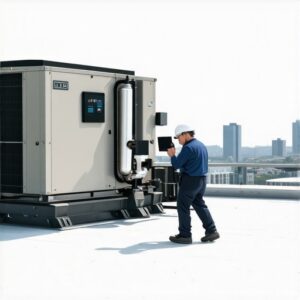
To understand why demand-controlled ventilation is such a massive leap forward, we must look at how traditional systems operate. Historically, commercial rooftop units (RTUs) were designed to dump a fixed amount of outdoor air into a building based on maximum occupancy assumptions. If a conference room was designed for fifty people, the system brought in enough outside air for fifty people, 24 hours a day, 7 days a week. During a freezing winter, that meant heating huge volumes of sub-zero outdoor air constantly, wasting thousands of dollars in energy bills. Conversely, if the system was choked down to save energy, the carbon dioxide levels in that conference room would skyrocket to over 2,500 parts per million (ppm) within forty-five minutes of a meeting starting. At that concentration, the human brain begins to shut down, leading to lethargy, headaches, and poor decision-making.
Demand-controlled ventilation changes this dynamic by utilizing real-time sensor arrays to monitor carbon dioxide levels, humidity, and total volatile organic compounds (TVOCs). When a room fills up, the CO2 levels rise. The sensors communicate with the building automation system, which opens the outside air dampers just enough to dilute the contaminants. When the room empties, the dampers close, saving massive amounts of energy by not heating or cooling unnecessary outside air. To maximize these savings, smart commercial properties are pairing DCV with heating service innovations transforming 2025 climate control, ensuring that energy efficiency and indoor air quality work hand-in-hand.
The Mechanics of Heat and Pressure in Cold Climates
In cold northern climates, introducing raw, freezing outside air into a duct system can cause thermal shock to your heating equipment. If a gas furnace or heat pump is flooded with 15°F air too quickly, the temperature of the heat exchanger drops below the condensing point of the flue gases. This creates a highly corrosive, acidic condensate that will eat through a stainless steel heat exchanger in a matter of seasons. This is why we integrate DCV with energy recovery ventilators (ERVs). An ERV uses the warm, stale exhaust air leaving the building to preheat the incoming cold, fresh air. It’s a thermodynamic exchange that occurs without the two air streams ever physically mixing.
For buildings utilizing modern heating service hacks for comfort and savings in 2025, this integration is critical. In extremely cold climates, many offices are making an oil to gas conversion or upgrading to cold climate heat pumps. These advanced systems rely on precise airflow calculations. If your return air ductwork is poorly sealed, or if your dampers are leaking, you lose your static pressure balance, and your high-efficiency equipment will short-cycle, causing premature wear on the compressor and fan motors.
The Airflow Manifesto: Fixing the Distribution Network
You can have the most advanced, AI-driven HVAC optimization controller on the wall, but if your ductwork is a leaking mess of cheap flex duct, your indoor air quality will still be terrible. Airflow follows the path of least resistance. If a duct joint is leaking in an unconditioned plenum space, you aren’t drawing stale air out of the office; you’re drawing dusty, musty air from the ceiling joists and dumping it onto your employees’ desks. That’s why we throw away the duct tape and use industrial-grade “Pookie” (mastic duct sealant) to hermetically seal every single joint. When we perform professional system performance testing, we look at external static pressure to make sure the air is actually reaching the breathing zone of the occupied space.
“The most expensive equipment in the world cannot overcome a bad duct system.” – Industry Axiom
To keep the air clean as it circulates, high-efficiency filtration is non-negotiable. Merely bringing in outside air isn’t enough; we must also scrub the recirculated air. Integrating HEPA filter systems into the main air handler prevents the recirculation of viruses, pollen, and ultra-fine dust. However, HEPA filters introduce a high pressure drop across the fan coil. This is why a proper physical assessment of the blower motor’s fan curve must be performed before upgrading filtration, ensuring the motor doesn’t burn out under the increased load.
Why App-Controlled Heating and Smart Thermostats Aren’t Enough
Many commercial property managers think that a quick thermostat installation with app-controlled heating systems is all it takes to modernize their building. While smart thermostats are great for setting schedules, they are only as good as the sensor data they receive. If a thermostat is mounted on an exterior wall or right under a supply register, it will read a completely false temperature, leading to wild swings in comfort. True climate control requires a holistic approach, linking thermostat installation to remote zone sensors, variable air volume (VAV) boxes, and modulated dampering systems that respond dynamically to occupancy shifts.
The Bottom Line: Comfort is Physics
At the end of the day, an office building is a complex thermodynamic system. If you ignore the balance between indoor air quality, thermal comfort, and energy efficiency, you pay for it in high utility bills and sluggish, unproductive employees. By investing in proper diagnostic testing, low-GWP refrigerant retrofits for older cooling units, infrared heater installation for warehouse spaces, and advanced demand-controlled ventilation, you aren’t just buying HVAC parts. You are engineering an environment designed for peak human performance. Don’t let a sales technician sell you a massive, oversized system when a calibrated, balanced, and smart ventilation strategy is what your building actually needs to thrive.