The Physics of Failure and the Mentor’s Ghost
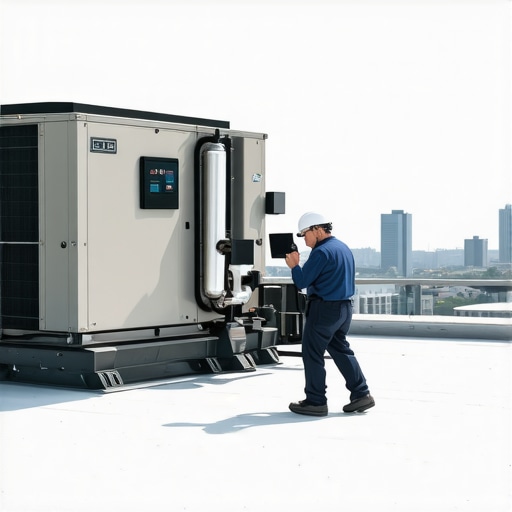
My old mentor, a man who had more refrigerant oil in his veins than blood, used to stand in front of a massive rooftop unit and scream, ‘You can’t cool what you can’t touch!’ This wasn’t just old-timer talk; it was a fundamental lesson in thermodynamics. If the air doesn’t cross that evaporator coil, if the molecules don’t actually bounce off those fins, the heat transfer doesn’t happen. In a busy commercial space, whether it’s a data center or a high-rise office, the stakes aren’t just a sweaty homeowner—they’re thousands of dollars in lost productivity and equipment damage. For thirty years, I’ve watched guys guess. They’d walk up to a dead unit, see a frozen coil, and think they just needed to add more juice. Wrong. They were ignoring the static pressure. They were ignoring the physics. Today, we’re moving past the era of ‘wait until it breaks’ into predictive technology that stops the screech of a failing bearing before it starts. This isn’t just a heating service innovation; it’s a total shift in how we keep the air moving.
“The most expensive equipment in the world cannot overcome a bad duct system.” – Industry Axiom
The 2025 Regulatory Cliff: R-454B and the A2L Transition
We are currently staring down the barrel of the biggest refrigerant transition since we killed R-22. The industry is moving toward low-GWP refrigerant retrofits and new equipment that utilizes A2L refrigerants like R-454B. Why does this matter for your commercial space? Because these new gases are ‘mildly flammable.’ You can’t just have a tin knocker slap these units in. They require specialized sensors and leak detection systems integrated directly into the air handler. Predictive tech now includes refrigerant leak sensors that can shut down the system and trigger an alarm before the concentration reaches a dangerous level. This transition is making old R-410A units more expensive to maintain. If you’re still topping off a system with a leak, you’re not just breaking the law under EPA Section 608; you’re throwing money into a hole that’s getting deeper by the day. Smart commercial managers are looking at these HVAC repair strategies to decide if it’s time to retrofit or replace before the 2025 mandates make parts for older units a luxury item.
Thermodynamic Zooming: Why Your Air Handler is a Body
Think of your commercial air handler as the lungs of the building. When we perform an air handler repair, we aren’t just swapping parts; we’re restoring the mechanical anatomy. In cold climates, where cold climate heat pumps are becoming the standard, the physics get even tighter. You’re dealing with defrost cycles and the management of latent heat. Latent heat is the energy required to change the state of water (humidity) without changing its temperature. In a crowded commercial space, the latent load from people breathing and sweating is massive. If your system isn’t pulling that humidity across the coil and dropping it below the dew point, you’re left with a ‘cold swamp.’ Predictive tech monitors the ‘approach temperature’—the difference between the refrigerant temperature and the air leaving the coil. If that gap widens, the tech knows the coil is scaling up or the airflow is restricted before the tenants ever feel a drop of sweat. This is how we avoid the emergency call on a Tuesday morning when the whole floor is whining about the heat.
“Ventilation shall be provided in accordance with the requirements of this standard to provide acceptable indoor air quality.” – ASHRAE Standard 62.1
The Invisible Enemies: IAQ and UV Light Installation
In a post-pandemic world, air quality isn’t just a ‘nice to have.’ It’s a liability. UV light installation for HVAC is a cornerstone of predictive maintenance because it prevents ‘dirty sock syndrome’—the buildup of biological growth on the evaporator coils that kills heat transfer. When you couple UV lights with heat recovery ventilators (HRVs), you’re not just cleaning the air; you’re recycling the energy from the exhaust air to pre-heat or pre-cool the incoming fresh air. This is where predictive sensors really shine. They can monitor the CO2 levels in a conference room and ramp up the HRV through relay services connected to the building’s automation system. It’s not magic; it’s just smart relay logic that ensures you aren’t over-ventilating an empty room and wasting thousands in utility costs. If you aren’t looking at preventative maintenance contracts that include sensor calibration for these systems, you’re essentially flying a plane with no gauges.
The Cold Climate Reality: Gas Lines and Polar Vortices
For those of us in the North, the winter is the real test. We’re seeing a surge in gas line installation for furnaces alongside hybrid heat pump systems. A cold climate heat pump is a beast until it hits -15°F; then, you need that gas backup to kick in. Predictive tech monitors the ‘flame rectification’ signal. If that signal starts to jitter, it means the burners are dirty or the heat exchanger is starting to fatigue. I’ve seen guys ignore a failing inducer motor until it seized on the coldest night of the year, leading to frozen pipes and a hot water heater repair that could have been avoided. By tracking the amp draw on that motor, we can predict its death three months out. We can also integrate whole-home humidifiers—or in this case, whole-building humidifiers—to protect the building’s infrastructure. Dry air at 10% humidity doesn’t just make people itchy; it shrinks wood trim and increases static electricity, which can fry sensitive electronics in a commercial environment.
The Myth of the ‘Simple’ Repair
A ‘Sales Tech’ will walk into your mechanical room, see a tripped breaker, and tell you that you need a whole new $50,000 RTU. I despise those guys. Usually, it’s a $40 contactor with pitted points or a capacitor that’s lost its microfarad rating because it’s been cooking in a hot cabinet. A real tech looks at the suction line—it should be ‘beer can cold’—and checks the superheat and subcooling. Predictive tech does this 24/7. It uses transducers to measure pressures and thermistors to measure temperatures, calculating real-time efficiency. This data allows for efficient HVAC repairs that are surgical rather than shotgun-style. Instead of replacing the whole unit, we might just need to address the vibration in the blower wheel before it shreds the bearings. This is the difference between a building that runs like a Swiss watch and one that is a constant drain on the CAPEX budget. Don’t let the ‘Pookie’ and tape crowd manage your assets. Demand the data. Check the delta-P across the filters. If you can’t measure it, you can’t manage it. That’s the law of the mechanical room, and it hasn’t changed since I started turning a wrench in the 80s.