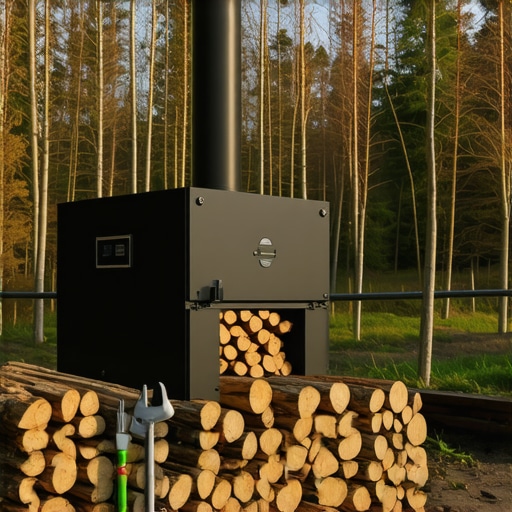
My old mentor used to scream, ‘You can’t cool what you can’t touch!’ but when he stood in front of a smoking wood-burning unit, he’d bark, ‘You can’t heat with what you can’t burn clean!’ This is why airflow matters more than horsepower, even in the world of biomass. I’ve spent thirty years watching homeowners think they’re outsmarting the utility companies by switching to wood, only to find themselves staring at a frozen pipe because their combustion logic failed at 3 AM. If you’re looking at a biomass boiler for 2026, you aren’t just buying a stove; you’re becoming a part-time chemical plant operator. Thermodynamics doesn’t care about your wallet; it only cares about heat transfer. When your heat exchanger is coated in a quarter-inch of creosote, it’s an insulator, not a conductor. You’re literally burning money and venting it out the chimney.
The Forensic Diagnosis: Why Your Biomass System Stays Cold
In the North, the enemy isn’t just the cold; it’s the physics of incomplete combustion. We see it every winter: the ‘Sound of Silence’ when a boiler hits a high-limit trip because the pump failed or the airflow was choked. If you’ve got a system that’s short-cycling or puffing back smoke, you’re looking at a mechanical anatomy failure. The limit switch replacement is often the first line of defense; if that switch doesn’t detect the correct temperature gradient, the whole system locks down to prevent a fire. It’s like a heart valve—if it’s stuck, the body dies. Many folks come to us for urgent furnace repair because they ignored the rattling sound of a failing circulator pump, which is essentially the boiler’s circulatory system. Unlike a standard gas furnace, biomass requires a delicate balance of primary and secondary air to hit those high-efficiency targets.
“The most expensive equipment in the world cannot overcome a bad duct system.” – Industry Axiom
When we talk about SEER2 compliant upgrades, we’re usually discussing the cooling side, but the logic carries over to heating. Efficiency is measured by how much energy you actually get into the living space versus what you lose. If your wiring repair for heating systems was done by a ‘Sparky’ who didn’t understand low-voltage controls, your boiler might not be communicating with your heating service innovations. You need a tech who understands the PID loop, not just a guy with a wire nut. For those looking to the future, the R-454B refrigerant transition services are dominating the conversation for heat pumps, but biomass users need to worry about the chemistry of their fuel. Wet wood is the ‘slugging compressor’ of the boiler world; it destroys efficiency and kills components.
The 5 Vital Maintenance Tips for 2026
1. Sensory Monitoring and Leak Detector Integration: Don’t just rely on your nose to smell a leak. Modern systems now allow for leak detector integration that can sniff out carbon monoxide or combustible gases before they become a headline. A sour, acidic smell usually means you’ve got moisture mixing with ash—a recipe for eating through steel. 2. Limit Switch and Safety Calibration: Every season requires a limit switch replacement or at least a calibration. These are mechanical safety devices that wear out. If they fail closed, you risk a boil-over; if they fail open, you stay cold. 3. Electrical Integrity: Professional wiring repair for heating systems is non-negotiable. Biomass boilers have high-torque auger motors and fans that pull significant amperage. Brittle wires from high-heat exposure are a leading cause of ‘ghost codes’ in the control board. 4. Indoor Air Quality Synergy: If you’re burning wood, your IAQ is taking a hit. We recommend UV light installation for HVAC to scrub the air of particulates and steam humidifiers to combat the bone-dry air that wood heat creates. 5. The Professional Sweep: This isn’t just about a brush. It’s about checking the draft. If you have a restaurant kitchen exhaust repair background, you know that static pressure is everything. The same applies here; if the chimney doesn’t draw, the fire doesn’t burn.
“Proper maintenance of biomass systems is essential to ensure that emission standards are met throughout the life of the equipment.” – ASHRAE Standards
We often see people skip their HVAC maintenance plans because they think a wood boiler is ‘low tech.’ That’s a $10,000 mistake. A proper plan includes dryer vent cleaning—which is a secondary fire hazard in many utility rooms—and a deep dive into the ‘Pookie’ (mastic) seals on your ductwork. If your ‘Tin Knocker’ didn’t seal the return air drops, you’re sucking basement dust directly into your heat exchanger. This leads to a ‘cold swamp’ feel where the air is warm but the humidity is all wrong. In 2026, we are also seeing more SEER2 compliant upgrades that integrate hybrid heat pumps with biomass. This requires a sophisticated ‘brain’ to switch between the ‘Gas’ (refrigerant) and the wood fuel depending on the ambient temperature outside. Understanding the latent heat removal during the summer and the sensible heat gain in winter is the mark of a true technician, not some Sales Tech trying to hit a commission. If you want your system to last, you need to treat it like the high-performance engine it is. Keep the ‘Juice’ flowing, keep the sensors clean, and for the love of all things holy, stop using duct tape where Pookie belongs. Check our blueprint for efficient repairs to see how we handle the complex physics of modern home comfort.