The Ghost in the Ductwork: Why Your Smart Phone Can’t Fix Bad Physics
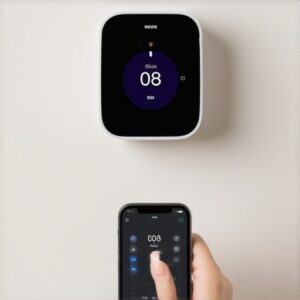
I remember my old mentor, a grizzled tin knocker named ‘Sarge’ who could smell a cracked heat exchanger from the driveway. He used to grab me by the collar of my uniform and scream, ‘You can’t heat what you can’t touch!’ To Sarge, a furnace was just a box that made fire; the real magic was in how that heat actually got to your toes. Today, everyone thinks they can solve their comfort problems by buying a shiny new app. They want to manage multiple zones from one phone, thinking a piece of software can override 30 years of neglected ductwork and poor new construction heating design. It doesn’t work that way. If your static pressure is through the roof, all the programmable thermostat programming in the world is just lipstick on a pig. You’re not managing comfort; you’re managing a slow-motion mechanical suicide.
“The most expensive equipment in the world cannot overcome a bad duct system.” – Industry Axiom
When we talk about app-controlled heating, we are really talking about the intersection of variable speed furnace services and precision air management. In a cold climate like Chicago or the Northeast, the enemy isn’t just the temperature; it’s the thermal gradient across your home. If you have one room that feels like a meat locker while the master bedroom is a sauna, your system is failing the basic laws of thermodynamics. We look at static pressure testing as the blood pressure of your HVAC system. If you start closing dampers via an app without a modulating furnace repair strategy that accounts for the reduced airflow, you’re going to slug the heat exchanger and trip the high-limit switch before the ‘smart’ app even knows what happened.
The Thermodynamic Zoom: Latent Heat vs. Sensible Heat in Your Zones
Let’s get technical. When you use an app to call for heat in Zone A, your modulating furnace needs to understand exactly how much ‘juice’ or gas to burn. A standard single-stage furnace is either ON or OFF—it’s like trying to drive a car that only goes 0 or 100 mph. When you pair that with smart zoning, the furnace overshoots the target, cycles off, and then your relay services have to work overtime. This constant hunting leads to ‘short cycling,’ which is the fastest way to kill a blower motor. You need variable speed furnace services to ensure the blower can ramp up or down based on the exact CFM requirements of the open zones. If the blower can’t adjust, the air speed in the open ducts becomes deafening, or worse, the air moves so slowly it can’t effectively transfer heat into the room.
For those living in older homes with radiator replacement needs, the logic changes but the physics remains. Managing a hydronic system from a phone requires a deep understanding of thermal lag. Water has a high specific heat capacity; it takes a long time to get hot and a long time to cool down. If your app is programmed to ‘swing’ the temperature too much, your boiler will be chasing its tail all night. This is where thermocouple replacement and relay services become critical. If that little copper sensor isn’t talking to the gas valve correctly, your smart home is just a dumb brick. You might even need infared heater installation for those stubborn additions where the ‘tin knocker’ couldn’t reach, providing localized sensible heat without taxing the primary system.
“Properly designed HVAC systems must account for the building envelope’s total heat loss to ensure equipment sizing matches the actual load.” – ASHRAE Standard 90.1
Many homeowners get scammed by ‘Sales Techs’ who try to sell them a $15,000 system when their real issue is a $50 programmable thermostat programming error or a blown capacitor. If you’re looking for real solutions, you should check out these heating service hacks for comfort and savings in 2025. I’ve seen guys quote a whole new unit because they didn’t know how to perform a proper static pressure testing. They see a system that keeps tripping and assume the ‘gas’ is low or the compressor is shot, when in reality, the ‘Pookie’ (mastic) on the return air drop has failed and the system is sucking in 20-degree air from the attic. It’s a joke.
The Multi-Zone Architecture: From Relays to Radiators
Managing multiple zones effectively requires a ‘brain’ that understands more than just temperature. It needs to understand the evaporative cooler services logic for dry climates or the flame rollout safety protocols for the North. If you have a multi-story home, you’re fighting the stack effect—hot air wants to go up, and cold air wants to stay in the basement. Your app needs to be integrated with modulating furnace repair technicians who can calibrate the gas valves to fire at 40% capacity for those light-load days. Otherwise, you’re just wasting money. If your system is old and clunky, you might need to understand how to identify when furnace repair is urgent and why before you try to get fancy with Wi-Fi controls.
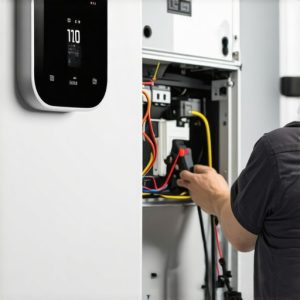
When we design new construction heating design plans, we ensure every run is sized for the ‘worst-case scenario.’ We don’t just ‘eyeball’ it. We use static pressure testing to verify that the ‘Sparky’ (electrician) didn’t run a wire through the middle of our plenum and that the installers didn’t kink the flex duct. If you’re dealing with an existing home, infrared heater installation can be a lifesaver for that one room over the garage that never gets warm. It’s about being an architect of airflow, not just a parts changer. For more on the future of these systems, read about heating service innovations transforming 2025 climate control. At the end of the day, comfort is physics. Your phone is just the remote control. If the engine under the hood—the variable speed furnace and the ductwork—is junk, no app is going to save you from a cold winter night. Stop listening to the sales guys and start listening to the airflow. It never lies. If you need a pro who actually knows their way around a manifold gauge, you can contact us here.