I’ve spent three decades crawling through spider-infested crawlspaces and baking in 140-degree attics, and if there is one thing I’ve learned, it is that the most dangerous things in a home are the ones you cannot see, smell, or taste. My old mentor, a crusty veteran who could identify a refrigerant leak just by the sound of the compressor’s hum, used to bark at me: ‘You can’t cool what you can’t touch, and you can’t breathe what you’ve poisoned!’ He was looking at a hack-job wall furnace installation where the previous ‘trunk-slammer’ technician had used silver tape instead of proper high-temp venting. The combustion gases were spilling right into the living room. That day ingrained a hard truth in me: carbon monoxide (CO) is a silent predator that doesn’t care about your AFUE rating or how shiny your new heat pump looks.
The Forensic Diagnosis of a Silent Killer
When we talk about furnace repair, most homeowners think about getting the heat back on so they don’t freeze during a Chicago-style polar vortex. But as a tech, my first thought is the integrity of the heat exchanger. Think of the heat exchanger as the lungs of your HVAC system. It separates the toxic flue gases from the air you breathe. Over time, the constant expansion and contraction of the metal—especially in variable speed furnace services where the unit is constantly modulating—can lead to microscopic cracks. If that metal ‘cage’ breaks, the beast (CO) gets out. This is why system performance testing is not just a line item to pad a bill; it is a literal lifesaver. We use combustion analyzers to ‘see’ the invisible, checking the parts-per-million of CO in your exhaust and ensuring the flame isn’t ‘lazy’ due to poor airflow.
“The most expensive equipment in the world cannot overcome a bad duct system, nor can it protect a family from combustion byproducts without proper monitoring.” — Industry Axiom
Why One Detector per Floor is the Absolute Minimum
Physics dictates how CO moves through a home, and it’s a misunderstood science. Some ‘Sales Techs’ will tell you CO is heavy and sinks, or it’s light and rises to the ceiling. The reality is that CO has a molar mass of about 28.0, while air is roughly 28.8. It is slightly lighter than air, but it behaves almost identically. It diffuses. It doesn’t just sit in a puddle on the floor. In a multi-story home, your furnace might be in the basement, but a cracked heat exchanger or a blocked flue can send CO up through the supply vents into every bedroom. If you only have one detector in the hallway on the first floor, the family sleeping on the second floor might never hear it until it’s too late. Furthermore, modern homes are sealed so tight for energy efficiency that they can experience ‘negative pressure.’ If you have a high-powered restaurant kitchen exhaust repair gone wrong or a massive range hood pulling air out of the house without enough ‘makeup air,’ it can actually suck the CO right back down the chimney of your water heater or furnace. This ‘back-drafting’ is a common cause of CO poisoning that a single detector would likely miss.
The Interaction of Modern Tech and Safety
We live in an era of geofencing temperature control and hyper-heat heat pumps. While these technologies are incredible for comfort, they change the ‘breathing’ patterns of a house. For instance, a hyper-heat pump might take over the load in moderate cold, but when the mercury drops to -15°F, your backup gas furnace kicks in. If that furnace hasn’t been fired up in months, you risk issues like a furnace flame sensor cleaning being overdue or, worse, a bird’s nest blocking the flue. That’s why preventative repair tips always emphasize a pre-season check. Even something as simple as dryer vent cleaning plays a role; a clogged dryer vent increases back pressure on the appliance, and if it’s a gas dryer, that’s another source of potential CO leakage into the laundry room.
The Thermodynamic Logic of Placement
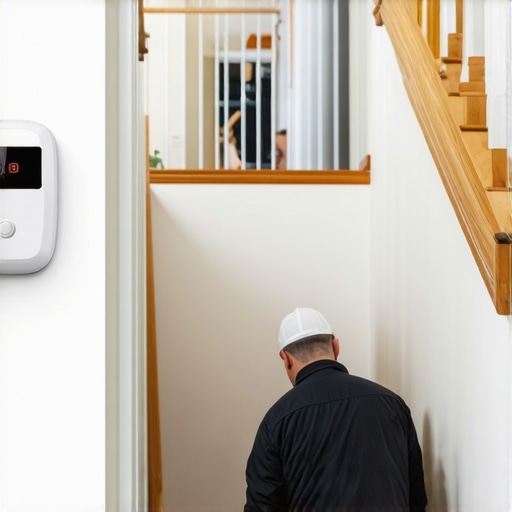
In the North, where we deal with heavy snow and sub-zero temps, your heating system is the heart of the home. But the heart can fail. If you are investing in radiant floor heating installation, you still have a boiler or a water heater burning fuel somewhere. That combustion process requires oxygen and produces waste. If the venting is compromised by ice or poor ‘tin knocker’ work, that gas has to go somewhere. NFPA 720, the Standard for the Installation of Carbon Monoxide Detection and Warning Equipment, is clear: you need a detector outside every separate sleeping area and on every level of the home, including the basement. Why? Because the ‘chirp’ of a low battery is annoying, but the ‘scream’ of a CO alarm is the only thing standing between your family and a permanent sleep. Dealing with a furnace repair myth like ‘I’ll smell the gas’ is dangerous because CO has no smell. You might smell the ‘sour’ scent of a compressor burnout, but you won’t smell the CO.
“Carbon monoxide alarms shall be installed in each separate sleeping area in the immediate vicinity of the bedrooms and on every level of the dwelling unit, including basements.” — NFPA 720 Section 9.4.1.1
The Anatomy of Protection
When I go into a house for furnace repair, I’m looking for more than just a blown capacitor or a dirty filter. I’m looking at the ‘Pookie’ (mastic) on the joints, the slope of the vent pipes, and the location of those CO detectors. If I see a detector plugged in right next to a furnace, I move it. Why? Because a tiny, normal ‘puff’ of CO at startup can trigger a false alarm, leading the homeowner to unplug the unit in frustration. You want them 15-20 feet away from the fuel-burning source. If you’re wondering when furnace repair is urgent, the answer is ‘immediately’ if your CO alarm goes off or if you see soot around the burners. Soot is a sign of incomplete combustion—it’s the physical manifestation of the gas that’s trying to kill you. Don’t be the person who tries to save a few bucks by skipping the upper-floor detector. Carbon monoxide is a patient killer; it waits for the coldest night of the year when the ‘Sparky’ (electrician) isn’t available and your furnace is working its hardest. Protect your home, floor by floor, and if you have any doubts about your system’s integrity, contact us for a full safety inspection. Peace of mind isn’t a luxury; it’s the result of good physics and better planning.