The Sound of a Silent Heat Exchanger
It’s 3 AM in the middle of a polar vortex. The wind is howling against the siding, and suddenly, you realize something is missing: the steady hum of your furnace. That silence isn’t peaceful; it’s the sound of an impending frozen pipe disaster. Most homeowners think a furnace just ‘dies,’ but as someone who has spent thirty years dragging tool bags through crawlspaces, I can tell you that equipment rarely commits suicide—it’s usually murdered by poor airflow or neglected combustion chemistry. My old mentor used to scream at me, ‘You can’t cool or heat what you can’t touch!’ He was a lead-pipe-swinging Tin Knocker who understood that airflow matters more than raw horsepower. If your air handler isn’t moving the right CFM (cubic feet per minute) across that heat exchanger, the metal is going to fatigue, crack, and eventually, the safeties will trip—if you’re lucky. If you’re unlucky, you’re looking at a carbon monoxide situation. This is where combustion analysis comes in. It’s the EKG for your heating system, revealing the hidden pathologies within the flame that a simple visual check will always miss.
“The most expensive equipment in the world cannot overcome a bad duct system.” – Industry Axiom
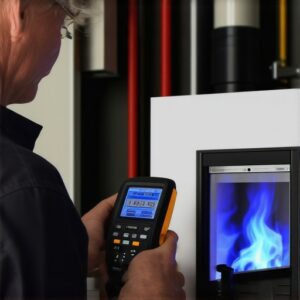
When I hook up my analyzer to the flue, I’m not just looking for a number; I’m performing a forensic diagnosis. I’m looking at the ratio of fuel to oxygen. If the oxygen levels are too high, your unit is wasting energy heating up outdoor air. If they are too low, you’re producing lethal levels of CO. This is the ‘Sensory Diagnostic’ phase. I can smell when a burner is running rich—it has that heavy, sweet-yet-acrid scent. But the analyzer gives me the cold, hard physics. If your air handler repair history shows repeated blower motor failures, the culprit is almost always Static Pressure. People love their MERV filter upgrades, but if you slap a MERV 13 on a system designed for a fiberglass ‘rock-catcher,’ you’re strangling the unit. It’s like trying to run a marathon while breathing through a cocktail straw. The heat exchanger will overheat, and that’s how you end up needing to identify when furnace repair is urgent before the cracks become life-threatening.
[IMAGE_PLACEHOLDER]
Thermodynamic Zooming: The Latent Heat of the North
In our climate, we aren’t just fighting the cold; we’re fighting the lack of moisture. This is why whole-home humidifiers are integrated into any smart HVAC setup. But here is the catch: adding moisture to a system with poor combustion can lead to accelerated corrosion of the secondary heat exchanger in high-efficiency furnaces. We need to talk about the ‘Dew Point’ of the flue gases. If the exhaust gets too cold too fast, it condenses into a nasty acidic liquid that eats through metal like a Sparky eats through a lunchbox. For those of you shifting toward cold climate heat pumps, the physics changes but the rules of airflow remain. We are moving toward the R-454B refrigerant transition services, which means we’re dealing with A2L refrigerants. These are ‘mildly flammable,’ and while they are better for the planet, they require precision. You can’t just ‘slug some juice’ into the suction line and call it a day. You need to know your subcooling and superheat to the decimal point. If your technician isn’t using a digital manifold and a micron gauge, they aren’t a technician; they’re a parts-changer.
“Equipment shall be sized to meet the calculated loads… oversizing is a primary cause of inefficiency and equipment failure.” – ACCA Manual J
I recently walked into a restaurant kitchen exhaust repair job where the makeup air unit was so out of whack that the front door was hard to pull open due to the vacuum. That’s an airflow failure on a massive scale, but it happens in homes too. When we talk about smart building management and AI-driven HVAC optimization, we’re really talking about sensors that can see what I see. A WiFi thermostat integration isn’t just about changing the temp from your phone; it’s about thermostat wiring upgrades that allow for variable-speed communication. This allows the system to ramp up or down based on the actual load, rather than just banging on at 100% and then slamming off (short-cycling). This is crucial for maintaining the life of your compressor. You can find more about this in our guide on preventative HVAC repair tips. We are moving away from the ‘on/off’ world and into a world of constant, modulated comfort. But all the AI in the world won’t save you if your heat exchanger is choked with soot because nobody bothered to do a combustion analysis. Stop falling for furnace repair myths that tell you a ‘tune-up’ is just a quick vacuum and a spray of WD-40. Real maintenance is about the chemistry of the flame and the physics of the air.