The Sound of a Cold House: A Forensic Diagnosis
It’s 3:00 AM, the outside temp is dropping into the single digits, and that familiar low-frequency hum of your furnace has been replaced by a rhythmic, metallic clicking—the sound of an igniter trying to do a job it can’t finish. As a tech who has spent three decades in crawlspaces and on icy rooftops, I can tell you that the silence of a dead furnace isn’t just uncomfortable; it’s a physical weight. You’re likely searching for emergency heating repair tips because you’re currently wrapped in a blanket, watching your breath condense in the living room. Before you panic and start calling every number on Google, we need to talk about the physics of what’s happening in that cabinet and how to stay safe while you wait for the ‘sparky’ or the ‘tin knocker’ to show up.
The Physics Lesson: You Can’t Heat What You Can’t Move
My old mentor, a man who could diagnose a bad capacitor by the smell of the air, used to scream at me, ‘You can’t heat what you can’t touch!’ He was talking about static pressure testing and the absolute necessity of airflow. In a northern climate like ours, where a polar vortex can turn a heat pump into a block of ice, the blower motor is the heart of the system. If that blower motor is struggling against a clogged filter or restricted ductwork, the heat exchanger will overheat and the limit switch will trip. This is why blower motor replacement is one of the most common mid-winter calls. If you don’t move the air across those burner tubes, you aren’t just losing comfort—you’re risking a cracked heat exchanger. This is why understanding how to identify when furnace repair is urgent and why is critical for your safety.
“The most expensive equipment in the world cannot overcome a bad duct system.” – Industry Axiom
The Forensic Diagnosis: What to Check Right Now
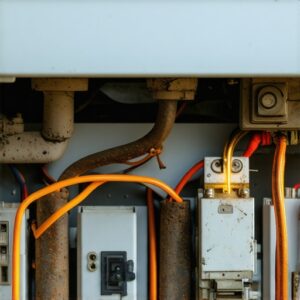
Before the tech arrives to perform manual J calculations or discuss multi-family heating upgrades, there are several forensic checks you must perform. First, check the thermostat. It sounds insulting, but I’ve driven an hour in a blizzard only to find the batteries were dead. Second, check your breakers. A furnace isn’t just burning gas; it’s using electricity to drive the inducer and the blower. If you see a tripped breaker, reset it once. If it trips again, stop. You have a grounded component, likely a shorted winding in the motor. Third, examine the intake and exhaust PVC pipes outside. If snow has drifted over them, the pressure switch will never close, and the furnace will never fire. This is a safety feature, not a bug.
The Danger of the “Sales Tech” and the Capacitor Scam
I despise “Sales Techs.” You know the type—they show up with a shiny clipboard and tell you that because your inducer motor is pulling 2.1 amps instead of 1.9, you need a $12,000 inverter-driven compressor or a whole new system. While furnace repair myths debunked by industry experts often center on these sales tactics, the reality is usually simpler. Sometimes, it’s just a dirty flame sensor that needs a five-minute cleaning with a dollar bill. If someone tries to sell you a replacement without performing static pressure testing or a combustion analysis, show them the door. If they haven’t mentioned the low-GWP refrigerant retrofits coming in 2025, they aren’t looking at the long-term health of your home’s climate control.
Safety First: Portable Heater Safety Checks
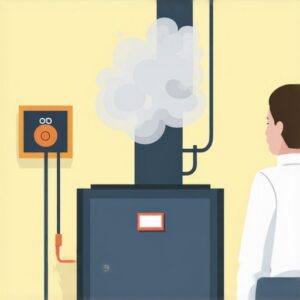
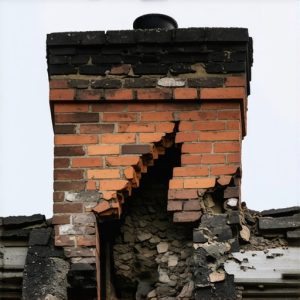
While you wait, you might be tempted to fire up every space heater in the house. This is where things get dangerous. Portable heater safety checks are non-negotiable. Never plug a space heater into a power strip; they draw too many amps and will melt the plastic housing, potentially starting a fire. Keep them at least three feet away from curtains and furniture. If you’re in a multi-family building, be aware that multi-family heating upgrades often involve shared venting systems—if you smell something sour or acidic, it might be a cracked heat exchanger leaking carbon monoxide into the common areas. If your CO detector goes off, get out immediately.
“Carbon monoxide is the silent byproduct of incomplete combustion; its presence is a failure of the heat exchanger or the venting system.” – ASHRAE Standards
Thermodynamic Zooming: Humidity and Heat Retention
In a dry northern winter, the air in your house becomes a sponge. It pulls moisture from your skin, making 70°F feel like 64°F. This is where steam humidifiers and whole-home humidifiers become essential. By increasing the humidity, you increase the air’s ability to hold onto sensible heat. If your furnace is down, a humidifier won’t fix the temp, but it will stop the dry air from evaporating moisture off your skin, which is the primary cause of that “chilled to the bone” feeling. Furthermore, if you’re looking at long-term efficiency, check your dryer vent. Proper dryer vent cleaning isn’t just for fire safety; a clogged vent creates backpressure in the laundry room that can mess with the pressure differentials in your home’s envelope.
The 2025 Transition: Inverters and Refrigerants
If your heating system is a heat pump, you’re likely already dealing with the complexities of low-GWP refrigerant retrofits. The industry is moving away from R-410A toward R-454B and R-32. These newer, inverter-driven compressors are incredibly efficient at pulling heat out of sub-zero air, but they require precision charging and specialized sensors. If your tech doesn’t understand the difference between sensible and latent heat loads during a heating service innovations transforming 2025 climate control discussion, you’re talking to the wrong person. The goal is a system that modulates its output rather than “short cycling,” which is the fastest way to kill a compressor.
Actionable Steps for Homeowners
If you’re still waiting, ensure you’ve cleared a path to the unit. The tech doesn’t want to move your Christmas decorations or old boxes of clothes to reach the filter rack. If you have a high-efficiency furnace, check the condensate drain line. If it’s clogged with slime or debris, the water will back up into the secondary heat exchanger, and the furnace will shut down to prevent a flood. A little bit of ‘Pookie’ (mastic) on a leaky duct or a quick flush of a drain line can sometimes be the difference between a $150 service call and an $8,000 emergency replacement. If the repair cost is more than 50% of the value of the unit, that’s when you look at contacting us for a real evaluation of your options. Don’t let a sales tech scare you into a purchase you don’t need—trust the physics, check the static pressure, and keep your ‘juice’ (refrigerant) where it belongs: inside the sealed system.