The first frost of the season isn’t just a date on the calendar; it is a violent wake-up call for every mechanical component in your basement. I remember my old mentor, a man who had more grease under his fingernails than blood in his veins, used to scream at me during my first winter in the field: ‘You can’t heat what you can’t touch!’ He wasn’t talking about the air; he was talking about the heat exchanger surface area and the physics of heat transfer. He’d stand there in a freezing crawlspace, pointing a shaky finger at a rusted-out burner, and remind me that airflow and surface contact are the only things standing between a homeowner and a frozen pipe disaster. That lesson stuck. It’s why I don’t just ‘fix’ a unit; I diagnose the thermodynamic failure that led to the breakdown in the first place.
The Forensic Anatomy of a Cold Start
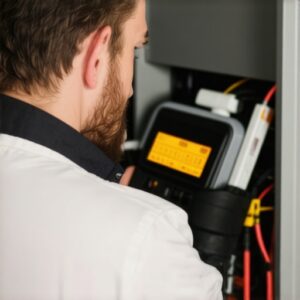
When you hear that rhythmic click-click-click of your furnace trying to kick on, you aren’t just listening to a machine; you are listening to a sequence of operations governed by logic and physics. The ignition process is a delicate dance between the induction motor, the pressure switch, and the hot surface igniter (HSI). If the inducer doesn’t pull enough vacuum to close that pressure switch, the gas valve stays shut. Why? Because the system is protecting you from a flame rollout. If the flue is blocked by a bird’s nest or internal soot, that vacuum never happens. I’ve seen sparky types try to jump out these switches to ‘test’ the system, which is a great way to melt your wiring harness or worse. Understanding how to identify when furnace repair is urgent and why is often the difference between a simple sensor cleaning and a total emergency heating repair at 3 AM on a Tuesday.
“The most expensive equipment in the world cannot overcome a bad duct system.” – Industry Axiom
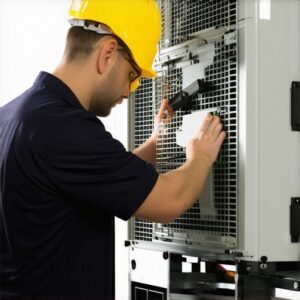
In our northern climate, the primary enemy is the cracked heat exchanger. As the furnace cycles, that metal expands and contracts. Over twenty years, those microscopic stress fractures turn into gaps. This isn’t just about efficiency; it’s about carbon monoxide. If the flame looks lazy or yellow instead of a crisp, roaring blue, you’ve got an oxygen-to-gas ratio problem, likely caused by a breach in the combustion chamber. When I perform a gas line installation for furnaces or fireplace insert services, I’m looking at the integrity of every joint and vent. A fireplace insert isn’t just a cozy aesthetic; it’s an auxiliary heat source that requires precise venting to prevent backdrafting when the main furnace kicks on and creates a negative pressure zone.
Beyond the Furnace: Specialized Heating Solutions
Fixing the main furnace is only half the battle in a modern home. For homeowners with detached garages or workshops, infrared heater installation is the gold standard. Unlike forced-air systems that try to heat the air—which just leaks out the door—infrared heaters use electromagnetic waves to heat the objects themselves. It’s the same reason you feel warm in the sun even on a cold day. Similarly, when we handle spa heater services, we are dealing with high-intensity heat transfer in a moisture-rich environment where corrosion is the constant threat. We use relay services to ensure the control board is communicating correctly with the pump and the burner, preventing the scale buildup that kills most pool and spa units.
“Design heating loads shall be determined in accordance with the procedures described in the ACCA Manual J.” – ASHRAE Standards
For those looking to modernize, a heat pump installation is no longer just a ‘Southern’ solution. Modern cold-climate heat pumps can extract heat even when it’s well below freezing outside, though I always recommend keeping that gas furnace as a dual-fuel backup for the ‘Polar Vortex’ weeks. To manage this complexity, remote thermostat access and thermostat wiring upgrades are mandatory. If you are still running a 2-wire mercury bulb thermostat, you are literally burning money. Modern systems require demand-controlled ventilation to balance indoor air quality with thermal efficiency, ensuring you aren’t just reheating the same stale, humid air.
The Repair vs. Replace Math
Here is the reality: a new furnace costs between $5,000 and $10,000 depending on the AFUE rating and complexity. A relay or a capacitor costs a fraction of that. If your unit is under 12 years old and the heat exchanger is solid, fix it. But if I see ‘Pookie’ (mastic) smeared over a cracked manifold, I’m telling you to pull the plug. Don’t let a ‘Sales Tech’ talk you into a new unit because of a dirty flame sensor. A flame sensor is a simple rod that uses flame rectification—a process where the flame itself conducts a micro-amp signal back to the board to prove it’s lit. If it’s dirty, the furnace shuts down. A five-minute cleaning with some steel wool saves you $8,000. For more on this, check out furnace repair myths debunked by industry experts. We focus on the science, not the commission. Whether it’s heating service hacks for comfort and savings in 2025 or a complex relay service for a multi-zone system, the goal is always the same: thermodynamic stability before the snow flies.
[IMAGE_PLACEHOLDER]