The Sound of a Dying Fire and the Physics of Efficiency
My old mentor, a grizzly veteran who smelled like pipe dope and burned dust, used to scream at me whenever I’d get lazy with a manometer: “You can’t heat what you can’t touch, and you can’t touch it if the air is moving too fast or too slow!” He was obsessed with the boundary layer of air on a heat exchanger. Most guys today just look for a blinking LED code and swap a board, but he understood that heating a home is a violent exchange of energy. If your furnace is pushing 140-degree air into a duct system sealed with nothing but cheap tape, you aren’t green—you’re just burning money to heat your attic. This is why the Energy Star heating certification matters. It isn’t just a marketing badge; it’s a thermodynamic guarantee that the machine isn’t wasting the fuel it consumes. When we talk about high-efficiency furnace installation, we are talking about capturing the latent heat of vaporization—the energy hidden in water vapor that old-school ‘clunkers’ just puked out the chimney.
The Secondary Heat Exchanger: Where the Magic (and the Acid) Happens
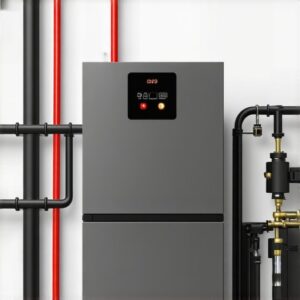
In a standard 80% AFUE furnace, you’ve got a single heat exchanger. The flames roar, the metal gets hot, the blower pushes air over it, and about 20% of your money goes straight out the flue. But an Energy Star certified unit, often hitting 96% or higher, utilizes a secondary heat exchanger. This is where we ‘zoom in’ on the thermodynamics. As the flue gases pass through this second set of coils, they cool down so much that the water vapor condenses into liquid. That phase change releases massive amounts of heat back into your home. However, that condensate is acidic. If you don’t have a chimney liner installation handled by a pro, or if you try to vent a high-efficiency unit into an old masonry chimney, you’ll literally dissolve the mortar from the inside out. This is why identifying when furnace repair is urgent is often about catching those drainage issues before they rot your heat exchanger. If you see water pooling at the base of your furnace, it’s not just a leak; it’s a chemical attack on your equipment.
“The selection of high-efficiency equipment must be matched by a distribution system capable of delivering the rated capacity at the design static pressure.” – ACCA Manual J Standards
Variable Speed Technology: No More ‘Blast or Nothing’
The biggest ‘green’ leap in recent years isn’t just the burner; it’s the blower motor. Old motors were PSC (Permanent Split Capacitor)—they were either on or off, like a light switch. Energy Star units almost always utilize variable speed furnace services featuring ECM (Electronically Commutated Motors). These motors are smart. They can ramp up or down to maintain a constant CFM (Cubic Feet per Minute) regardless of how dirty your filter is (though you should still change it). This prevents the ‘cold draft’ feel at the start of a cycle. More importantly, it integrates with smart building management systems to maintain a whisper-quiet baseline. When you pair this with hospital HVAC zoning techniques—dividing the house into thermal territories—you stop heating the guest room no one uses. This is the difference between a ‘Tin Knocker’ who just slaps ductwork together and an airflow architect who understands static pressure.
The Heat Pump Revolution and the Financing Bridge
We are currently facing a massive regulatory shift. With the 2025 transition to A2L refrigerants, the cost of ‘juice’ (refrigerant) and equipment is climbing. That’s why financing for heat pump installs has become a critical tool for homeowners trying to go green without emptying their 401k. A modern heat pump doesn’t ‘create’ heat; it moves it. Even in a polar vortex, there is heat energy in the outside air. Using a reversing valve, the system pulls that heat indoors. When you combine an Energy Star furnace with a high-SEER2 heat pump in a ‘dual fuel’ setup, you have the ultimate green weapon. The heat pump handles the mild days, and the gas furnace kicks in only when the mercury bottoms out. To keep these complex systems running, preventative maintenance contracts are no longer optional—they are an insurance policy against a $2,000 compressor burnout caused by a $10 clogged orifice.
Beyond the Furnace: Air Quality and Wall Units
If you’re in a tight, modern home, you aren’t just worried about temperature; you’re worried about the ‘soup’ you’re breathing. HEPA filter systems integrated into your return air drop can scrub particles down to 0.3 microns, which is essential when your high-efficiency furnace is moving air more frequently at lower speeds. For those in older homes or additions where ductwork is a nightmare, wall furnace installation or ductless mini-splits offer a targeted green solution. These avoid the 20-30% energy loss associated with leaky ducts. I’ve seen too many ‘Sparkies’ try to wire these up without understanding the communication bus between the head and the compressor—always hire a tech who knows his way around a multimeter. To ensure your system survives the next decade, check out these top HVAC repair strategies to extend your system’s life.
“Equipment must be sized to the building’s thermal envelope, not the previous unit’s nameplate.” – ASHRAE Standard 62.2
The Reality of the Green Household
Going green isn’t about a sticker; it’s about the math of the manifold. If your HVAC repair guy doesn’t check your gas pressure or your static pressure, he isn’t doing his job. A system that is ‘over-fired’ will crack the heat exchanger in five years, regardless of its Energy Star rating. This is the ‘Scam Tune-Up’ I hate—where they just spray some foam on the coils and leave. True efficiency comes from ‘Pookie’ (mastic) on the duct joints and a perfectly balanced refrigerant charge. If you’re ready to stop guessing, look into heating service hacks for comfort and savings in 2025 to see where the industry is heading. Green is the color of money saved, but only if the physics are right.