The Sound of Static and the Desert in Your Hallway
You wake up with a nosebleed, the hardwood floor is gapping like a bad set of teeth, and every time you touch the doorknob, you get zapped like a lab rat. Your thermostat says it is 72 degrees, but you are shivering. This is not a ghost; it is the physics of dry air. Specifically, your bypass humidifier has quit, and your furnace is now a giant hair dryer sucking every ounce of moisture out of your life. I have spent thirty years crawling through spider-infested crawlspaces and baking in attics, and I will tell you right now: most ‘Sales Techs’ will try to sell you a high-efficiency furnace installation when all you really have is a clogged $40 solenoid or a calcified pad. They want the commission; I want your static pressure to be right and your skin to stop peeling.
The Mentor’s Mantra: Airflow is King
My old mentor, a grizzly tin knocker named ‘Sarge’ who smelled like PVC glue and cheap coffee, used to scream at me, ‘You can’t add water to air you can’t touch!’ We were on a job in a freezing Chicago suburb, and the homeowner was complaining that her humidifier was ‘broken.’ Sarge didn’t even look at the unit first. He looked at the ductwork. He saw a bypass damper closed tighter than a drum. ‘This is why airflow matters more than horsepower,’ he growled. He taught me that a bypass humidifier is a simple pressure differential machine. If the air isn’t forced through that water-soaked pad because of a closed damper or a crushed flex duct, you aren’t humidifying anything. You are just wasting water. That lesson stuck. Before you start swapping parts, you have to understand the thermodynamic dance of latent heat and evaporation.
“Proper humidification strategy must account for the building envelope’s ability to retain moisture without causing interstitial condensation.” – ASHRAE Standard 62.1
The Forensic Diagnosis: Why the Water Stopped Flowing
We are using Blueprint A today—the Forensic Diagnosis. Think of your humidifier like a basic circulatory system. You have the ‘brain’ (the humidistat), the ‘gatekeeper’ (the solenoid valve), and the ‘lungs’ (the evaporator pad). If any of these fail, the system goes into arrest. In cold climates, we deal with sensible heat all day, but the latent heat—the moisture content—is what actually makes you feel warm. Dry air at 70 degrees feels like 65 because moisture is evaporating off your skin, cooling you down. When we fix a humidifier, we are essentially performing dehumidification services in reverse.
Step 1: The Humidistat and the ‘Click’ Test
First, turn your furnace up so it’s actually running. A bypass humidifier usually won’t fire unless the blower motor is moving air. Now, go to the humidistat on the return duct and crank it all the way up. Did you hear a click? That click is the internal switch closing to send 24 volts to the solenoid. No click? You might have a dead humidistat or a blown transformer. I’ve seen guys try to quote a full furnace repair services package when it was just a loose low-voltage wire that the ‘Sparky’ bumped while installing a new outlet nearby. If it clicks but no water flows, we move down the line.
Step 2: The Solenoid Valve – The Heart of the Problem
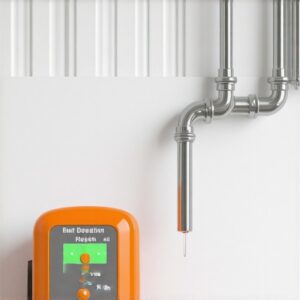
The solenoid is an electromagnetic coil that pulls a plunger to let water through. Over time, the ‘juice’ (electricity) is fine, but the ‘gas’ (water) is blocked by calcium deposits. If you feel the solenoid and it’s warm to the touch, it’s getting power. If no water is coming out of the bottom tube, that valve is gunked up. You can try cleaning the internal orifice—it’s a tiny hole, often smaller than a needle—but usually, you just replace the valve. Don’t let a tech tell you that a stuck valve means you need a heat pump replacement. That’s a classic Sales Tech move to hit a monthly quota.
The Thermodynamic Zoom: Latent Heat and the Dew Point
Why do we care so much about this? Because of the physics of the evaporator pad. As the warm air from your supply plenum is forced through the bypass duct and across the wet pad, it undergoes evaporative cooling. The water changes state from liquid to vapor. This requires energy (latent heat). If your furnace is short-cycling because of a faulty limit switch replacement, the air doesn’t stay hot long enough to pick up the moisture. You need long, steady run times, which is why variable speed furnace services are the gold standard for humidification. They move air slower and longer, allowing the air to reach a higher relative humidity without hitting the dew point on your windows and causing rot.
“The most expensive equipment in the world cannot overcome a bad duct system or improper pressure balancing.” – ACCA Manual J / Industry Axiom
The Anatomy of the Pad: More Than Just a Filter
The evaporator pad (or water panel) is coated in a ceramic-like material designed to hold water in a thin film. If you haven’t performed preventative HVAC repair tips and changed that pad in three years, it’s likely a brick of calcium. Water will just bead off it and run down the drain instead of evaporating into the air stream. I’ve seen ‘Tin Knockers’ install these upside down or backwards. Look for the colored mark on the top of the pad; it usually indicates the ‘up’ side. While you’re in there, check the distribution tray. If the holes are clogged with scale, the water won’t hit the pad evenly, leaving dry spots and reducing efficiency by 80%.
Modern Optimization and the Future of Comfort
In 2025, we are seeing AI-driven HVAC optimization where sensors detect the outdoor temperature and automatically adjust the indoor humidity setpoint. This prevents ‘window sweating’ when the temperature drops to -10°F. If your system is old, you might be looking at a radiator replacement or even a chimney liner installation for a new high-efficiency setup, but don’t ignore the humble humidifier. It’s the difference between a house that feels like a home and one that feels like a kiln. If you’ve checked the damper, replaced the pad, and verified the solenoid is clicking, but you still have no moisture, check the saddle valve on your water line. Those ‘poke-through’ valves are notorious for clogging with sediment. Sometimes you have to replace them with a real ball valve to get the flow you need. Don’t settle for a dry house. Humidity is not magic; it’s just plumbing meeting psychrometrics. If you’re overwhelmed, get a furnace tune-up services professional who knows how to use a manometer, not just a clipboard and a price book.