
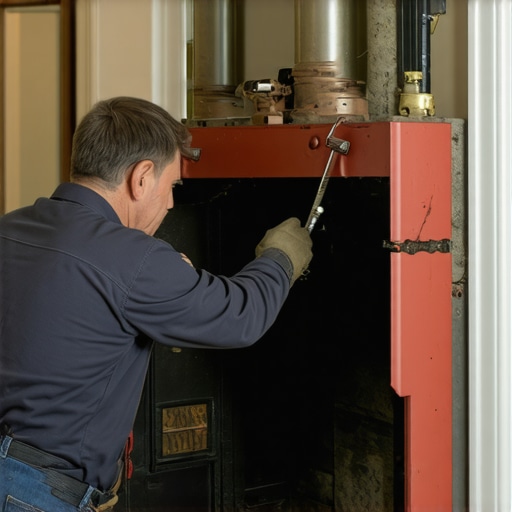
The Silent Killer in the Basement: A Forensic Look at Chimney Health
I’ve spent thirty years crawling through crawlspaces and balancing on ice-slicked rooftops, and if there is one thing I’ve learned, it’s that homeowners treat their chimneys like a ‘magic hole’ that just makes smoke disappear. It’s not magic; it’s physics. When we talk about the case for professional chimney liner installation in older homes, we aren’t just talking about keeping the rain out. We are talking about the delicate balance of draft, pressure, and the chemical warfare happening inside your flue. In my decades of steam boiler repair and variable speed furnace services, I’ve seen more ‘near-misses’ with carbon monoxide than I care to count, usually because a ‘Sales Tech’—those guys who care more about their commission than your life—ignored the venting system during a replacement.
“The vent system shall be designed and installed so as to develop a positive flow adequate to remove flue gases to the outside atmosphere.” – NFPA 54 / ANSI Z223.1 National Fuel Gas Code
The Narrative Matrix: The Sales Tech Scam That Nearly Cost a Life
I remember following a ‘pro’ into a 1920s Tudor in the dead of January. The homeowner had just shelled out twelve grand for a high-efficiency furnace. The previous tech, a classic box-swapper, told her she was ‘all set.’ When I arrived for a routine hot water heater repair, I smelled it immediately—that sour, metallic tang of flue gas. I looked at the base of the chimney. The mortar was liquefying. The ‘Sales Tech’ had vented a new 80% furnace into an oversized, unlined masonry chimney. Because the new furnace was more efficient, the flue gases were cooler. They couldn’t create enough lift to escape the cold brick stack. Instead, they reached their dew point inside the chimney, turned into acidic water, and started eating the house from the inside out. I had to shut her system down on a 10-degree night. It wasn’t the furnace’s fault; it was the lack of a stainless steel liner. This is why identifying when furnace repair is urgent often starts with looking at your chimney, not the burner.
The Thermodynamic Reality of Older Flues
In the North, where the polar vortex likes to park itself, the enemy is the ‘cold plug.’ An old, unlined chimney is essentially a giant heat sink. When your boiler or furnace kicks on, it has to push a column of cold, heavy air out of the way. If that chimney is too wide—which it usually is in older homes designed for coal or wood—the flue gases lose their velocity and heat. They stall. This is where new construction heating design differs from old-school retrofits. In a modern setup, we use demand-controlled ventilation and precisely sized liners to ensure that ‘stack effect’ happens instantly. Without a liner, you get ‘flame rollout,’ where the fire literally backs out of the cabinet because it has nowhere else to go. It’s not just about AC installation or keeping cool; it’s about the thermodynamics of exhaust.
The Anatomy of a Failing Chimney
When I perform a forensic diagnosis, I look for three things: moisture, masonry decay, and blockages. If you have an old steam boiler, you’re dealing with massive amounts of BTUs. When that system cycles off, the chimney cools rapidly. If you don’t have a modern liner, the soot and moisture combine to form sulfuric acid. This eats the ‘Pookie’ (the mastic or mortar) right out from between the bricks. This is why top HVAC repair strategies must include a chimney inspection. I’ve seen chimneys where the internal clay tiles have collapsed, creates a bridge that blocks 90% of the air. You might think you need a pool heater repair or a shop heater services fix, but if the main stack is blocked, the whole building is a gas chamber.
“Masonry chimneys shall be lined with low-heat appliance chimney liners listed for the use intended.” – International Residential Code (IRC) R1003.11
Dual Fuel Heat Pumps and the Smart Building Future
We are moving toward dual fuel heat pump systems and smart building management, which is great for the ‘Sparky’ (electrician) and the ‘Tin Knocker’ (duct guy). But as we transition, we are leaving these old chimneys behind. If you switch to a heat pump but keep a gas water heater or a backup boiler on that old chimney, you’ve just created an ‘orphaned water heater’ situation. The chimney is now way too big for just the water heater. The gases will never get hot enough to draft. You need a professional to downsize that flue with a liner, or you’re going to have CO drifting into your bedroom. This is the stuff they don’t tell you in the glossy brochures for AC installation secrets.
Why DIY is a Death Wish
I’ve seen guys try to drop a flexible liner down a chimney themselves. They kink the metal, they don’t seal the ‘tee’ at the bottom, and they leave gaps where the ‘juice’ (refrigerant or gas) can leak into the wall cavities. Professional installation involves calculating the exact cross-sectional area needed for your specific BTU load. It’s not about just shoving a pipe down a hole. Whether it’s expert tips for 2025 success or keeping a 50-year-old boiler alive, the venting is the most critical safety component. If your ‘pro’ doesn’t bring a manometer and a combustion analyzer to check the draft, kick them out of your house. They aren’t a technician; they’re a salesman in a uniform. Comfort is physics, and the physics of a chimney liner are non-negotiable for anyone living in a home built before 1990. Don’t let a $20 capacitor fix turn into a $20,000 masonry rebuild because you ignored the lining.
