The Sound of Silence: A Monday Morning Nightmare
It’s 5:00 AM on a Monday in mid-February. The outside air temperature is a bone-chilling -10°F, and the wind is howling off the lake like a freight train. Most people are hitting snooze, but for a facilities manager, this is the hour of reckoning. I’ve spent thirty years in this trade, crawling through sub-basements that smell like damp limestone and ancient iron, and I can tell you exactly when a school boiler is about to quit before I even see it. You don’t hear the roar of the atmospheric burners; you hear the silence. That silence means frozen pipes, canceled classes, and a repair bill that will eat your annual budget for lunch. I remember my old mentor, a man who could diagnose a steam trap by the vibration in his boots, used to scream, ‘You can’t heat what you can’t touch!’ He wasn’t just talking about the radiators; he was talking about the physics of heat transfer. If that water isn’t moving, or if that steam isn’t expanding, you’re not just failing the students; you’re fighting the laws of thermodynamics. And in the North, during a polar vortex, thermodynamics always wins. This isn’t about ‘topping off’ anything; this is about mechanical integrity.
“The most expensive equipment in the world cannot overcome a bad duct system or a neglected hydronic loop.” – Industry Axiom
The Anatomy of the Failure: Why Schools Are Different
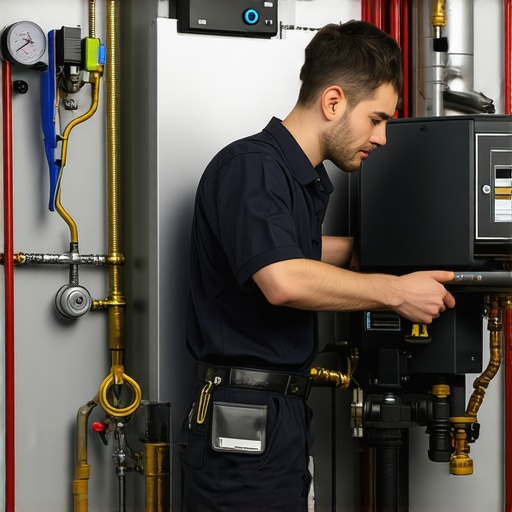
Maintaining a school boiler isn’t like fixing a furnace in a three-bedroom ranch. We are talking about massive thermal loads, complex piping architectures, and the safety of hundreds of kids. When a ‘Sales Tech’—those guys who look more like used car salesmen than mechanics—walks into your mechanical room and immediately suggests a $200,000 replacement because of a little soot, you need to show them the door. Most ‘catastrophic’ failures are actually just small components that gave up because nobody looked at them for five years. We start with the nervous system of the machine. The relay services and safety controls are what prevent your boiler from becoming a pressurized bomb. If your relay doesn’t signal the burner to fire, or worse, doesn’t signal it to stop, you have a major problem.
Move 1: The Safety Loop and Limit Switch Replacement
Every boiler has a safety loop. This is a series of switches that must all be closed for the unit to operate. The MVP of this loop is the limit switch. Its job is simple: if the boiler gets too hot, it cuts the power. Over time, the internal diaphragm or bimetal strip in these switches wears out. They become ‘lazy.’ A lazy limit switch might trip when it shouldn’t, causing the unit to short cycle, or it might not trip at all. I’ve seen heat exchangers glowing cherry red because a $40 limit switch failed to open. Part of any real preventative HVAC repair plan involves testing these safeties under load. We don’t just ‘check’ them; we simulate a failure to ensure they react. If you haven’t performed a limit switch replacement in the last decade, you’re playing Russian Roulette with your boiler’s heat exchanger. This is also where we look at the relay logic. Modern school systems often use multi-stage relays to fire different burners based on demand. If one relay is pitted or charred, the whole sequence is thrown off, leading to uneven heating and wasted fuel.
The Physics of the North: Dealing with the Polar Vortex
In our climate zone, we deal with Sensible Heat—the heat you can feel on a thermometer—but in steam systems, we also deal with Latent Heat. When water turns to steam, it absorbs a massive amount of energy without changing temperature. When it reaches the classroom radiator and condenses back to water, it releases that energy. If your steam traps are stuck open, that steam blows right through, and you’re literally burning money. If they’re stuck closed, the radiator stays cold, and the kids are wearing coats in math class. This is where multi-family heating upgrades and institutional strategies overlap. Whether it’s church heating systems or a high school gym, the physics remain the same: you must manage the condensate. We often see ‘water hammer’—that loud banging in the pipes. That isn’t ghosts; it’s steam hitting a pocket of cold water and collapsing. It’s violent enough to shatter cast iron fittings. Proper maintenance ensures the ‘Tin Knockers’ and ‘Sparkies’ have done their jobs, but the technician must balance the system’s pressure.
“A boiler system is only as reliable as its lowest-rated safety device.” – ASME CSD-1 Standard
Move 2: Combustion Analysis and Pellet Stove Repair Integration
While the main boiler does the heavy lifting, many rural schools or auxiliary buildings use secondary heat sources. If you’re dealing with a pellet stove repair for an agriculture building or a remote classroom, the focus shifts to air-to-fuel ratios. Just like the big boiler, if you have too much air, you’re heating the outdoors. Too little, and you’re creating Carbon Monoxide. For the main boiler, we use a digital analyzer to check the flue gases. We look for the ‘Sweet Spot’ of CO2 and O2 levels. This is how we protect the budget. A 1% increase in combustion efficiency can save a school district thousands of dollars over a single winter. If the heat exchanger is coated in scale or soot, the heat stays in the firebox instead of transferring to the water. We call this ‘insulating the heat.’ It’s the ultimate sin in thermodynamics.
Move 3: IAQ Improvement Services and MERV Filter Upgrades
You can’t talk about boilers without talking about how that heat gets to the kids. In most modern schools, the boiler heats a coil in an Air Handling Unit (AHU). This brings us to IAQ improvement services. Since the 2020 era, Indoor Air Quality isn’t just a luxury; it’s a mandate. We are seeing a massive push for MERV filter upgrades. But here is the trap: if you slap a high-density MERV 13 filter onto a motor designed for a MERV 8, you increase the static pressure. It’s like trying to breathe through a wet towel. The motor works harder, pulls more amps, and eventually burns out. You need a pro to calculate if your blowers can handle the ‘juice’ required to pull air through those tighter pleats. Furthermore, dry winter air in the North cracks wood floors and irritates respiratory tracts. Integrating whole-home humidifiers (or in this case, whole-school steam humidification) into the AHU loop is essential for student health. It’s not just about comfort; it’s about reducing the transmission of airborne pathogens.
The 2025 Transition: Cold Climate Heat Pumps and Infrared
We are entering a new era of HVAC. The old R-410A refrigerant is being phased out for A2Ls, and the ‘gas’ is getting more expensive. For schools looking to modernize, cold climate heat pumps are becoming a viable supplement to the boiler. These aren’t your grandfather’s heat pumps that quit at 40°F. Modern vapor-injection compressors can pull heat out of the air down to -15°F. By using these for shoulder seasons (Spring and Fall), you can keep the big iron boiler offline, saving massive amounts of fuel. For large, high-ceiling areas like shops or bus garages, infrared heater installation is the way to go. Instead of heating the air—which just rises to the ceiling—infrared heats the objects (the floors, the tools, the people). It’s the most efficient way to keep a ‘Tin Knocker’ warm while they’re working on ductwork in a drafty warehouse.
Move 4: The Institutional Strategy – Churches and Multi-Family
Large-scale heating isn’t localized. I often find myself applying the same logic to church heating systems and multi-family heating upgrades. These buildings share a common flaw: they are often ‘zoned’ poorly. One wing is a sauna, and the other is a walk-in freezer. By installing smart thermostatic radiator valves and balancing the hydronic flow, we can achieve efficient HVAC repairs that pay for themselves in one season. I followed a tech once who wanted to replace a whole church boiler because the ‘limit switch kept tripping.’ I found a $20 air vent that was clogged, causing the system to air-bind. The boiler wasn’t broken; it was just ‘constipated.’ That’s the difference between a technician and a salesman.
Move 5: The Budget Firewall – Why Maintenance Wins
If you wait for the boiler to fail, you’ve already lost. Emergency rates, expedited shipping for parts, and the cost of portable heaters will triple the price of a standard tune-up. You need a checklist that includes: 1. Low water cut-off testing (the most common cause of boiler explosions). 2. Flue gas analysis. 3. Pump lubrication and alignment. 4. Limit switch replacement cycles. 5. Water chemistry analysis to prevent ‘Pookie’ (sludge) from building up in the pipes. Knowing when a repair is urgent vs. when it can wait is the hallmark of a veteran technician. We don’t guess; we measure.
Closing the Loop on Comfort
Protecting a school’s budget isn’t about buying the cheapest parts; it’s about the physics of longevity. Whether it’s IAQ improvement services to keep the kids healthy or cold climate heat pumps to reduce the carbon footprint, every move must be calculated. Don’t let a ‘Sales Tech’ talk you into a system you don’t need. Trust the ‘Tin Knockers’ and the veteran mechanics who know that airflow—and water flow—is king. If you’re ready to stop the Monday morning nightmares, it’s time to get serious about your mechanical room. Check your safeties, clean your burners, and for heaven’s sake, change your filters before the ‘Sparky’ has to come out to replace a blown motor. Contact a professional who knows the difference between a minor fix and a major hazard.