The Ghost of Cold Iron: Why Your Shop Is Freezing
I’ve spent thirty years dragging my tool bag through attics and crawling into the guts of industrial warehouses, and I’ll tell you one thing that hasn’t changed: most workshop heating is a joke. You see a guy buy a 100,000 BTU forced-air unit, hang it from the rafters, and then wonder why he’s still shivering while the ceiling is 90 degrees. My old mentor used to scream at me, ‘You can’t heat what you can’t touch!’ He was a mean old bastard with a pack of Camels perpetually glued to his lip, but he was right. In a warehouse or workshop, air is a lousy messenger. Heat is lazy. It wants to rise and escape through the roof deck. That is where infrared heating comes in. Unlike a furnace that tries to warm up every cubic inch of air, infrared is a sniper. It warms the slab, the tools, and the man. But if you place it wrong, you’re just burning gas to heat the top of your drill press. Working in the trade, you learn that comfort is physics, not magic. Whether we are talking about heating service hacks for comfort and savings in 2025 or complex industrial setups, placement is the difference between a productive day and a day spent hugging a space heater.
“Radiant heating systems must be designed to account for the view factor, ensuring that the radiant energy is intercepted by the floor and occupants rather than being lost to non-insulated wall surfaces.” – ASHRAE Fundamentals Handbook
The Anatomy of Infrared: Thermodynamic Zooming
To understand placement, you have to understand the ‘Inverse Square Law.’ It sounds like something a ‘Sparky’ (electrician) would obsess over, but for us HVAC veterans, it’s the law of the land. If you double the distance between the heater and the floor, you don’t just lose half the heat; you lose three-quarters of it. This is sensible heat in its purest form. When that ceramic plate or tube glows orange, it emits electromagnetic waves. Those waves don’t care about the air. They only turn into heat when they hit a solid object—like your workbench or your cold concrete slab. This is why choosing the right HVAC fixes involves more than just looking at a price tag; it’s about the geometry of the room. If you’re dealing with a cold climate like Chicago or the Northeast, you’re fighting the ‘Cold Wall’ effect. In these zones, the danger of ice blocking vents or high-efficiency drains freezing is real, but the primary enemy in a shop is the thermal mass of the floor. You need that slab to act as a radiator. If you’ve got a massive workshop, you might even consider heating service innovations transforming 2025 climate control like solar thermal heating integration to pre-heat storage tanks, but for the raw grunt work of a Tuesday morning, infrared is king.
The Forensic Diagnosis: Where You’re Losing Money
I’ve walked into shops where the ‘Tin Knocker’ (duct guy) just slapped a unit in the center of the room and called it a day. That’s a amateur move. When I do a ‘Forensic Diagnosis’ of a workshop, I look at the ‘Heat Sink’ areas first. Are you near a bay door? That’s where your gas line installation for furnaces or infrared tubes needs to focus. You want to create a ‘heat curtain.’ If you have a crawl space under an office section of the shop, you need to look into how to identify when furnace repair is urgent particularly for those peripheral crawl space heating solutions. A common failure point in these systems isn’t the burner—it’s the electrical components. I’ve seen countless DIYers try a transformer replacement themselves, only to fry the entire control board. Control board diagnostics require a steady hand and a true VOM meter, not a YouTube video and a prayer. If your heater is humming but not glowing, you’re likely looking at a failing igniter or a transformer that can’t handle the load of the gas valve. Don’t be the guy who ignores the acidic smell of a transformer burnout until the whole shop is dark.
“The heat loss of a building must be calculated using the peak outdoor design temperature to ensure that radiant tube heaters provide sufficient coverage for the intended work zones.” – ACCA Manual J
The Blueprint: Strategic Placement and Smart Management
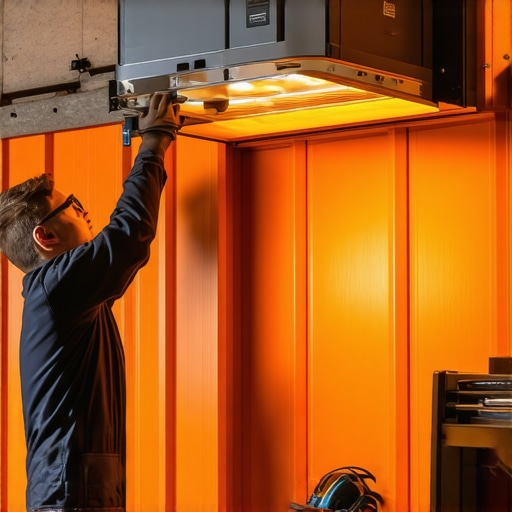
For a warehouse heating solution to actually work, you need to angle the reflectors. If you hang them flat, you’re heating the top of your head and leaving your feet in the 40-degree range. Angle them at 30 degrees toward the center of the work zone. This allows the radiant ‘throw’ to overlap. It’s like painting a wall; you want the edges to blend. While you’re at it, don’t ignore the air quality. Even though infrared doesn’t move air, dust still settles on those reflectors. This is why duct cleaning services and general equipment cleaning are vital. If the reflector is covered in ‘Pookie’ (mastic) or shop dust, the emissivity drops, and you’re just wasting juice. For the modern shop, smart building management is the final piece of the puzzle. Being able to ramp down the heat when the shop is empty—and I mean really ramp it down—is how you save the big bucks. Just make sure your gas line installation for furnaces is sized for the total BTU load. I’ve seen guys try to manifold three heaters onto a half-inch line; the result is a lazy flame and a lot of carbon monoxide. If you see ‘flame rollout’ or hear a ‘whumping’ sound on startup, call a pro. That’s not ‘character,’ that’s a death wish. Whether it’s a steam boiler repair for an old radiator system or a high-tech infrared array, physics doesn’t care about your feelings. Do it right, or do it twice.”