The Thermal Mass Manifesto: Why Your Shovel is a Sign of Engineering Failure
I remember my old mentor, a man we called ‘Iron Lung’ Miller because he could smell a cracked heat exchanger from the driveway, used to scream at me during the blizzard of ’93: ‘You can’t cool what you can’t touch, and you can’t melt what you don’t understand!’ He was standing on a frozen driveway in 10-degree weather, watching a homeowner struggle with a heart-attack-inducing pile of snow. Miller wasn’t just being a cranky old tin knocker; he was teaching me the first law of hydronic justice. Snow melt systems aren’t a luxury; they are a thermodynamic solution to a mechanical problem that most people solve with manual labor and bad backs.
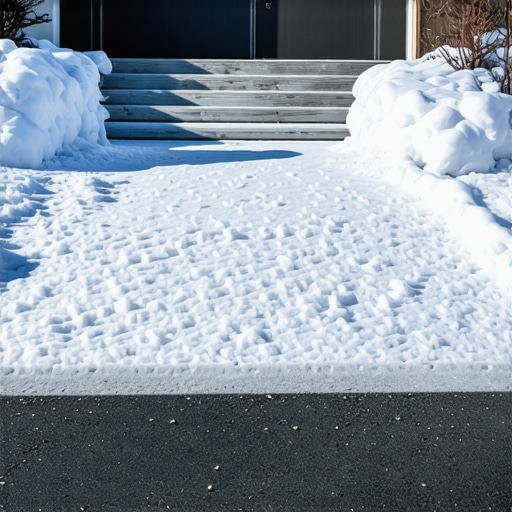
When we talk about snow melt, we’re talking about turning your driveway into a giant radiator. It’s about BTU density. In the North, where the frost line sits deep and the wind-chill makes your eyes water, your outdoor surfaces are massive heat sinks. A proper snow melt system installation uses a boiler—the real heart of a home’s mechanical room—to circulate a glycol-water mixture through PEX tubing buried in the concrete. We aren’t just ‘heating the ground.’ We are overcoming the latent heat of fusion. It takes 144 BTUs to turn one pound of ice at 32°F into one pound of water at 32°F. If your ‘Sales Tech’ doesn’t mention the math, he’s just trying to sell you a shiny box.
“Snow-melting systems shall be designed to provide heat at a rate sufficient to melt snow as it falls and to prevent the accumulation of ice on the surface.” – ASHRAE Handbook – HVAC Applications
If you’re still relying on a shovel, you’re living in the 19th century. Modern heating service innovations have moved the needle. We are seeing a massive shift toward high-efficiency boiler maintenance services to support these systems. A boiler that hasn’t been descaled is a ticking time bomb when it’s trying to push heat into a frozen slab of concrete. You’ll hear the ‘kettling’—that banging sound that sounds like a trapped ghost—and that’s your heat exchanger screaming for help.
The Anatomy of the Melt: Beyond the Pipes
Installing a snow melt system isn’t just about laying pipe. It’s about the integration of the whole mechanical ecosystem. For instance, many of my clients are looking at multi-family heating upgrades where we combine a two-stage furnace installation for the living spaces with a dedicated hydronic loop for the walkways. Why? Because comfort isn’t just about the air temperature; it’s about the safety of the path to your front door. If you’re doing a SEER2 compliant upgrade for your cooling, it’s the perfect time to look at the boiler too. They aren’t separate worlds; they share the same gas line, the same thermostat wiring upgrades, and often the same ‘Sparky’ (electrician) to get the controls right.
Speaking of controls, let’s talk about the ‘brain.’ A snow melt system isn’t just ‘on’ or ‘off.’ If you leave it on all winter, you’ll go broke. If you wait until the snow is six inches deep to turn it on, you’ve already lost. You need moisture and temperature sensors embedded in the concrete. This is where industrial heater services logic comes into play. We use ‘idling’ modes to keep the slab at 34°F when the forecast predicts a storm, then ramp up the BTUs the second the first flake hits the sensor. It’s beautiful, it’s precise, and it’s pure physics.
The 2025 Refrigerant Shift: R-454B and Your Heating Strategy
You might wonder what R-454B refrigerant transition services have to do with melting snow. Everything. As we move away from R-410A, the new A2L ‘mildly flammable’ refrigerants are changing how heat pumps work in cold climates. For many, a hybrid approach is the future. You use a heat pump for the shoulder seasons and a high-efficiency gas boiler for the deep freeze and snow melting. If you’re looking at financing for heat pump installs, make sure your contractor isn’t a ‘Sales Tech’ who ignores the hydronic side. You want a system that handles air purification integration inside and a clear driveway outside. It’s a holistic mechanical plan.
“Designers must consider the thermal resistance of the slab and the back-loss to the ground when calculating the required boiler capacity for snow-melting systems.” – ACCA Manual N (Commercial Load Calculation)
I’ve walked into too many jobs where a guy quoted a ‘sweet deal’ but didn’t account for back-loss. Without insulation under that PEX tubing, you’re just heating the worms six feet underground. That’s why choosing the right HVAC fixes requires a technician who actually knows how to use a manometer and a combustion analyzer, not just a guy with a clipboard and a smile.
Why Maintenance is the Only Way Out
Whether it’s refrigerant leak detection on your AC or checking the glycol PH levels in your snow melt system, maintenance is the only thing standing between you and a $10,000 repair bill. I’ve seen boilers fail because the owner thought ‘it’s a sealed system’ and didn’t check the expansion tank. Newsflash: nothing is truly sealed forever. Oxygen ingress will eat your cast iron heat exchanger from the inside out, leaving you with a sour-smelling mess on the floor. Check the furnace repair myths; the biggest one is that ‘if it’s running, it’s fine.’ Wrong. If it’s running inefficiently, it’s stealing from your retirement fund.
If you’re in a high-stakes environment—think industrial heater services for a loading dock—the snow melt system is a safety requirement. A slip-and-fall lawsuit costs a lot more than a boiler tune-up. We see the same logic in multi-family heating upgrades. Landlords are tired of the liability. They want a system that ‘just works,’ which means we need robust boiler maintenance services and proper thermostat wiring upgrades to ensure the sensors are talking to the manifold correctly. [IMAGE_PLACEHOLDER]
The Forensic Diagnosis: When to Upgrade
How do you know if your current heating setup can handle a snow melt add-on? It starts with the ‘Forensic Diagnosis.’ I look at your gas pressure, your venting, and your existing electrical load. If you’re still running an old pilot-light furnace, a two-stage furnace installation is your first step toward efficiency. From there, we look at the ‘gas’ (refrigerant) and the overall ‘juice’ (power) availability. If your system is over 15 years old, you are likely throwing money out the window. You should identify when furnace repair is urgent before the first frost hits, or you’ll be the one shoveling while your neighbor’s driveway is bone-dry and steaming.
Comfort isn’t magic. It’s the result of SEER2 compliant upgrades, proper refrigerant leak detection, and a technician who understands that the house is a machine. Don’t let a ‘Sales Tech’ talk you into a system that’s too big for your ductwork or a boiler that can’t handle the head pressure of an outdoor loop. Airflow is king, but in the winter, BTU transfer is the law of the land. Stop shoveling. Start engineering.