The silence of a geothermal system that refuses to switch from heating to cooling is a specific kind of technical frustration. You’ve spent the money on a high-efficiency ground-source loop, but when the first heatwave of the season hits, your vents are breathing out lukewarm air instead of the crisp, dehumidified relief you paid for. I’ve seen this a thousand times in my thirty years on the tools. While some ‘Sales Tech’—the guys who care more about their commission than your comfort—will immediately try to sell you a full heat pump installation or claim your ground loop is ‘depleted,’ the reality is usually buried in the physics of the refrigeration cycle. My old mentor used to scream at me in the back of a sweltering van, ‘You can’t cool what you can’t touch!’ This is why airflow and the mechanical state of your reversing valve matter more than the brand name on the cabinet. If you aren’t moving the heat out of the refrigerant and into the ground loop effectively, the whole system is just a very expensive paperweight.
“Properly sized equipment and distribution systems are essential for maintaining comfort and minimizing energy use, particularly in high-performance geothermal applications.” – ACCA Manual J
The Forensic Diagnosis: Why Your Mode Switch Is Failing
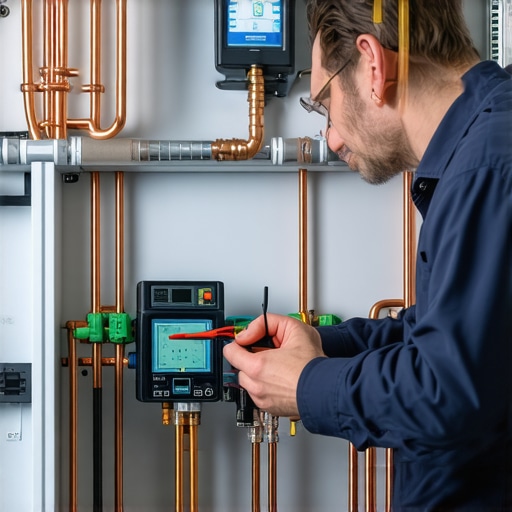
When a geothermal heat pump refuses to switch modes, we have to look at the heart of the operation: the reversing valve. Unlike a standard split system, a geothermal unit relies on a constant 55-degree ground temperature to act as its heat sink. The reversing valve is a four-way manifold that redirects the flow of hot ‘juice’ (refrigerant gas). In cooling mode, the compressor pumps hot gas to the coaxial heat exchanger (the water-to-refrigerant coil), where the ground loop water carries the heat away. If the valve doesn’t slide, you’re stuck in the wrong season. This isn’t magic; it’s a delicate balance of pressure and electromagnetics. Most techs fail to check the 24-volt solenoid coil first. If that coil is fried, the valve won’t shift, regardless of what the thermostat says. You can trace this by checking the ‘O’ or ‘B’ terminal on your control board. If you have 24 volts but no ‘clunk’ from the valve, you’ve found your culprit. This is often more reliable than a generic efficient HVAC repair strategy because it targets the specific mechanical failure of ground-source hardware.
Thermodynamic Zooming: The Physics of Latent Heat
To understand the failure, you have to understand the enthalpy of the air. In a mixed climate like the Northeast or Midwest, we deal with massive humidity swings. A geothermal unit in cooling mode must drop the evaporator coil temperature below the dew point of the return air. This is how we remove latent heat. If your system won’t switch modes, or if it switches but fails to dehumidify, you might be looking at an air handler repair issue rather than a loop problem. If the blower isn’t moving enough CFM (Cubic Feet per Minute) across that coil because of a clogged MERV filter upgrade, the refrigerant won’t boil off correctly. This causes ‘slugging,’ where liquid refrigerant returns to the compressor, which is a death sentence for the unit. A real tech checks the static pressure—the resistance to airflow—before they ever touch the refrigerant gauges. If the ‘tin knocker’ who installed your ducts didn’t size the return air drops correctly, your high-tech geothermal pump is essentially suffocating. This is a common oversight that leads people to seek heating service hacks when they should be looking at their ductwork.
“The ground-source heat pump is a heat exchanger that utilizes the earth as a thermal sink or source, requiring precise flow rates to maintain thermodynamic efficiency.” – ASHRAE Standards
Electrical Gremlins and the Sparky’s Nightmare
Sometimes the issue isn’t the valve itself, but the ‘Sparky’ (electrician) or the low-voltage wiring. Geothermal units are sensitive to voltage drops. If your contactor is pitted or your capacitor is leaning toward the end of its life, the compressor might start, but the reversing valve solenoid might not have enough ‘oomph’ to hold the slide in place. I’ve found instances where a simple HVAC maintenance plan would have caught a loose common wire that was arcing every time the mode switched. Furthermore, in regions where we do gas line installation for furnaces alongside heat pumps, dual-fuel setups can have complex ‘fossil fuel kits’ or interface boards. If the board thinks the furnace should be running, it might lock out the heat pump’s cooling function entirely. This is why rebate application assistance often requires professional commissioning; the state wants to ensure the controls are actually talking to each other. If you’re dealing with a wall furnace installation or a propane conversion service in a hybrid setup, the logic gets even stickier. A stuck mode is often just a confused control board.
The Airflow Manifesto: Pookie, Mastic, and Static Pressure
I cannot stress this enough: airflow is king. You can have the most expensive ground loop in the county, but if your ducts are leaking ‘juice’ into the crawlspace, you’re losing. I’ve seen systems where the installer used cheap tape instead of ‘Pookie’ (mastic) on the plenums. Over time, that tape dries out, the plenum leaks, and the static pressure drops so low that the air doesn’t have the velocity to reach the far bedrooms. This makes it feel like the unit hasn’t switched modes even when it has. If you’re investigating evaporative cooler services for a workshop or secondary building, you know how important seals are. The same applies to your geothermal air handler. We don’t just ‘top off’ a system; it’s a sealed loop. If it’s low on refrigerant, there is a leak, likely in the ‘suction line’ or the evaporator coil. Finding that leak is a forensic job, not a sales job. Don’t let a tech tell you otherwise. If you’re unsure about the state of your system, you should contact us for a real diagnostic, not a sales pitch.
Repair vs. Replace: When to Pull the Plug
So, when is it time to stop troubleshooting and start looking at a new heat pump installation? If your reversing valve has internal ‘bypass’—where the hot gas is leaking directly into the suction side—the labor to replace that valve often rivals the cost of a new unit because of the ‘gas’ recovery and brazing involved. However, if the issue is a $150 solenoid or a $40 capacitor, you’d be a fool to replace the whole thing. This is where choosing the right HVAC fixes becomes critical. Geothermal units are long-term investments. The ground loop itself lasts 50 years; the ‘box’ in your utility room lasts 15 to 20. If your unit is under 12 years old, troubleshoot the modes. Check the thermostat, check the 24v signal, and for the love of thermodynamics, check your filters. A dirty filter is the number one cause of ‘mode failure’ calls that turn out to be nothing more than a lack of maintenance. Stop listening to the sales techs and start listening to the physics. Comfort isn’t magic; it’s the controlled movement of BTUs from one place to another. [HowTo: Geothermal Troubleshooting] 1. Verify 24V at the reversing valve solenoid. 2. Use a magnet to manually trip the valve slide to check for mechanical sticking. 3. Test ground loop pump flow rates to ensure heat exchange is occurring. 4. Check static pressure across the air handler to rule out airflow restrictions. “,”image”:{“imagePrompt”:”A close-up, high-detail photograph of a geothermal heat pump’s internal components, specifically focusing on a four-way reversing valve with copper piping and a black solenoid coil. A technician’s hand is visible holding a digital multimeter probe against the electrical terminals. The lighting is bright and professional, showing the metallic textures and technical complexity of the HVAC system.”,”imageTitle”:”Geothermal Reversing Valve Diagnostic”,”imageAlt”:”A technician testing the electrical signal on a geothermal heat pump reversing valve solenoid coil.”},”categoryId”:0,”postTime”:””}“`
The silence of a geothermal system that refuses to switch from heating to cooling is a specific kind of technical frustration. You’ve spent the money on a high-efficiency ground-source loop, but when the first heatwave of the season hits, your vents are breathing out lukewarm air instead of the crisp, dehumidified relief you paid for. I’ve seen this a thousand times in my thirty years on the tools. While some ‘Sales Tech’—the guys who care more about their commission than your comfort—will immediately try to sell you a full heat pump installation or claim your ground loop is ‘depleted,’ the reality is usually buried in the physics of the refrigeration cycle. My old mentor used to scream at me in the back of a sweltering van, ‘You can’t cool what you can’t touch!’ This is why airflow and the mechanical state of your reversing valve matter more than the brand name on the cabinet. If you aren’t moving the heat out of the refrigerant and into the ground loop effectively, the whole system is just a very expensive paperweight.