The Physics of Fire: Why Your Gas Line Is Choking Your Comfort
My old mentor, a grizzly veteran who could smell a gas leak from the curb, used to scream at me every time I reached for a wrench: ‘You can’t burn what you can’t feed! Physics doesn’t care about your thermostat settings!’ He was right. Most homeowners—and frankly, too many ‘Sales Techs’ looking for a quick commission—think that if you want more heat, you just buy a bigger furnace. That is the quickest way to kill a heat exchanger and waste five figures of your hard-earned money. If you are looking at warehouse heating solutions or even just a residential upgrade, the math starts at the meter, not the plenum.
“Equipment capacity must be matched to the actual load of the structure, but more importantly, the fuel delivery system must be capable of sustaining the maximum input rating of that equipment under peak demand.” – ACCA Manual S
The core problem is dynamic pressure drop. When your furnace kicks on, it needs a specific volume of natural gas or propane to maintain a stable flame. If your gas line is undersized, the pressure at the manifold drops the second the valve opens. This leads to a weak, ‘lazy’ flame that doesn’t heat the exchanger properly, causing condensation that rots the metal from the inside out. You think you need a furnace ignition repair because the unit is locking out, but the reality is your gas line is literally starving the fire.
The Forensic Diagnosis: Anatomy of a Gas Capacity Failure
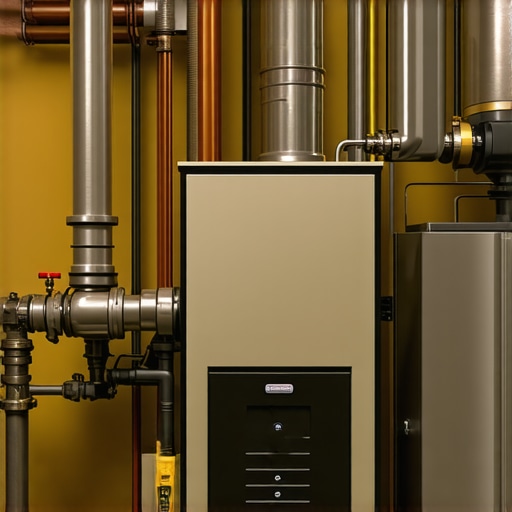
When I walk into a mechanical room and see a shiny new 100,000 BTU furnace hooked up to a 50-foot run of half-inch black iron pipe, I already know I’m looking at a future limit switch replacement call. Here is how the anatomy of failure works. The limit switch is the safety brain of your furnace; it’s designed to shut things down if the internal temperature gets too high. When a gas line is undersized, the furnace struggles to reach steady-state combustion, often causing ‘flame rollout’ or erratic heat patterns that trip that switch. Most guys will just swap the switch and leave. A real tech looks at the water column (W.C.) pressure with a manometer while the unit is firing. If that needle drops more than an inch when the ‘juice’ starts flowing, you have a plumbing problem, not an HVAC problem.
We see this often in hospital HVAC zoning or large-scale residential projects where zoning system installation has been added after the fact. Each zone adds a layer of complexity to how much heat is needed at any given moment. If you haven’t upgraded your gas line to handle the maximum possible draw, you’re essentially trying to run a marathon while breathing through a cocktail straw. This is why furnace repair myths debunked by industry experts often start with the fuel source. It’s not always a bad board; sometimes it’s just physics.
The North Climate Reality: Why Capacity Matters in a Polar Vortex
In cold climates like Chicago or the Northeast, the ‘Monsoon Effect’ of the South is replaced by the ‘Polar Vortex Pressure Trap.’ When the temperature hits -10°F, every house on the block is drawing maximum gas from the utility main. If your internal piping is marginal, your furnace will struggle precisely when you need it most. We see furnace ignition repair calls skyrocket during these freezes. The igniter glows, the gas valve clicks, but the ‘gas’ is so low on pressure it won’t sustain a flame. This isn’t a part failure; it’s a capacity failure. It’s one of the reasons how to identify when furnace repair is urgent and why is such a critical topic for homeowners—knowing the difference between a broken part and a fundamental design flaw can save you thousands.
“Gas piping shall be sized so that the pressure at the inlet to the equipment is not less than the minimum required by the equipment manufacturer.” – NFPA 54 (National Fuel Gas Code)
If you’re considering thermostat wiring upgrades or moving to programmable thermostat programming to save money, keep in mind that those digital brains assume the mechanical systems are perfect. A smart thermostat won’t tell you that your contactor repair was actually caused by a vibrating unit struggling with poor combustion. It just tells you the house is cold.
The Solution: Beyond the ‘Sparky’ and the ‘Tin Knocker’
To fix these issues, you need a tech who understands more than just how to use ‘Pookie’ (mastic) on a duct joint. You need someone who can calculate the equivalent length of every elbow and tee in your gas line. Upgrading to inverter-driven compressors for your AC side is great for efficiency, but on the heating side, efficiency comes from complete combustion. If you’re on a preventative maintenance contract, your tech should be checking your manifold pressure every single year. If they aren’t pulling out a manometer, they aren’t doing their job; they’re just ‘toasting’ the unit. Using top hvac repair strategies to extend your systems life means looking at the fuel delivery first. If you’re ready to stop guessing and start fixing your home’s thermal envelope correctly, it’s time to contact us for a real load calculation. We don’t just sell boxes; we engineer comfort based on the laws of thermodynamics.