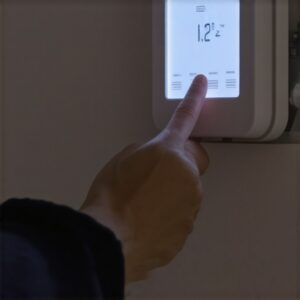

I’ve spent thirty years dragging my tool bag through crawlspaces and balancing on ice-slicked roofs while the wind howls like a banshee. In that time, I’ve learned one immutable truth: the most expensive furnace in the world is nothing more than a giant paperweight if you don’t have control over the airflow. My old mentor, a grizzly veteran who could smell a gas leak from a block away, used to bark at me, ‘You can’t heat what you can’t touch!’ He wasn’t talking about the furniture; he was talking about the molecular dance of heat transfer. If you’re leaving a vacation home unattended in a Northern winter, you aren’t just managing a thermostat; you’re managing a delicate thermodynamic balance. This is where geofencing temperature control and app-controlled systems shift from ‘luxury’ to ‘survival gear’ for your property.
“Properly sizing equipment and ducts is the first step in ensuring a system can actually deliver the BTU/h it promises, especially in unoccupied structures.” – ACCA Manual J Standards
The Forensic Diagnosis: Why Your Cabin is a Heat Sink
When you leave a vacation home for three weeks in January, the building materials—the 2x4s, the drywall, the flooring—all reach a state of thermal equilibrium with the frigid outside air. If you arrive and crank a standard single-stage furnace to 75 degrees, you’re creating a massive thermal shock. A standard furnace is either 100% on or 100% off. It’s like trying to drive a car with only two settings: neutral and floor-it. This is why modulating furnace repair and installation have become the gold standard. A modulating furnace adjusts its gas valve in tiny increments, providing a steady stream of ‘juice’ to maintain a precise temp without the violent swings that stress your heat exchanger. If you’re dealing with an older unit, understanding how to identify when furnace repair is urgent and why is the difference between a cozy weekend and a flooded basement from burst pipes.
Inverter-Driven Compressors and the Physics of Efficiency
Most folks think an AC or Heat Pump is just ‘making cold.’ In reality, it’s a heat mover. In a vacation home, inverter-driven compressors are your best friend. Unlike those old-school ‘clunkers’ that kick on with a massive electrical surge that makes the lights flicker, an inverter ramp up slowly. It’s like a dimmer switch for your compressor. This is critical for remote homes where power grids might be flaky. When you combine this with system performance testing, you ensure that the ‘gas’ (refrigerant) is moving at the exact mass flow rate needed to strip the cold from the air. This level of precision is why heating service innovations transforming 2025 climate control are leaning so heavily into variable-speed tech. You want a system that ‘sips’ energy while you’re away but can ‘gulp’ it when it sees you’re five miles out via geofencing.
The Combustion Analysis: Don’t Let Your Furnace Kill You
Every time I perform furnace repair services, I pull out my analyzer. If a tech walks into your house without a combustion analyzer, kick them out. Combustion analysis measures the ratio of oxygen to fuel and the parts per million of carbon monoxide. In a vacation home that’s been sealed up tight, a cracked heat exchanger is a silent killer. The heat exchanger is the metal wall between the fire and the air you breathe. When it cracks, the ‘Sparky’ (electrician) isn’t the one you need; you need a pro who knows how to spot flame rollout. This is especially vital when integrating solar thermal heating integration, as the hand-off between systems must be seamless to avoid backdrafting. For more on this, look at furnace repair myths debunked by industry experts to see why ‘just a cleaning’ is often a dangerous lie.
“Uncontrolled air leakage can account for up to 40% of the energy used to heat or cool a typical home, making insulation as vital as the furnace itself.” – ASHRAE Standards
The Airflow Manifesto: Pookie and Attic Insulation
You can have the fanciest app-controlled thermostat in the world, but if your ductwork is leakier than a screen door on a submarine, you’re wasting your money. I’ve seen ‘Tin Knockers’ slap together ducts with nothing but silver tape. Real pros use ‘Pookie’ (mastic). It’s a messy, grey paste that seals a duct for fifty years. In a vacation home, attic insulation for heating is your primary defense. Heat moves toward cold. If your attic is under-insulated, your furnace is essentially trying to heat the entire outdoors. We use hospital HVAC zoning principles in high-end homes to ensure that even if the attic is freezing, the living areas stay at a rock-solid 55 degrees to prevent pipe bursts. This is one of those heating service hacks for comfort and savings in 2025 that the sales techs never mention because they’d rather sell you a new box than fix your ‘Pookie’ application.
Leak Detector Integration: The Final Frontier
The real ‘pro move’ for a vacation property is leak detector integration. Modern smart thermostats don’t just talk to the furnace; they talk to moisture sensors under your sinks and near your water heater. If a pipe freezes because the power went out and the temp dropped, the system alerts your phone before the ‘Suction Line’ (the copper pipe returning to the unit) turns into a block of ice. It’s about proactive defense. If you want to keep your system running until the wheels fall off, you need to follow top hvac repair strategies to extend your systems life. Control is not just about comfort; it’s about the physics of protecting your investment from the brutal reality of the seasons.