You’re standing in a basement that’s currently 48 degrees and falling. You’ve got the burner door off, the smell of dust and cold iron in your nose, and you’re staring at a tiny, flickering blue flame. The pilot is lit. You’ve held the knob down for sixty seconds, you’ve flipped it to ‘On,’ and… nothing. The main burners won’t kick. You hear the thermostat click, but the furnace is as silent as a grave. Most ‘Sales Techs’ would walk in here, see a fifteen-year-old cabinet, and immediately start writing up a quote for a $12,000 high-efficiency furnace installation. They’ll tell you the ‘brain’ is dead or the valve is ‘shot’ without ever pulling a multimeter out of their bag. I’ve spent thirty years catching these guys in the act, and let me tell you, your furnace isn’t a mystery; it’s a machine governed by the laws of physics.
The Physics Lesson: Why Airflow and Heat Matter More Than Horsepower
My old mentor, a grizzled tin knocker named Sully, used to scream at me in the middle of a crawlspace: ‘You can’t burn what you can’t sense, and you can’t cool what you can’t touch!’ He was obsessed with the Seebeck effect before I even knew what a millivolt was. The reason your gas valve won’t open despite having a pilot flame is almost always a failure in the safety feedback loop. In the HVAC world, we don’t trust sensors; we trust the physical transfer of energy. Your pilot flame isn’t just there to light the gas; it’s a miniature power plant. If the thermocouple or thermopile isn’t generating enough DC voltage to hold that solenoid open, the gas valve stays shut to prevent your house from becoming a localized bomb. This is why proper furnace tune-up services are about more than just vacuuming out some dust; they are about verifying the integrity of this electrical-thermal handshake.
“The most expensive equipment in the world cannot overcome a bad duct system.” – Industry Axiom
In the cold North, where a polar vortex can turn your pipes into ice sculptures overnight, the gas valve is your last line of defense. We deal with ‘Sensible Heat’—the stuff you can actually feel on your skin—but we also deal with the brutal reality of thermal expansion. When your furnace cycles, that heat exchanger is expanding and contracting like a set of lungs. If you haven’t kept up with maintenance, that metal gets brittle. A ‘Sales Tech’ loves a cracked heat exchanger because it’s an automatic ‘red tag’ and a new sale. But sometimes, the valve won’t open because the ‘Sparky’ who wired the house didn’t ground the furnace properly, or the flame sensor is just coated in a microscopic layer of carbon. Before you panic, you need to understand the mechanical anatomy of what’s happening under the hood.
The Forensic Diagnosis: Anatomy of a Silent Furnace
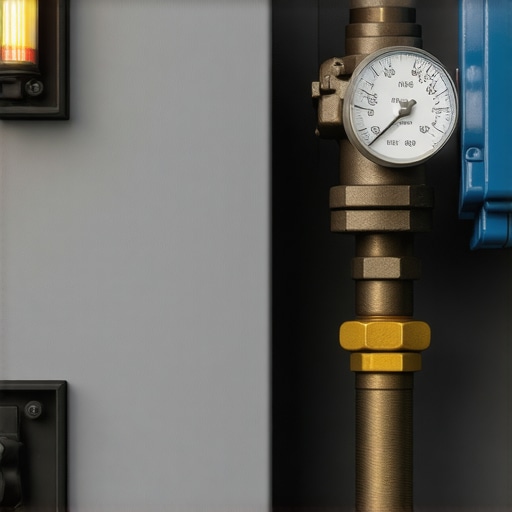
When we look at why that valve is stubborn, we have to look at the millivolt circuit. A standard thermocouple should be producing about 25 to 30 millivolts when it’s bathed in that blue flame. If it’s only kicking out 12, the magnet inside the gas valve won’t have the strength to pull the plunger. It’s pure electromagnetism. You can’t ‘trick’ it. You also have to consider the ‘limit switches.’ These are the bouncers of the HVAC world. If the furnace got too hot during the last cycle because of a clogged filter—forcing the unit to ‘short cycle’—the high-limit switch might have tripped. If that switch is open, the gas valve will never get the 24V signal it needs from the control board to dump gas into the manifold. It’s a safety logic gate, and it’s there for a reason. This is why identifying when furnace repair is urgent is often about recognizing these silent safety shutdowns.
“Gas-fired appliances shall be installed in accordance with the manufacturer’s instructions and the National Fuel Gas Code.” – NFPA 54 / ANSI Z223.1
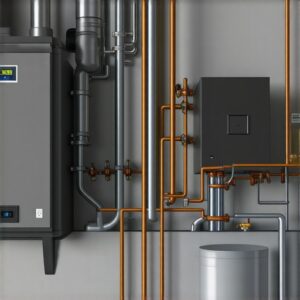
If you’re looking at high-efficiency furnace installation or even an oil to gas conversion, you’re moving into the realm of ‘Demand-Controlled Ventilation.’ Modern systems are much more finicky than the old ‘cast iron monsters’ of the 70s. They use draft inducer motors to ‘pre-purge’ the combustion chamber. If that motor isn’t spinning fast enough to close a pressure switch, the gas valve remains a paperweight. It’s a chain of events: Inducer starts -> Pressure switch closes -> Igniter glows/Pilot lights -> Flame sensor confirms -> Gas valve opens. If any link in that chain breaks, you’re staying cold. This is particularly critical in multi-family heating upgrades where venting becomes a complex game of static pressure and ‘Pookie’—that thick, gray mastic we use to seal the tin.
The Trap: Repair ($500) vs. Replace ($8,000)
The ‘Sales Tech’ will tell you that a gas valve failure is the ‘beginning of the end.’ That’s a load of ‘juice.’ A gas valve is a mechanical component. It can fail, but it’s rarely the root cause. Often, the issue is ‘flame rollout’ caused by a clogged chimney or a cracked heat exchanger, which trips a small thermal fuse near the burners. If you just replace the valve, you haven’t fixed the problem; you’ve just ignored the symptoms of a potentially lethal carbon monoxide situation. If you are using ventless gas heater services or fireplace insert services, these safety checks are even more vital because there is no chimney to hide the mistakes. I’ve seen DIYers try to bypass limit switches with a jumper wire—don’t be that person. You might get the heat back on, but you’re essentially disabling the brakes on a car because they were squeaking.
For those in new construction heating design, we’re seeing a massive shift toward heating service innovations like heat pump installation integrated with gas backups (dual-fuel systems). This is the best of both worlds, but it doubles the complexity of the troubleshooting. If your gas valve won’t open on a hybrid system, it might actually be the outdoor sensor thinking it’s 50 degrees outside when it’s actually 20. Before you buy a new unit, check the basics: Is the gas cock actually in the ‘on’ position? Is the ‘Suction Line’ of your gas supply sized correctly for the BTU load? Sometimes the ‘Tin Knocker’ who did the original install used 1/2 inch pipe when they should have used 3/4, starving the valve of pressure.
Beyond the Valve: Safety and Strategy
If you’re supplementing your heat with portable heaters, please perform portable heater safety checks. These things are the leading cause of house fires in the winter. They pull huge amounts of amperage—enough to melt a cheap outlet and keep a ‘Sparky’ busy for a week. As we move into 2025, the industry is changing. We’re moving away from old refrigerants and toward higher-efficiency standards that make furnace repair myths even more dangerous. The ‘old school’ way of just ‘giving it a thump’ with a wrench doesn’t work on a modern modulating gas valve that uses a pulse-width modulation signal to control flame height. You need a tech who understands the math of the manifold pressure—usually 3.5 inches of water column for natural gas—and who isn’t just trying to hit their monthly sales quota. Comfort is a matter of physics, not magic, and a lit pilot is just the first sentence in a long story about how your home stays warm.