The Anatomy of a Failed Boiler Service: A Veteran Technician’s Perspective
The coldest nights in the Northeast don’t just test your insulation; they test the integrity of the person who last touched your boiler. I remember my old mentor, a grizzly veteran who smelled like pipe dope and menthol, screaming at me in a cramped basement in mid-January: ‘You can’t heat what you can’t touch, and you can’t touch what you don’t measure!’ That lesson stuck. He wasn’t talking about the radiator; he was talking about the thermodynamic transfer of energy from a flame to the heat exchanger. If a technician walks into your mechanical room with nothing but a multi-tool and a rag, you aren’t getting a service—you’re getting a performance. In a North/Cold climate zone, where a cracked heat exchanger isn’t just a repair issue but a carbon monoxide death sentence, the ‘splash and dash’ service is an insult to the trade. Real boiler maintenance is about managing sensible heat and ensuring the combustion process doesn’t turn your basement into a hazard zone.
“The most expensive equipment in the world cannot overcome a bad duct system—or in the case of hydronics, a poorly calibrated combustion cycle.” – Industry Axiom
Red Flag 1: The Absence of Combustion Analysis
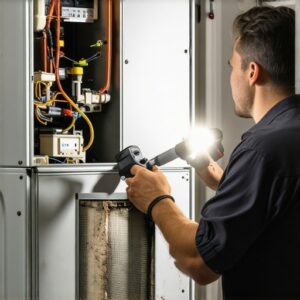
If your tech didn’t pull a digital combustion analyzer out of their bag, they didn’t service your boiler. Period. Modern high-efficiency boilers are essentially computers that burn gas. Without checking the CO2 levels, O2 percentages, and stack temperature, the tech has no idea if the unit is running lean or rich. A boiler running too rich will ‘soot up’ the heat exchanger, acting as an insulator that prevents heat from reaching the water—that’s latent heat being wasted out the vent. This often leads to needing a furnace ignition repair later because the electrodes are caked in carbon. A real pro checks the flame signal in microamps to ensure the control board diagnostics are reading a healthy fire.
Red Flag 2: Ignoring the Contactor and Electrical Integrity
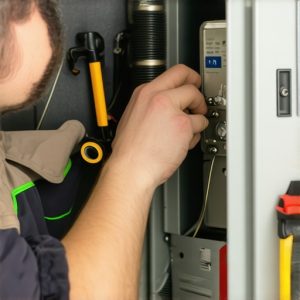
I’ve followed behind ‘Sales Techs’ who see a scorched wire and immediately quote a $12,000 system replacement. That’s a scam. Often, a simple contactor repair or cleaning the terminals is all that’s needed to keep the pump or the blower moving. In heavy-duty heating zones, the electrical components take a beating from the constant cycling. If the tech didn’t check the capacitor on your circulator pump or the amp draw on the inducer motor, they left you stranded. They should be looking for pitted contacts that can weld shut, causing the system to overheat or fail to engage when the thermostat calls for heat. When I’m deep in control board diagnostics, I’m looking for ghost voltages that indicate a failing transformer or a shaky ‘Sparky’ (electrician) job on the main line.
Red Flag 3: The Neglected Expansion Tank and Pressure Relief Valve
Hydronics is physics in a closed loop. As water heats up, it expands. If your tech didn’t ‘tap’ the expansion tank or check its pre-charge with a tire gauge, they missed a critical failure point. A water-logged tank leads to high system pressure, which causes the pressure relief valve to weep. I’ve seen homeowners put a bucket under the valve, thinking it’s normal. It’s not. It’s a sign that the system is stressed. This is why choosing the right HVAC fixes involves understanding the relationship between pressure and temperature. If they didn’t check the ‘Juice’ (refrigerant) in a hybrid heat pump system or the fluid pressure in a boiler, they didn’t do their job.
“Standard 155 defines the commercial furnace repair requirements to ensure seasonal efficiency doesn’t drop below 80% AFUE through improper venting or scaling.” – ASHRAE Standards
Red Flag 4: Poor Integration of Modern Controls
We are in the era of the voice control setup Alexa Google, yet many old-school techs are afraid of the low-voltage wires. If your tech didn’t check the C-wire integrity or ensure your smart thermostat is actually modulating the boiler correctly, you’re losing money. In northern climates, we often see snow melt systems installation integrated into the main boiler loop. If the technician doesn’t understand demand-controlled ventilation or how a shop heater services secondary loop affects the primary loop’s flow, the whole house will suffer from ‘short cycling.’ The unit turns on and off so fast that it never reaches its steady-state efficiency, cooking the internal components and leading to premature failure.
Red Flag 5: No Discussion of Long-Term Maintenance Plans
A ‘one-and-done’ service call is a red flag. Reliable companies push HVAC maintenance plans because boilers are temperamental beasts. Whether it’s a heat pump installation or a commercial furnace repair, these machines require an annual ‘piling on’ of data to track degradation. If the tech didn’t document the manifold gas pressure or the static pressure of the flue, how will the next guy know if the heat exchanger is slowly clogging? They should be looking at the ‘Pookie’ (mastic) on any ductwork transitions if it’s a forced-air combo and ensuring the ‘Tin Knocker’ (duct guy) didn’t leave any gaps. Without a plan, you’re just waiting for a Christmas Eve breakdown. For more on this, check out preventative HVAC repair tips to see what a real service checklist looks like.
Conclusion: Don’t Settle for a ‘Part-Swapper’
Comfort isn’t a setting on a dial; it’s the result of precisely managed thermodynamics. If your boiler service felt like a quick oil change rather than a forensic investigation, you’ve been underserved. A master tech knows that a boiler is a heart, and the pipes are the arteries. If the blood isn’t moving right, or the ‘fire in the belly’ isn’t clean, the whole system dies. Ensure your next technician treats the furnace ignition repair or contactor repair with the technical gravity it deserves. If you suspect your system was handled poorly, it’s time to contact us for a real diagnostic that actually looks at the physics, not just the price tag.