The Anatomy of a Cold House: Why Your Furnace is Silent
There is a specific kind of silence that happens at 3 AM in the middle of a January freeze. It is not the peaceful kind; it is the heavy, expensive kind. As a technician who has spent three decades crawling through spider-infested crawlspaces and balancing on icy rooftops, I can tell you that the sound of a furnace failing to ignite is the sound of a homeowner about to lose a few thousand dollars if they aren’t careful. But here is the secret the big HVAC franchises don’t want you to know: half the time, that ‘dead’ furnace just needs a five-minute adjustment. I’ve seen ‘Sales Techs’—those guys who get a commission for every unit they sell rather than every unit they fix—quote a grieving widow $12,000 for a new system when all she had was a dirty flame sensor. I followed one of these guys into a suburban home last winter. He’d told the homeowner her heat exchanger was ‘compromised’ and she needed a full replacement by morning. I pulled the panel, took out a piece of Scotch-Brite, cleaned the $20 sensor, and the unit roared to life. She didn’t need a new furnace; she needed a technician with a conscience. Before you call for a 24/7 heating emergency response, you need to understand the physics of your system. A furnace is not a magic box; it is a thermodynamic exchange machine. It requires fuel, oxygen, and an unobstructed path to move that energy. If any part of that triangle is broken, the safety sensors—those tiny electronic snitches—will shut the whole thing down to prevent your house from becoming a charcoal briquette.
“The most expensive equipment in the world cannot overcome a bad duct system.” – Industry Axiom
Thermodynamic Zooming: How Heat Actually Moves
When your furnace kicks on, it isn’t just ‘making hot air.’ It is a complex sequence of operations. First, the inducer motor draws air through the heat exchanger to clear out any residual gases. Then, the igniter glows—reaching temperatures over 2,500°F—before the gas valve clicks open. The blue flame then transfers its sensible heat into the metal of the heat exchanger. Your blower motor then pushes cold return air over the outside of that hot metal. This is where the magic happens: the air absorbs the heat through conduction and convection, and the now-warm air is distributed through your ductwork. If you have a steam boiler repair issue or a baseboard heater repair need, the medium changes (water or steam instead of air), but the physics of heat transfer remain the same. If the airflow is restricted, the heat exchanger overheats, the limit switch trips, and you’re back in the cold. This is why top HVAC repair strategies to extend your systems life always start with the simplest component: the filter.
The 7 DIY Fixes to Save Your Wallet
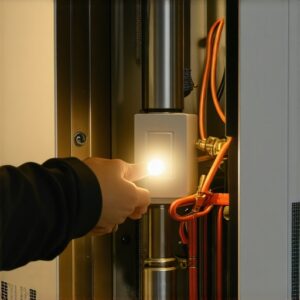
1. The Filter Paradox: You might think buying the ‘HEPA-rated, allergen-killing, 4-inch thick’ filter is helping your family. It isn’t. It’s strangling your furnace. High-MERV filters create massive static pressure. If your furnace is short-cycling (turning on and off every few minutes), check the filter. If it looks like a sweater, throw it away. A furnace without airflow is like a human trying to run a marathon while breathing through a cocktail straw. 2. The Thermostat Ghost: It sounds insulting, but I’ve driven an hour in a blizzard just to change two AA batteries. If your screen is blank or fading, the thermostat can’t send the 24-volt signal to the control board. Also, check your ‘C-wire’ connection if you just installed a smart thermostat. 3. The Emergency ‘Kill Switch’: Most furnaces have a switch that looks exactly like a light switch on the side of the unit or a nearby wall. I’ve seen many ‘broken’ furnaces that were actually just turned off by a teenager looking for a light switch or a homeowner bumping into it while moving boxes. Check it twice. 4. The Flame Sensor (The Sales Tech’s Best Friend): This is a small metal rod that sits in the path of the flame. Over time, it develops a thin layer of carbon or oxidation. If the sensor can’t detect the ‘rectification’ of the flame (a tiny DC current moving through the fire), it will shut the gas off after 3 to 5 seconds. You can fix this with a piece of emery cloth or a dollar bill. Clean it until it’s shiny. This is the core of most furnace ignition repair calls. 5. The Condensate Trap: If you have a high-efficiency (90% AFUE or higher) furnace, it produces water as a byproduct of combustion. If the drain line or the ‘P-trap’ gets clogged with slime or dust, the pressure switch will detect the backup and kill the power. Clear the line, and you’ll likely clear the code. 6. The Breaker Box: Furnaces are often on their own dedicated circuit. If the blower motor had a minor surge, it might have tripped the breaker. Flip it all the way to ‘Off’ then back to ‘On.’ If it trips again immediately, you have an electrical short—time to call a pro or a ‘Sparky.’ 7. The Intake and Exhaust Vents: In heavy snow, the PVC pipes exiting your house can get buried. If the furnace can’t ‘breathe’ in or ‘exhale’ out, the pressure switch won’t close, and the unit won’t fire. Ensure these pipes are clear of snow, ice, and bird nests.
When DIY Ends and Danger Begins
While I’m a fan of homeowners knowing their equipment, there are lines you don’t cross. If you smell ‘rotten eggs’ (mercaptan added to natural gas) or a sharp, acidic sourness (which could be a transformer or motor winding burning up), get out of the house. Refrigerant leak detection on a heat pump or checking for a cracked heat exchanger requires tools you don’t have, like a combustion analyzer or a leak detector. If you are dealing with a commercial furnace repair, the voltages are higher and the stakes are bigger—don’t touch it. According to ACCA Manual J, “Properly sizing heating and cooling equipment is critical… to ensure equipment provides the comfort and humidity control intended.” If your DIY fixes aren’t working, it might be an underlying issue with the original manual J calculations or a faulty heat pump installation that was never sized correctly for your climate zone. This is when how to identify when furnace repair is urgent and why becomes your most important read. Don’t be the guy who tries to bypass a safety limit with a jumper wire; I’ve seen that end in house fires. If you’ve checked the 7 points above and you’re still shivering, it’s time to find a furnace repair services provider who values their tools more than their sales brochure. Understanding furnace repair myths debunked by industry experts can help you navigate the conversation with a tech so you don’t get taken for a ride. Remember, comfort is physics, not magic. Keep your ‘Pookie’ (mastic) tight on your duct joints and your filters clean, and you’ll survive the winter without breaking the bank.