The Anatomy of a Catastrophic Failure: Why Your Boiler Room is a Ticking Time Bomb
There is a specific smell to a boiler room that’s on the edge of a nervous breakdown. It’s a cocktail of baked dust, hot mineral scale, and a faint, metallic tang that tells me the heat exchanger is working overtime to compensate for a lack of maintenance. I’ve spent thirty years in the guts of commercial buildings, and I can tell you this: a hotel boiler doesn’t just die; it gives you warnings that most people ignore until the guests are screaming for hot water at 6 AM during a January blizzard. When the silence of a failed plant hits, it’s the loudest sound in the building. I remember walking into a boutique hotel in downtown Chicago where the manager was vibrating with anxiety. A ‘Sales Tech’—one of those guys who carries a shiny iPad but couldn’t tell a thermocouple from a thermal expansion valve—had just quoted him $210,000 for a total plant replacement. The tech told him the cast iron sections were ‘compromised’ based on a single look at some external rust. I pushed that kid aside, pulled the burners, and found a fouled flame sensor and a blocked condensate trap that was backing up into the combustion chamber. It was a $300 fix disguised as a $200k crisis. That’s the difference between a technician and a salesman. Understanding the physics of your system saves you from the ‘Sales Tech’ scam. We’re talking about the thermodynamic reality of hydronic heating, where every BTU counts and every leak is a symptom of a deeper pathology.
“The most expensive equipment in the world cannot overcome a bad duct system—or in this case, a neglected hydronic loop.” – Industry Axiom
1. The Rhythmic Rattling and the Need for Radiator Replacement
If your hotel sounds like a percussion ensemble every time the heat kicks on, you have a serious problem with your steam or hot water distribution. This isn’t just ‘the building settling.’ It’s water hammer. In a steam system, when steam hits a pocket of cool condensate, it collapses instantly, creating a vacuum that pulls a slug of water at high velocity into a pipe elbow or a radiator. This mechanical shock is enough to fracture cast iron. If your radiators are leaking at the valves or the sections are weeping, radiator replacement becomes an inevitability rather than an option. The physics here are simple: energy is being wasted as mechanical force instead of heat transfer. When we look at older hotels, the transition to heating service innovations often involves moving away from these antiquated loops toward more precise control. If you’re still relying on 50-year-old radiators, your ‘sensible heat’ (the temperature we feel) is likely being undermined by massive energy loss through uninsulated piping and failing steam traps.
2. The Acrid Scent of Inefficiency: Flame Rollout and Combustion Issues
When I walk into a boiler room and smell something sour, I know the heat exchanger is either soot-clogged or cracked. This is where we talk about ‘Flame Rollout.’ If the internal passages of the boiler are restricted by scale or soot, the combustion gases have nowhere to go but out the front of the unit. This melts wiring harnesses and creates a carbon monoxide nightmare. In the North, where we deal with deep-freeze cycles, the metal undergoes massive thermal expansion and contraction. This is why furnace repair and boiler maintenance are non-negotiable. Modern heating service hacks suggest using combustion analysis tools to check the O2 and CO levels. If your boiler isn’t breathing, it’s dying. We see this often when ‘Tin Knockers’ or installers don’t provide enough combustion air to the room, forcing the boiler to choke on its own exhaust.
3. The Ghost in the Gauge: Erratic Pressure and Expansion Tank Failure
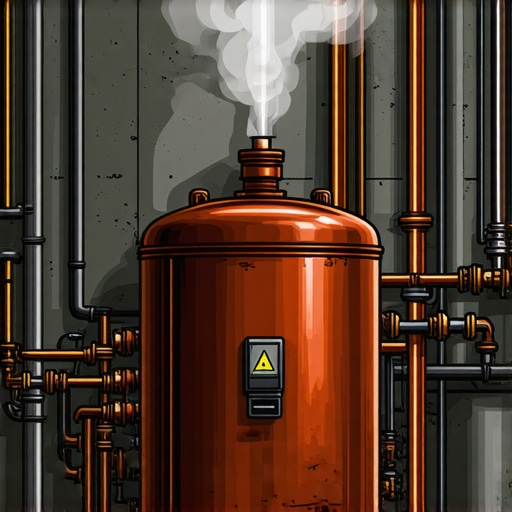
A boiler is a pressurized vessel, and pressure is governed by the expansion of water. Every time you heat water, it expands. If your expansion tank—the ‘lung’ of your system—has a ruptured bladder, that extra volume has nowhere to go. The pressure relief valve will pop, spitting ‘juice’ (system water) all over the floor. Then, as the system cools, the pressure drops, and the auto-fill valve kicks in, introducing fresh, oxygenated water. This is the ‘death cycle’ for a boiler. Fresh water brings in oxygen and minerals, which cause internal corrosion and ‘Pookie-like’ sludge buildup. If you’re constantly seeing the pressure gauge dance, you’re looking at a systemic failure. This is often when I recommend considering AC installation upgrades that include dual fuel heat pump systems. By offloading some of the heating load to hyper-heat heat pumps, you can extend the life of your central boiler plant significantly.
“Standard 155P provides a method of testing for the commercial efficiency of boiler systems, ensuring that latent heat recovery is maximized to prevent energy waste.” – ASHRAE Standards
4. Skyrocketing Bills and the AI-Driven HVAC Optimization Solution
If your utility bills look like a phone number, your boiler is likely ‘short cycling.’ This happens when the unit is oversized or the controls are stupid. It fires up, hits high-limit temperature in two minutes because it can’t shed its heat fast enough, and then shuts down. This ‘stop-start’ behavior is the fastest way to kill a compressor in an AC installation or a burner in a boiler. This is where AI-driven HVAC optimization comes into play. Modern sensors can predict load based on outdoor ambient temperature and occupancy, modulating the flame so the boiler runs longer at a lower, more efficient intensity. If you’re stuck with 80% AFUE equipment, you’re literally venting 20 cents of every dollar out the chimney. Moving toward SEER2 compliant upgrades and high-efficiency hydronics isn’t just about ‘being green’; it’s about not being broke.
5. The Puddle of Doom: Corrosion and Transitioning to Geothermal Heat Pump Systems
The moment you see rust flakes (iron oxide) or green ‘science experiments’ (copper oxidation) on your boiler sections, the clock is ticking. Corrosion is an electrochemical process that doesn’t stop once it starts. In many luxury hotels, we are seeing a shift away from central gas boilers toward geothermal heat pump systems. These systems use the earth as a heat sink or source, providing incredible efficiency. For hotels with tight air quality standards, adding UV light installation for HVAC and dehumidification services ensures that the latent heat is managed, preventing that ‘old hotel’ musty smell. If your boiler is leaking, don’t just patch it. Analyze your duct design services and see if a transition to hyper-heat heat pumps could eliminate the need for a boiler altogether. Comfort is physics, not magic. You need a tech who understands the psychrometrics of the building, not a salesman with a quota. If your ‘Sparky’ or ‘Tin Knocker’ is telling you it’s time to replace, make sure they aren’t just looking for a commission. Get a forensic diagnosis.