The Smell of Stagnation: Why Your Basement Is a Petri Dish
Listen, I’ve spent thirty years belly-crawling through crawlspaces and sweating in attics, and if there’s one thing that makes my skin crawl more than a nest of brown recluses, it’s the smell of a basement that isn’t breathing. You know that scent—earthy, thick, and slightly sour. That’s the smell of your home’s lungs failing. Most homeowners think they have a ‘leaky basement’ or a foundation issue when, in reality, they have an airflow catastrophe. My old mentor used to scream at me until he was blue in the face: ‘You can’t cool what you can’t touch, and you can’t dry what you can’t move!’ He was a grizzled old tin knocker who didn’t care about SEER2 compliant upgrades or fancy Wi-Fi gadgets; he cared about the physics of air exchange. He knew that the basement is the gut of the house, and if the gut is rotting, the whole body gets sick. This is where the Heat Recovery Ventilator (HRV) comes in, not as some optional luxury, but as the only thing standing between you and a $20,000 mold remediation bill.
“Ventilation is the intentional introduction of outdoor air into a space that is primarily used to control indoor air quality by diluting and displacing indoor pollutants.” – ASHRAE Standard 62.2
In the cold North, where we spend half the year battened down like we’re on a submarine, our houses have become too tight. We’ve sealed them up with spray foam and triple-pane windows to save a buck on the gas bill, but we’ve created a pressurized box of stagnant, humid air. When that warm, moisture-laden air hits the cold concrete of your basement walls, it reaches the dew point. That’s when the ‘sweat’ starts. You don’t need a furnace repair services call yet, but you do need to understand that your modulating furnace repair isn’t going to fix a humidity-driven biological growth. You need an HRV to swap that swampy basement air for fresh, dry outdoor air without throwing your heat out the window.
The Thermodynamic Zoom: How an HRV Actually Works
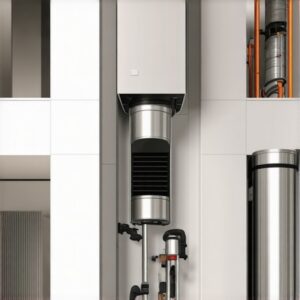
An HRV isn’t just a fan in a box. It’s a sophisticated heat exchanger. Inside that chassis, there is a honeycomb core—usually made of aluminum or specialized plastic—where two separate air streams pass each other. The stale, humid air from your basement is sucked out and pushed through the core. Simultaneously, fresh, cold air from outside is pulled in. These two streams never actually touch (so no, you aren’t breathing the exhaust), but they exchange thermal energy. The outgoing warm air ‘gives’ its heat to the incoming cold air. In a proper furnace tune-up services inspection, we look at the static pressure of this system. If your tin knocker didn’t size the ducts right, the HRV won’t move the ‘gas’ (the air) efficiently, and you’ll end up with a core that freezes over in the winter.
Think about the latent heat. When we talk about emergency heating repair, we’re usually dealing with sensible heat—the temperature you see on the thermostat installation. But mold lives for latent heat—the energy trapped in water vapor. An HRV strips that moisture out by constantly refreshing the air volume. If you’re running a church heating systems or a large residential basement, the volume of air you need to move is massive. Without an HRV, that moisture just sits on the floor joists until they start to get ‘fuzzy.’ I’ve seen homeowners try to fix this with a humidifier installation in the winter because the upstairs is dry, but they’re just feeding the beast in the basement. It’s a vicious cycle that usually leads to a 24/7 heating emergency response when the mold gets into the ductwork and triggers everyone’s allergies.
The ‘Sales Tech’ Trap and the Airflow Manifesto
I can’t tell you how many times I’ve followed a ‘Sales Tech’—those guys who wear clean uniforms and carry iPads but wouldn’t know a furnace flame sensor cleaning if it bit them—who tried to sell a customer a brand new $15,000 system because their basement ‘felt damp.’ They’ll tell you that you need SEER2 compliant upgrades to solve a comfort issue. That’s a load of garbage. If the ductwork is wrong, the most expensive compressor in the world won’t fix it. The most expensive equipment in the world cannot overcome a bad duct system, as the industry axiom goes. Real comfort comes from controlling the static pressure and the air exchange rate. When I’m checking a system, I’m looking for ‘Pookie’ (that’s mastic duct sealant for you laypeople) on every joint. If your HRV is leaking air into the attic instead of pulling it from the basement, you’re just burning money.
For those in the North, the danger of ice blocking the heat pump or the HRV intake during a polar vortex is real. This is why preventative HVAC repair tips for year-round efficiency always include checking your exterior hoods. If those hoods are clogged with dryer lint or snow, your HRV is struggling to breathe, your modulating furnace repair becomes more complex because the pressure switches are tripping, and the mold starts its slow creep across your drywall. It’s not magic; it’s physics. You have to balance the house. If you pull 200 CFM (Cubic Feet per Minute) out, you better be putting 200 CFM of tempered air back in, or you’re pulling air through the cracks in your foundation, bringing radon and moisture with it.
The Blueprint for a Dry Basement: Installation and Maintenance
If you’re considering an HRV, don’t just let some sparky wire it up to a switch. It needs to be integrated into your thermostat installation or a dedicated humidistat. We often see these units installed ‘stand-alone,’ which is fine, but for the best results, they should be interlocked with the furnace blower. This ensures that when the HRV is scrubbing the air, the furnace is distributing it. This is especially critical in church heating systems where the occupancy fluctuates wildly. When you have 300 people breathing in a basement hall, the CO2 and moisture levels skyrocket. An HRV handles that load without the furnace repair services guy having to come out because the heat exchanger cracked from the stress.
“Properly designed ventilation systems shall provide a minimum of 0.35 air changes per hour but not less than 15 CFM per person.” – ASHRAE 62.1
Maintenance is the other half of the battle. You can’t just ‘set it and forget it.’ I tell my customers that an HRV needs a ‘bath’ every six months. You pull the core, rinse it in the utility sink, and check the drains. If the condensate drain is plugged, that water is going right into the bottom of the cabinet, rusting out the housing and—you guessed it—growing mold inside the machine that’s supposed to stop it. It’s ironic, but I’ve seen it a hundred times. This is why furnace tune-up services should always include the ventilation equipment. If you want to know how to identify when furnace repair is urgent and why, look for water pooling under your HRV or furnace; that’s a red flag that your drainage system is failing how to identify when furnace repair is urgent.
Final Thoughts from the Attic
At the end of the day, an HRV is the unsung hero of the HVAC world. It doesn’t get the glory of a high-efficiency AC or the ‘wow’ factor of a smart thermostat, but it does the heavy lifting of keeping your home’s air from turning into a stagnant pond. If you’re tired of the basement funk and want to stop mold before it gets a foothold, stop looking at ‘magic’ sprays and start looking at your air exchange. For more on efficient HVAC repairs the blueprint for cooler summers and warmer winters, check out our guide efficient HVAC repairs. Don’t let a ‘Sales Tech’ talk you into a system you don’t need; focus on the airflow, seal your ducts with Pookie, and keep your ‘juice’ (refrigerant) where it belongs. Comfort isn’t a luxury; it’s the result of thermodynamics done right. If you need help getting your system balanced, you can always contact us for a real technician’s perspective contact us. Stay dry, stay warm, and for heaven’s sake, change your filters.