The Frustrating Sound of a Smart Home Losing Its Mind
You’re lying in bed at 3 AM, and instead of the steady, rhythmic hum of a well-balanced blower motor, you hear it: the repetitive, rhythmic ‘click-clack’ of a contactor trying to engage and failing. You check your phone, and the app says ‘Offline.’ Your $300 piece of wall jewelry has decided to quit talking to the router, and now your high-efficiency furnace installation is sitting idle while the house temp drops. This isn’t a ‘glitch’; it’s usually a failure of basic electrical physics. My old mentor used to scream at me in the back of a sweltering van, ‘You can’t cool what you can’t touch, and you can’t control what you can’t power!’ He was a ‘tin knocker’ from the old school who believed that airflow mattered more than horsepower, but he knew that if the controls were flaky, the most expensive evaporator coil in the world was just a hunk of copper and aluminum.
“The most expensive equipment in the world cannot overcome a bad duct system or an improperly configured control interface.” – Industry Axiom
The Forensic Diagnosis: Why Your WiFi Thermostat Keeps Dropping Out
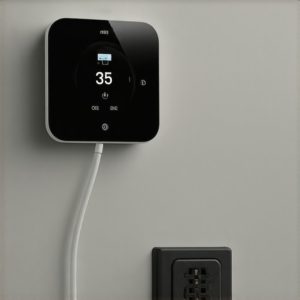
When I walk into a mechanical room and see a smart thermostat acting up, the first thing I look for isn’t the WiFi signal—it’s the ‘juice.’ Most homeowners and even some ‘Sparkies’ forget that these modern processors require a constant 24V AC power supply to keep the radio chip active. If your system was installed by someone cutting corners, they likely didn’t pull a ‘C-wire’ or Common wire. Without that dedicated return path to the transformer, the thermostat has to ‘power-steal’ from the heating or cooling circuits. This is like trying to run a marathon by sipping water through a needle; eventually, the capacitor inside the thermostat drains during a long cooling cycle, the WiFi chip dies to save power, and your connection drops. This is especially prevalent when dealing with heating service hacks that prioritize aesthetics over engineering. If your ‘gas’ (refrigerant) is flowing but the brain is dead, you’re stuck in the dark.
The Thermodynamic Reality of Airflow and Filtration
We often see connection drops coinciding with system stress. Let’s talk about MERV filter upgrades. Everyone wants hospital-grade air, but if you slap a MERV 13 filter onto a blower motor designed for a fiberglass ‘rock-catcher,’ you increase the static pressure. High static pressure leads to overheating, which can cause the limit switch on your furnace to trip. When that switch trips, it cuts power to the R-terminal. No R-terminal means no power to the thermostat. Suddenly, your WiFi drop isn’t a router issue; it’s an airflow issue. This is why we perform Manual J calculations and static pressure tests before recommending high-efficiency filtration. You have to understand the enthalpy of the air you’re moving. In humid climates, if the unit short-cycles because the thermostat is rebooting, you fail to remove the latent heat (humidity). The house stays at 72 degrees but feels like a Louisiana swamp because the evaporator coil never stayed below the dew point long enough to wring the water out of the air.
Solving the Signal vs. Shielding Conflict
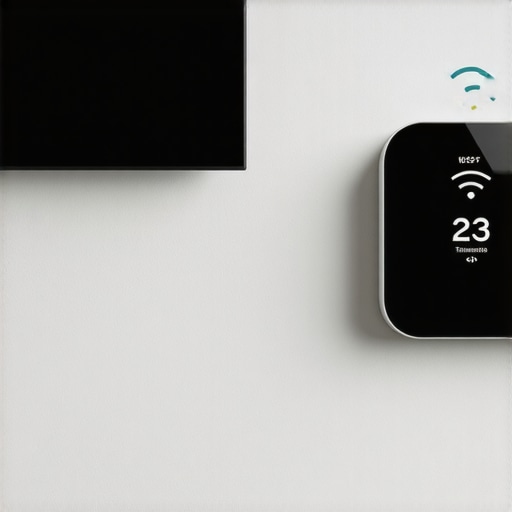
Mechanical rooms are often ‘Faraday cages’—metal ducts, foil-faced insulation, and heavy equipment that eat WiFi signals for breakfast. If your thermostat is mounted behind a return air drop or near a restaurant kitchen exhaust repair zone with heavy electrical interference, you’re going to lose the handshake between the device and the AP. For my clients, I often recommend programmable thermostat programming that includes a dedicated 2.4GHz SSID. The 5GHz band is fast, but it can’t punch through ‘Pookie’ (mastic) and sheet metal like the lower frequencies can. Furthermore, integrating energy recovery ventilators (ERVs) or occupancy sensor installation requires a robust control backbone. If the primary thermostat is flickering, the whole ‘climate orchestra’ goes out of tune.
“Proper sizing of HVAC equipment requires an accurate building load calculation. Over-sized equipment leads to poor humidity control and excessive cycling, which degrades control system stability.” – ACCA Manual J Standards
The Math: Repair vs. Replace
Is it worth fixing a flaky smart integration? A service call to run a new 18/8 thermostat wire might cost you $300 to $500, but compare that to the wear and tear on your compressor. Every time that thermostat drops and reboots, it might be bypassing the ‘short-cycle timer.’ If your compressor tries to start against high head pressure because it didn’t have time to equalize, you’re looking at a $3,000 burnout. I’ve seen evaporative cooler services and electric heater services fail prematurely simply because the ‘brain’ was sending rapid-fire signals due to low voltage. If you’re struggling with these issues, you need to look at top HVAC repair strategies that address the control circuit, not just the mechanicals. Whether it’s ventless gas heater services or a complex multi-zone setup, the wiring is the nervous system. Don’t let a ‘Sales Tech’ talk you into a whole new $15,000 unit when your problem is just a $20 transformer upgrade and a solid ‘C’ wire connection. For real diagnostics, it’s always better to contact us before the ‘suction line’ stops being ‘beer can cold’ and starts freezing up solid. Real comfort is physics, not magic, and it starts with a steady 24-volt heartbeat. “, “image”: {“imagePrompt”: “A close-up, high-detail photo of a master HVAC technician’s hands using a multimeter to test the 24V AC terminals on a modern smart thermostat baseplate. The background shows a dimly lit mechanical room with galvanized steel ductwork and blue ‘Pookie’ mastic sealant visible on the seams. The technician is wearing a work shirt with a name patch, and the multimeter display shows a clear 26.2 volts.”, “imageTitle”: “Testing Voltage on a Smart Thermostat”, “imageAlt”: “HVAC technician checking C-wire voltage with a multimeter to solve WiFi connection drops.”}, “categoryId”: 0, “postTime”: “”}