The Hidden Electrical Hazards in Your Older HVAC System
When most homeowners think about their heating and cooling systems, they think about comfort. They think about the cool breeze on a humid July afternoon or the warmth of the furnace during a January freeze. In the industry, we often see people treat HVAC systems like plumbing – it’s all about pipes, refrigerants, and airflow. But as a Licensed Master Electrician and HVAC Technician, I’m here to tell you that your HVAC system is, first and foremost, a high-voltage electrical appliance. In fact, it is likely the largest consumer of electricity in your entire home.
My name is Louis Elwood. I’ve spent decades in the crawlspaces, attics, and mechanical rooms of homes across the Pacific Northwest. I’ve seen the “pro” installations and the “weekend warrior” disasters. The reality is that if your home is more than 15 years old, your HVAC system might be harboring silent electrical hazards that could lead to more than just a breakdown – they could lead to a house fire. In this guide, we are going to dive deep into the invisible connection between your home’s wiring and your comfort system.
Why Older Homes Struggle with Modern HVAC Demands
The electrical landscape of the average American home has changed drastically over the last few decades. In the 1970s and 80s, a 100-amp electrical panel was considered standard, and for the time, it was plenty. You had a fridge, a few lights, a television, and maybe a basic air conditioner. Fast forward to today: we have high-powered computers, electric vehicle chargers, smart appliances, and sophisticated HVAC systems that demand precise power delivery.
Modern high-efficiency systems are marvels of engineering, but they have a specific appetite for power. When we talk about “inrush current,” we are talking about the massive surge of electricity required to get a compressor motor spinning from a dead stop. This is often referred to as Locked Rotor Amps (LRA). On an older system that is struggling with age, that LRA can spike significantly higher than its original rating. If your home is still running on an aged 100-amp service, that surge can put an immense strain on your entire electrical infrastructure.
This is where we often see the need for an electric panel upgrade Bothell WA. If your panel is original to a 20-year-old home, the bus bars may be corroded, or the breakers may have lost their “tension,” meaning they no longer trip when they should – or they trip far too often. An overloaded panel doesn’t just shut down; it generates heat. And in the world of electricity, heat is the enemy of safety.
The “Big Three” Warning Signs of HVAC Electrical Failure
You don’t need to be a licensed electrician to spot the early warning signs of a system in distress. Your home will usually try to tell you something is wrong before the smoke starts to rise. Here are the three most common symptoms I see in the field:
1. Flickering Lights When the Compressor Kicks In
Have you noticed that the lights in your living room dim for a split second when the AC starts up? This isn’t just a “quirk” of an old house. It is a sign of a significant voltage drop. When the compressor demands that massive inrush of current we discussed earlier, it pulls so much power that the rest of the house sees a temporary dip. While a tiny flicker is common in some older setups, a noticeable dimming suggests that your wiring or your capacitor is failing. This is exactly Why Flickering Lights When the AC Starts is a Job for an Electrician.
2. The AC Breaker Trips Periodically
A circuit breaker is a safety device designed to protect your home from fire. If it trips, it’s doing its job. However, many homeowners treat a tripped breaker like a nuisance, flipping it back on and going about their day. If your Why Your AC Breaker Trips Every Time the Compressor Tries to Start is a recurring issue, you have a serious problem. It could be a grounded compressor, a failing fan motor, or a “weak” breaker that has been heat-damaged over time. Repeatedly resetting a breaker that is protecting a faulty HVAC unit is a recipe for an electrical fire.
3. The Smell of Ozone or Burning Plastic
If you ever smell something metallic or like burning electronics near your indoor air handler or outdoor condenser, shut the system off at the thermostat and the breaker immediately. This is often the result of “arcing.” Arcing occurs when electricity jumps across a gap in a wire or a loose connection. It generates temperatures hot enough to melt copper and ignite surrounding insulation. If you catch this early, you might just need a new contactor or a wire repair. If you wait, you’re looking at a full system replacement or worse.
The Silent Danger: The Outdoor Disconnect Box
One of the most neglected components of any HVAC system is the outdoor disconnect box. This is the small metal box mounted to the side of your house near the AC unit. Its job is to provide a way to manually cut power to the unit for servicing. Because it’s outside, it is subjected to extreme temperature swings, humidity, and even nesting insects.
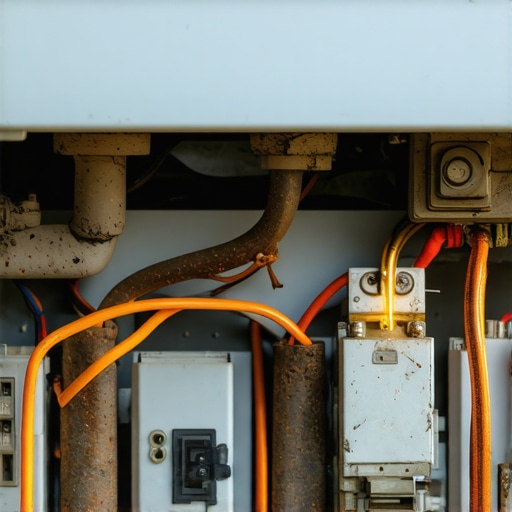
Over time, the lugs (the screw-down terminals that hold the high-voltage wires) can loosen due to thermal expansion and contraction. When a connection is loose, it creates resistance. In electrical terms, Resistance = Heat. I have opened hundreds of these boxes only to find charred wires and melted plastic. Understanding Why your outdoor AC disconnect box is melting and how to stop it is vital for long-term home safety. Often, the wires have oxidized so badly that they are barely making contact, forcing the AC unit to “starve” for voltage, which in turn destroys the expensive compressor motor inside the unit.
Beyond loose lugs, moisture is a major factor. If the weather stripping on that box fails, rainwater can seep in, leading to corrosion and “tracking,” where electricity begins to find paths across the surface of the insulation. This is a silent killer of HVAC systems.
The SEER2 Transition and Electrical Compatibility
The HVAC industry recently underwent a major shift with the implementation of SEER2 (Seasonal Energy Efficiency Ratio 2) standards. These regulations require new units to be significantly more efficient than those built just a decade ago. While this is great for your energy bill and the environment, it introduces new electrical complexities.
Many of these new high-efficiency units utilize “inverter technology.” Instead of the motor being either “on” or “off,” it ramps up and down slowly. These systems use sensitive circuit boards that are much more prone to damage from “dirty power” or voltage surges than the “dumb” mechanical systems of the past. When you hire HVAC installers, you must ensure they understand the electrical requirements of these modern machines. It’s not just about hooking up two hots and a ground anymore.
In many cases, Why Your High-Efficiency AC Installation Requires a Dedicated Electrical Circuit becomes the primary focus of an upgrade. If your old unit shared a circuit or had undersized wiring, the new SEER2 unit may throw error codes or suffer premature board failure. Furthermore, you need to be aware of The Truth About SEER2 Compliance and Your Home Warranty; if the electrical installation isn’t up to code, the manufacturer may deny your warranty claim when that expensive inverter board fries during a summer storm.
The Physics of Failure: Blower Motors and Contactors
Inside your home, the blower motor in your furnace or air handler is working just as hard as the compressor outside. These motors are often the first things to go in an aging system. As bearings wear down, the motor has to work harder to spin the fan, which increases the amperage draw. This extra heat can eventually melt the insulation on the motor windings.
Knowing How to Spot a Failing Blower Motor Before it Smokes can save you thousands in emergency repairs. Listen for high-pitched squealing or a “humming” sound when the fan tries to start. These are signs that the capacitor (the “battery” that gives the motor a kick-start) is failing or the motor itself is seizing.
Then there is the contactor. Think of the contactor as a heavy-duty relay that acts as the bridge between your thermostat and the high-voltage power. Every time your AC turns on, this mechanical switch slams shut. Over thousands of cycles, the metal points (contacts) become pitted and charred. This creates “pitting,” which increases resistance and can eventually cause the contacts to weld together. If they weld shut, your outdoor unit will keep running even when the thermostat says “off,” potentially freezing your coils and destroying your compressor.
DIY Hazards: Why “Just Changing a Fuse” is Dangerous
I get it – everyone wants to save a buck. But when it comes to HVAC electrical systems, DIY is a dangerous game. One of the most common mistakes I see is homeowners replacing a blown fuse in the disconnect box with a larger fuse, or worse, a piece of copper pipe (yes, I’ve seen it).
A blown fuse is a symptom, not the problem. If a 30-amp fuse blows, it’s because the circuit drew more than 30 amps. By putting in a larger fuse, you are allowing the circuit to carry more current than the wires are rated for. The wires will become the fuse, melting inside your walls where you can’t see them.
Another hazard is the “single pole contactor.” In many older or cheaper units, the contactor only breaks one side of the 240-volt circuit. This means that even when the unit is off, one of the power legs is still “hot” to the ground. If an untrained homeowner starts poking around inside the cabinet thinking the power is off because the fan isn’t spinning, they can receive a lethal shock. This is why electrical work should always be left to a pro who understands the specific schematics of HVAC equipment.
Your HVAC Electrical Safety Checklist
As we wrap up, I want to give you a few actionable steps to ensure your home stays safe. Don’t wait for a heatwave to find out your system is a fire hazard. Use this checklist to evaluate your older HVAC system:
- Check the Panel: Open your electrical panel. Do you see any signs of “sooting” or discoloration around the HVAC breaker? Feel the breaker (carefully) – it should not be hot to the touch.
- Listen to the Start-up: Stand near your outdoor unit when it starts. If you hear a loud “clunk” followed by a struggle to turn over, your start capacitor may be failing, putting extra stress on your wiring.
- Inspect the Disconnect: Look at the box on the side of your house. Is it rusted? Is the conduit (the whip) leading to the AC cracked or brittle? If the “guts” of the box look melted, call an expert immediately.
- Monitor Your Lights: If your lights dim significantly when the AC starts, you likely have a voltage drop issue that needs to be addressed at the panel or the unit.
Your HVAC system is a complex marriage of thermodynamics and high-voltage electricity. Don’t let an outdated electrical setup turn your comfort system into a liability. If you have any doubts about the safety of your wiring, contact an electrician HVAC expert Mill Creek WA. A professional inspection can identify loose connections, failing components, and code violations before they lead to an expensive – or tragic – failure. Stay cool, stay warm, but most importantly, stay safe.