The Chemistry of Destruction: Why Your Spa is Eating Its Own Heart
My old mentor used to scream, ‘You can’t cool what you can’t touch!’ while we were dragging 80-pound compressors across gravel rooftops in the mid-August heat. He wasn’t just talking about airflow over an evaporator coil; he was talking about the fundamental physics of heat transfer. Whether it is a 5-ton AC installation or a high-efficiency spa heater, the laws of thermodynamics are indifferent to your comfort. If the medium—be it air or water—cannot properly interact with the heat exchanger, the system will eventually self-destruct. In the world of pool and spa heating, water chemistry is the silent assassin. I have seen 2025-ready, high-efficiency heaters reduced to scrap metal in less than six months because the owner thought a few pH strips were optional. You might be worried about SEER2 compliant upgrades for your home, but if your spa’s water chemistry is off, you’re literally pumping acid through your investment.
“The most expensive equipment in the world cannot overcome a bad duct system.” – Industry Axiom
This axiom applies to water systems too. A spa heater is essentially a boiler’s smaller, more temperamental cousin. When we talk about commercial furnace repair or even church heating systems, we focus on scale and soot. In a spa, we deal with the Langelier Saturation Index (LSI). If your water is ‘hungry,’ it will pull the copper right out of your heat exchanger tubes to satisfy its chemical imbalance. Here are the three undeniable signs that your spa heater is failing due to poor water chemistry, diagnosed from the perspective of a guy who has spent three decades in the trenches.
1. The ‘Copper Penny’ Aroma and Heat Exchanger Pitting
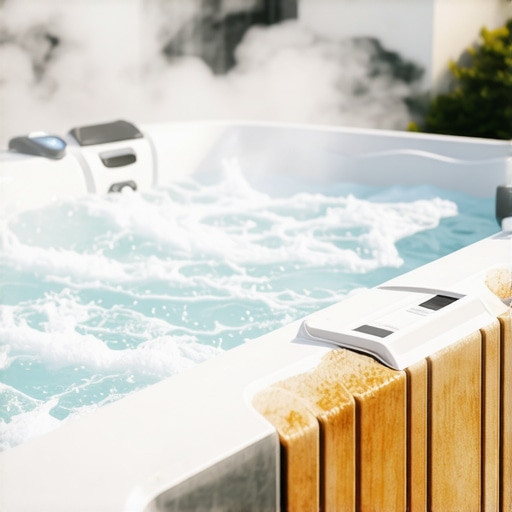
If you lift the cover of your spa and catch a metallic, sour scent, you aren’t smelling ‘clean’ water; you’re smelling the slow dissolution of your heat exchanger. When the pH drops below 7.2, the water becomes acidic. This acidity attacks the copper heat exchanger, a process known as ‘cupro-solvency.’ In my 30 years, I’ve seen heat exchangers that looked like Swiss cheese. The thermodynamic zooming here is critical: the acidic water creates microscopic pits on the surface of the copper. This reduces the surface area available for heat transfer and eventually leads to a breach where the pool water enters the combustion chamber. This isn’t just a repair; it’s a total system failure. You’ll need a leak detector integration to catch this early, but usually, by the time you smell it, the damage is done. This is why choosing the right HVAC fixes often starts with preventative chemistry, not just mechanical parts. Choosing the right HVAC fixes requires understanding that your heater is a chemical reactor as much as a mechanical one.
2. High-Limit Tripping and the Screech of Calcium Scale
On the flip side of acidity is alkalinity. If your pH is too high, calcium begins to precipitate out of the water. Imagine the arteries of a heart clogging with cholesterol; that is what scale does to your heater’s internal tubing. You’ll start hearing a high-pitched whistling or ‘kettling’ sound—that’s the sound of water boiling inside the heat exchanger because the scale is preventing the heat from transferring into the bulk water. The ‘Sparky’ (electrician) might tell you it’s a transformer replacement issue or a bad sensor, but a seasoned tech knows that the control board is just doing its job. The control board diagnostics will show a ‘High-Limit’ error because the internal temperatures are skyrocketing while the spa water stays cold. This is thermodynamic insulation at its worst. Just as we use Manual J calculations to size a home system, the heater’s flow rate must be matched to its thermal output. Scale ruins that balance. If you’re seeing these errors, it’s a sign that furnace repair is urgent before the heat exchanger cracks from thermal stress.
3. Sooting and Flame Rollout: The Silent Fire Hazard
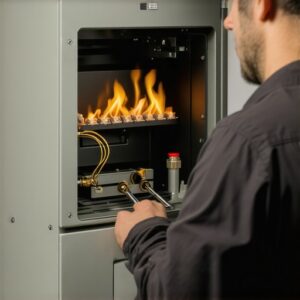
When the heat exchanger gets coated in scale, it doesn’t just affect the water side; it affects the fire side. The copper fins become clogged with soot because the heat cannot escape into the water. This causes the flames to ‘roll out’ of the combustion chamber, searching for oxygen. I’ve walked onto commercial jobs where the plastic demand-controlled ventilation sensors were melted because of flame rollout. This is a massive safety risk. If you see black soot on the top of your heater or smell an acidic/sour exhaust, shut it down. You’re looking at more than just a transformer replacement; you’re looking at a potential fire. In these cases, financing for heat pump installs might be a better long-term play than trying to salvage a soot-choked gas heater.
“Equipment shall be installed in accordance with its listing and the manufacturer’s instructions and shall conform to applicable regulations.” – EPA Section 608 / ASHRAE Standards
In humid climates like Houston or Florida, the ‘Monsoon Effect’ can worsen this by adding moisture to that soot, creating a corrosive paste that eats the cabinet from the inside out. This is why airflow in the equipment room is king. If you don’t have proper ventilation, your heater is gasping for air while drowning in its own chemicals. Always check your AC installation standards even for pool heaters—clearances matter. For more on high-stakes mechanical failures, see the AC installation secrets that most sales techs won’t share. Proper maintenance isn’t a ‘scam tune-up’; it’s the only thing standing between you and a $5,000 replacement bill.
The Forensic Verdict
Don’t let a ‘Sales Tech’ convince you that a failing heater is just ‘old age.’ If it’s five years old and the heat exchanger is pitted, the water chemistry killed it. Check your pH, keep your LSI between -0.3 and +0.3, and make sure your ‘Tin Knocker’ (duct guy) or pool tech has actually checked the gas pressure. Whether you are managing church heating systems or a backyard spa, physics doesn’t take a day off. If you need help diagnosing a complex failure or are looking for SEER2 compliant upgrades to your overall home climate system, reach out to a veteran who knows the difference between a bad capacitor and a dead compressor.