The Ghost in the Ductwork: Why Your Fan Won’t Quit
There is a specific kind of silence in a house during a Chicago winter that only an HVAC vet recognizes. It is the silence that should be there when the setpoint is reached, but instead, you hear that low-frequency hum of a blower motor that refuses to die. You check the thermostat. It says ‘System Off.’ You check the furnace. The burners are cold, but the air is still pushing through the registers. Most homeowners think it’s a minor quirk, but after 30 years of crawling through crawlspaces and smelling scorched transformers, I know better. You’re likely dealing with a stuck furnace relay, a component no bigger than a pack of cards that can hike your electric bill and kill your blower motor before the season is out.
The Mentorship Lesson: Airflow is the Alpha and Omega
My old mentor, a man who could diagnose a bad TXV from three rooms away just by the sound of the liquid line, used to scream at me, ‘You can’t heat what you can’t touch!’ This wasn’t just about dirty filters. It was about the physics of the entire air-handling sequence. He taught me that the furnace is a calculated dance of pressures and temperatures. If the relay sticks and the blower runs indefinitely without the burners on, you aren’t just wasting ‘juice’ (electricity); you are stripping the sensible heat right out of the room and moving it back into the cold return-air drops. You’re essentially running a giant, expensive fan that’s doing nothing but making your house feel drafty and dry.
“The blower motor shall be capable of delivering the required airflow against the external static pressure of the duct system to ensure heat exchanger longevity.” – ASHRAE Standard 6.2 Adaptation
The Forensic Anatomy of a Stuck Relay
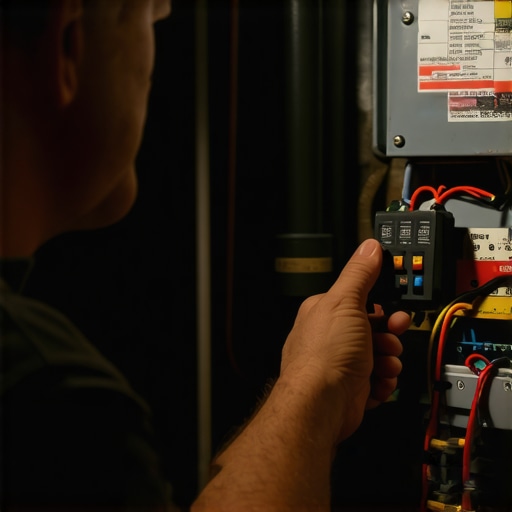
To understand why this happens, we have to look at the ‘brain’ of your system. Inside your furnace cabinet—behind that panel that probably hasn’t been opened since the last urgent furnace repair—is the integrated furnace control (IFC) board. On that board, or sometimes as a standalone component, is the relay. Think of it as a gatekeeper. When the thermostat sends 24 volts down the ‘G’ wire (the fan wire), it creates an electromagnetic field in the relay. This pulls a set of high-voltage contacts closed, allowing 120 volts to rush into the blower motor. Carbon tracking is the enemy here. Every time those contacts snap shut, a tiny spark occurs. Over ten years, that sparking creates pits and ‘pookie-like’ carbon buildup until one day, the contacts weld themselves shut. Now, even when the 24V signal disappears, the high-voltage gate stays open. The fan is now a zombie—it’s ‘on’ but the brain is dead.
The Troubleshooting Protocol: Is it the Relay or the ‘Sparky’ Next Door?
Before you go assuming you need a high-efficiency furnace installation, we need to isolate the failure. First, go to your thermostat. Is the fan switch set to ‘On’ instead of ‘Auto’? Don’t laugh—I’ve charged a $150 diagnostic fee more times than I can count just to flip a switch for a sheepish homeowner. If it’s on ‘Auto’ and the fan is still screaming, pull the thermostat off the wall. If the fan stops, your thermostat is the culprit, likely needing thermostat wiring upgrades or a fresh smart thermostat setup. If the fan keeps running with the thermostat completely disconnected, the ‘gas’ is being fed to the motor directly from a welded relay on the board.
Thermodynamic Zooming: The Risk of Ignoring the Relay
When a relay sticks, it’s not just an annoyance. In a cold climate, a blower that runs 24/7 without heat can actually drop the temperature of the heat exchanger below the dew point of the surrounding air if there’s any humidity present. This causes condensation on the metal. Condensation on a heat exchanger leads to rust, and rust leads to cracks. A cracked heat exchanger is a death sentence for a furnace because it leaks carbon monoxide into your living space. This is why preventative HVAC repair isn’t just a sales pitch—it’s a safety requirement. I’ve seen ‘Sales Techs’ ignore a stuck relay just to wait for the heat exchanger to fail so they can sell a whole new unit. That’s garbage. You fix the relay to save the system.
“Failure of the fan control to de-energize can lead to excessive motor wear and unintended infiltration of unconditioned air.” – ACCA Manual S
Repair vs. Replace: The Cold Hard Math
If you have an older furnace with a standalone relay, you’re looking at a cheap fix—maybe $30 for the part and an hour of labor. But if you have a modern unit, that relay is soldered onto a complex circuit board. You can’t just swap the relay; you have to swap the whole board, which can run $500 to $800. If your furnace is pushing 15 years old and has an 80% AFUE rating, you might start looking at efficient HVAC repairs versus the long-term savings of an Energy Star heating certification unit. But don’t let a ‘Tin Knocker’ talk you into a ductless mini-split installation if your existing ductwork is solid. Comfort is physics, not a trend.
The Verdict
A furnace relay stuck in the ‘on’ position is a mechanical ‘seizure’ of your system’s lungs. It’s a sign that your components are reaching their duty-cycle limit. If you’re hearing the fan run right now, go check that thermostat. If it’s on ‘Auto’ and the air is blowing cold, call a real tech—not a salesman. For more on what to look for, check out these furnace repair myths to stay informed. Don’t let a $50 part turn into a $10,000 headache because you ignored the sound of the ghost in your ducts.