The High-Stakes Gamble of Skipping Your Annual Heating Service
My old mentor, a man who had ‘Tin Knocker’ tattooed on his forearm before most of today’s tech-bros were born, used to scream at me while we were wedged into freezing crawlspaces: ‘You can’t heat what you can’t touch!’ He wasn’t talking about physical contact with the furnace cabinet; he was talking about the boundary layer of air on the heat exchanger. If your heating service isn’t looking at the molecular reality of heat transfer, they are just playing house. He taught me that airflow is the blood of the system, and a furnace is just a heart that will have a coronary if you don’t keep the arteries clear. Most people treat their HVAC system like a toaster—they expect it to work every time they push the button. But a furnace is a controlled explosion inside a metal box. Skipping an inspection isn’t ‘saving money’; it is a high-stakes bet against the laws of thermodynamics, and in the North, the house always wins when the temperature drops to sub-zero.
The Forensic Diagnosis: Anatomy of a Heating System
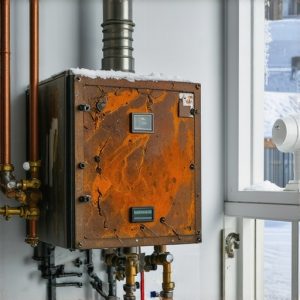
When I walk up to a unit, I’m not looking for a sales opportunity. I’m looking for a crime scene before the crime happens. We start with the control board diagnostics. Modern boards are like the brain of the operation, logging every ‘heart flutter’ the system experiences. If I see a recurring code for a limit switch replacement, I know we have an airflow problem that is cooking the internals. The limit switch is a safety device designed to shut down the gas valve if the internal temperature exceeds safe parameters. If that switch trips, it’s usually because the blower motor replacement you’ve been putting off has finally led to a total lack of convection across the heat exchanger. [IMAGE_PLACEHOLDER] When that happens, the metal expands and contracts too rapidly, leading to the ultimate death sentence: a cracked heat exchanger. This is where the gamble turns deadly, as combustion byproducts like carbon monoxide can leak into your breathing air.
“Proper maintenance is the primary defense against heat exchanger failure and carbon monoxide leakage.” – ASHRAE Standard 155P
Thermodynamic Zooming: How Cold Climate Heat Pumps Actually Work
For those of you moving toward cold climate heat pumps, the physics change but the stakes remain high. In a traditional AC, we move heat out. In a cold climate heat pump, we are scavengering heat from the outside air even when it feels like a polar vortex. This requires a ‘Flash Injection’ or Enhanced Vapor Injection (EVI) circuit. If your service tech doesn’t understand how to check the subcooling on an EVI circuit, they shouldn’t be touching your unit. These systems rely on inverter-driven compressors that modulate their speed to match the load. If your static pressure testing shows that your ductwork is too restrictive, that expensive inverter will work itself to death trying to overcome the resistance of a ‘pinched artery’ duct system. This is why I tell people that the ‘Gas’ or ‘Juice’ (refrigerant) is only half the story; if the air can’t move, the heat can’t go anywhere. You end up with a high-tech brick sitting on your pad.
The Airflow Manifesto and the Blower Motor’s Burden
The blower motor is the hardest-working component in your home. It’s the ‘Sparky’ of the mechanical world, turning electrical energy into kinetic movement. If you’ve been skipping your heating service, your blower wheel is likely coated in a layer of ‘fuzz’ that reduces its aerodynamic efficiency. This leads to a higher amp draw and eventual motor burnout. During a real inspection, we don’t just look at the motor; we perform static pressure testing. We use a manometer to measure the resistance of the air as it enters and leaves the furnace. If that pressure is too high, it’s like trying to breathe through a straw while running a marathon. You can find more about the technical side of these repairs in our guide on how to identify when furnace repair is urgent and why. We often find that a simple cleaning or a minor adjustment to the ‘Pookie’ (mastic) on the plenum can save a motor from an early grave.
“The most expensive equipment in the world cannot overcome a bad duct system.” – Industry Axiom
The Invisible Enemy: Latent Heat and Heat Recovery Ventilators
In the North, we seal our houses tight to keep the heat in. But a tight house is a sick house without proper ventilation. This is where heat recovery ventilators (HRVs) come in. An HRV is a thermodynamic marvel—it takes the stale, warm air from your bathroom and kitchen and passes it through a heat exchange core. Simultaneously, it brings in fresh, sub-zero air from outside. The two streams never mix, but the warmth from the outgoing air is transferred to the incoming air. If your HRV filters are clogged, you’re losing that efficiency and increasing the load on your primary heater. It’s one of those heating service hacks for comfort and savings in 2025 that most people overlook until their windows start dripping with condensation and mold starts growing in the corners.
Fireplace Inserts and the Backdrafting Risk
Many homeowners use fireplace insert services to add supplemental heat. While a cozy fire is great, it can create a ‘house depressurization’ scenario. If your fireplace is sucking air out of the house and your furnace is trying to vent combustion gases, the fireplace might actually win the ‘tug-of-war,’ pulling carbon monoxide back down the furnace flue. This is why a comprehensive heating service must look at the whole house as a single pressure vessel. We check the ‘Flame Rollout’—if the burners look like they are dancing or reaching out toward the cabinet, you have a pressure or venting issue that needs immediate attention. You can read about more furnace repair myths debunked by industry experts to understand why ‘it worked fine last year’ is the most dangerous phrase in HVAC.
Protecting Your Investment with Priority Service Memberships
The best way to avoid the ‘July 4th Panic’ (or in the North, the ‘New Year’s Eve Freeze’) is to get on a schedule. Priority service memberships aren’t just a way for us to keep busy; they are a way to ensure your system is ‘Beer Can Cold’ in the summer and ‘Toaster Warm’ in the winter without the emergency surcharge. Plus, professional techs can provide rebate application assistance. In 2025, there are thousands of dollars available for upgrading to high-efficiency equipment, but the paperwork is a nightmare. We handle that because we know which AFUE ratings qualify for which credits. Don’t leave money on the table because you didn’t want to pay for a tune-up. To keep your system running for twenty years instead of ten, check out these top hvac repair strategies to extend your systems life. In the end, HVAC is just physics and sweat. Don’t gamble with either.