The Brain is Only as Good as the Nervous System
I’ve spent three decades crawling through blown-in insulation and balancing on sun-baked parapet walls, and if there’s one thing that keeps me awake at night, it’s the sight of a $400 smart thermostat wired to a system that’s wheezing for air. Homeowners think they’re buying a magic wand. They see the slick interface and the AI-driven HVAC optimization marketing, and they assume it’ll fix a twenty-year-old compressor that’s screaming for mercy. It won’t. My old mentor used to stand over a condenser, sweat dripping off his chin, and holler, ‘You can’t cool what you can’t touch!’ He was talking about the boundary layer of air on the evaporator coil. If your smart thermostat doesn’t understand the physics of your home, it’s just an expensive wall ornament. In the Southwest, where the dry bulb temperature hits 115°F before lunch, the margin for error is zero. You aren’t just fighting heat; you’re fighting sensible heat loads that will cook a capacitor in a single afternoon. If you’re messing with your setup without understanding static pressure or the specific needs of hyper-heat heat pumps, you’re setting yourself up for a service call that costs more than the gadget you just installed.
“The most expensive equipment in the world cannot overcome a bad duct system.” – Industry Axiom
The ‘C-Wire’ Ghosting and the Power Robbery
The most common amateur move I see involves the common wire, or the ‘C-wire.’ Modern thermostats are power-hungry little computers. They need constant juice to keep the Wi-Fi connected and the screen glowing. Many old four-wire bundles don’t have a dedicated common. I’ve seen ‘Sparky’ wannabes try to jump the G-terminal to the C-terminal just to get the thing to power up. Sure, the screen turns on, but now you’ve lost independent fan control. Or worse, the thermostat tries to ‘power steal’ from the cooling circuit. This pulses the contactor, making it chatter like a set of false teeth in a blender. That chatter burns the points on the contactor and, eventually, kills the transformer. If you’re moving toward heating service innovations transforming 2025 climate control, you need a solid 24V foundation. Without it, your ‘smart’ tech is just a liability. If your air handler repair was done recently and they didn’t pull a new wire, they did you a disservice. A system that can’t reliably signal its components is a system that’s going to fail during the first heatwave of July.
Location: Why Your Thermostat is Lying to You
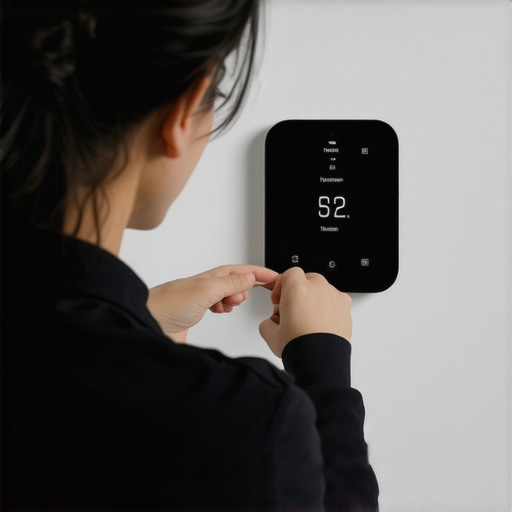
I once walked into a house where the owner complained the AC never shut off. The thermostat was mounted right next to the kitchen pantry, three inches from the wall where the refrigerator’s condenser fan blew hot air every time the compressor kicked on. The thermostat thought the house was 85 degrees while the living room was a meat locker. Smart thermostat setup requires more than just screwing it into the old holes. You have to consider draft, sunlight, and internal heat gains. If you’ve got an evaporative cooler service running in the background, the humidity shift alone can throw off some of the more sensitive AI-driven HVAC optimization algorithms. You need a location that represents the average ‘dead air’ of the home. I’ve seen guys put them right under a supply register. The second the ‘gas’ (refrigerant) starts flowing and the coil gets cold, the thermostat feels that 55-degree air and shuts the system down before the rest of the house even knows the AC is on. We call that short-cycling, and it’s the fastest way to kill a compressor since R-22 was the king of the hill.
“Design shall be based on the heating and cooling loads of the space to be conditioned, determined in accordance with ACCA Manual J.” – ASHRAE Standard 62.1
Thermodynamic Zooming: Latent vs. Sensible Heat
In the Southwest, we deal with sensible heat—the heat you can feel on a thermometer. But don’t think you’re exempt from latent heat (humidity) issues, especially during the monsoon. A smart thermostat that isn’t configured for your specific blower speed can’t manage the dew point. When you install expert tips for 2025 success, you have to look at the SEER2 compliant upgrades. These new units are designed to run longer, slower cycles to wring the moisture out of the air. If you set your smart thermostat to ‘aggressive’ cooling, it might cycle the unit too fast. You’ll hit the setpoint, but the house will feel like a swamp because the evaporator coil never stayed below the dew point long enough to drain the condensate. This is why efficient HVAC repairs often involve more than just swapping parts; they involve re-programming the brain to respect the laws of thermodynamics. If you have a biomass boiler service or a complex hybrid system, the ‘out of the box’ settings on a Nest or Ecobee are almost certainly wrong. They don’t know your house has a high thermal mass or leaky ducts.
The Airflow Manifesto: Why AI Can’t Fix Tin
Everyone wants to talk about ‘AI-driven HVAC optimization,’ but AI can’t fix a crushed return duct or a ‘tin knocker’ who didn’t use enough ‘Pookie’ (mastic) on the joints. If your smart thermostat is demanding 100% capacity from a heat pump replacement but your ducts are sized for a unit from 1985, you’re going to hit a high-limit switch. I’ve seen smart setups that ramp up the fan speed to the max because they can’t reach the temperature fast enough. High static pressure is the silent killer. It puts a load on the blower motor that eats electricity and burns out windings. This is where airflow measurement services come in. You need to know if your system can actually deliver the CFM (cubic feet per minute) the thermostat is asking for. If you’re ignoring heat recovery ventilators in your setup, you’re also missing out on the efficiency of fresh air exchange. A smart thermostat should be the conductor of an orchestra, but if the violin strings are made of kite string (cheap, leaky ducts), the music is going to be terrible. I always tell customers to spend the money on sealing the plenum before they spend it on the fancy touchscreen.
Common Configuration Disasters
The worst mistake is not telling the thermostat what kind of ‘juice’ it’s controlling. I’ve seen people set up a smart thermostat for a standard electric furnace when they actually have a hyper-heat heat pump. In the winter, the thermostat thinks it needs to kick on the ‘Aux’ heat (the expensive electric toaster strips) the second the temp drops two degrees. That’s a $400 monthly mistake. A proper setup involves diving into the installer settings—not the homeowner ones—to set the lockout temperatures. You want that heat pump running as long as possible because it’s four times more efficient than the strips. Same goes for those with preventative HVAC repair plans. You have to ensure the thermostat knows the difference between an air handler repair and a full system overhaul. If you don’t calibrate the internal thermometer, you’re also flying blind. I’ve seen brand-new units that were off by four degrees right out of the box. I always pull out my NIST-calibrated probe to check. If the thermostat says 72 but the probe says 76, your AI optimization is based on a lie. For more help, you can always contact us to get a tech who actually knows how to use a multimeter. Don’t let a bad setup turn your SEER2 compliant upgrades into a SEER10 nightmare. Modern HVAC is a game of inches, and the thermostat is the most important inch of all.