The Thermodynamic Reality of Warm Toes
Most folks think comfort is just a number on a wall, but after thirty years of crawling through spider-infested joist spaces, I can tell you that comfort is a matter of surface temperature and thermal mass. When you talk about retrofitting radiant floor heating into a house that wasn’t built for it, you’re not just talking about a weekend DIY project; you’re talking about a battle against the second law of thermodynamics. You want to know if it’s possible? Yes. Is it easy? Not if you’re doing it right. I’ve seen enough ‘handyman’ radiant jobs that ended up as nothing more than expensive floor-warmers that couldn’t keep a room above sixty degrees in a light frost. Most ‘Sales Techs’ will tell you to just slap some electric mats under a rug and call it a day, but they’re just looking for a commission. Real HVAC repair and system design require understanding how heat moves through solids versus air.
The Physics Lesson: Sarge and the ‘Touch’ Principle
My old mentor, a man we called Sarge because he treated every mechanical room like a battlefield, used to scream at me, ‘You can’t heat what you can’t touch!’ I was twenty-two, shivering in a Chicago basement, trying to understand why a massive boiler wasn’t keeping the second floor warm. Sarge grabbed my hand—literally shoved it against a cold radiator—and barked, ‘Air is a lazy insulator, boy. If you want to move BTUs, you need mass.’ This is the core philosophy behind radiant heating. Unlike a traditional furnace that just blows hot air (which immediately rises to the ceiling where nobody lives), radiant floors turn your entire floor into a low-temperature radiator. It’s about sensible heat. We aren’t just heating the air; we are heating the objects in the room. This is why heating service innovations are moving back toward these old-school physics principles, just with better tech.
“Radiant heating systems shall be designed and installed in accordance with the heat loss requirements of the structure as determined by ACCA Manual J or other approved methods.” – ACCA Manual J Standard
The Anatomy of a Retrofit: The Three Paths
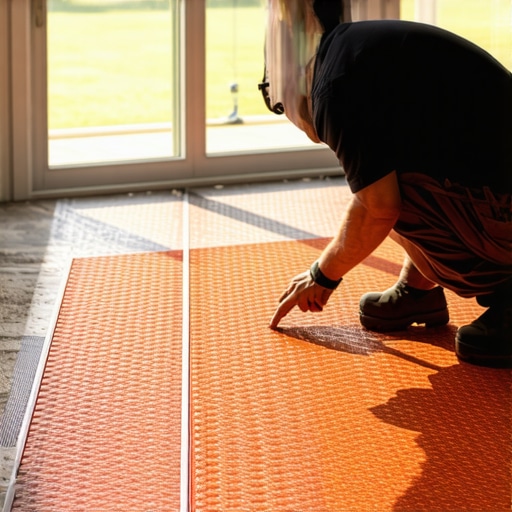
When you decide to pull the trigger on a retrofit, you have three main avenues. The first is the ‘Above-Subfloor’ method. This is where we add thin panels or sleeper tracks on top of your existing subfloor. It raises your floor height by about half an inch to an inch. If you’ve got the headroom and don’t mind trimming your doors, this is the most efficient for heat transfer. The second is the ‘Below-Joist’ or ‘Staple-Up’ method. This is where I spend my time—wedged in a crawl space, stapling PEX tubing to the underside of your floorboards. It’s non-invasive for your living room but requires serious crawl space heating solutions like heavy-duty insulation to force the heat up through the wood, rather than losing it to the dirt below. The third is the Electric Mat. These are great for a small bathroom, but for a whole-house solution? Your electric bill will look like a phone number. For whole-house comfort, hydronic (water-based) is the only way to fly.
[image_placeholder_1]
The Climate Factor: Managing the Polar Vortex
In the North, where the frost line is deeper than most people’s retirement accounts, we deal with extreme Delta T (the difference between inside and outside temperatures). If your home has a cracked heat exchanger or a failing steam boiler, you might think radiant is the magic fix. But here’s the kicker: radiant systems have a massive ‘thermal lag.’ They take hours to warm up. If you live in a place where the temperature drops forty degrees in three hours, you need more than just floor heat. This is where hyper-heat heat pumps come in as a secondary stage. You use the radiant for your ‘base load’—keeping the house at a steady 65—and use the heat pump to handle the peaks. This prevents the ‘overshoot’ problem common with programmable thermostat programming in high-mass systems.
The Boiler and Chimney Nexus
If you’re going hydronic, you need a heat source. If you have an existing boiler, we need to talk about hotel boiler services or professional grade residential units. You cannot just pipe 180-degree water from a steam boiler into PEX tubing; you’ll melt the floor finish or crack the tubing. We use mixing valves to drop that ‘juice’ down to a safe 100-110 degrees. Furthermore, if you’re upgrading to a high-efficiency condensing boiler to run your radiant floor, you might need a chimney liner installation. These new units exhaust much cooler gases than old-school atmospheric boilers. Without a proper liner, that moisture will condense inside your brick chimney and eat the mortar from the inside out. I’ve seen chimneys collapse because a ‘Sales Tech’ forgot that one little detail.
“Proper venting of category IV appliances is critical to prevent carbonic acid damage to masonry structures.” – ASHRAE Standards
The ‘Tin Knocker’s’ Perspective on Air Quality
Even with the best radiant floor, you still need air movement. Why? Because floors don’t filter air. You still need a robust furnace filter replacement schedule for your air handler or HRV system. I’ve walked into ‘pristine’ radiant homes that smelled like a locker room because there was zero air exchange. And don’t forget the ‘Pookie’—that’s duct mastic for you civilians. If you have any ductwork for cooling or supplemental heat, it needs to be sealed tighter than a submarine. Air leaks are just lost money. Whether it’s a garage heater installation or a whole-home setup, the seals matter more than the brand name on the box.
The Verdict: Is It Worth It?
Retrofitting radiant is a high-cost, high-reward move. It’s for the homeowner who plans to die in that house. It’s for the person who hates the sound of a blower motor kicking on at 3 AM. But if you’re doing it, do it right. Don’t let some ‘Sparky’ tell you he can wire up a whole house with electric cable without checking your service panel. Don’t let a plumber who doesn’t know Manual J sizing slap a boiler in your basement. Check our top HVAC repair strategies and ensure your system is built on physics, not fluff. If you need a hand figuring out if your crawl space can handle a staple-up system, or if you’re dealing with a system that’s all ‘gas’ and no heat, it might be time to contact us. Real tech, no sales pitch. Just the cold, hard truth about staying warm.