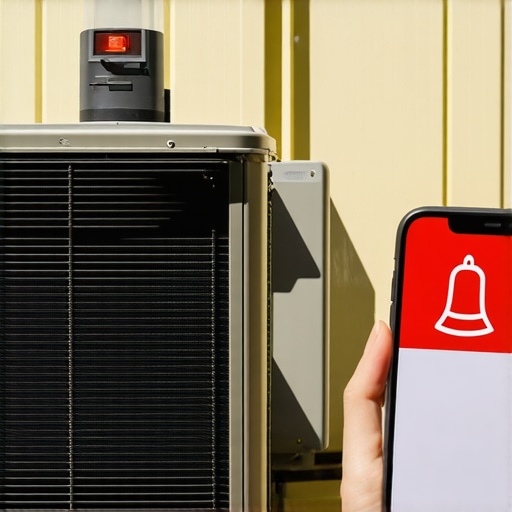
I followed a so-called ‘Sales Tech’ last August into a three-story brick home in Chicago. This kid—fresh out of a two-week ‘sales bootcamp’ and wearing a shirt so white it blinded you—was trying to tell a retired schoolteacher she needed a $22,000 geothermal heat pump systems installation because her wall furnace installation was ‘leaking radiation.’ Total garbage. I walked in, looked at her 1970s radiator replacement history, and checked her thermostat. The kid hadn’t even looked at the thermostat wiring upgrades she’d had done the year before. The issue? A simple sensor alert on her smartphone that he’d intentionally ignored to push a high-ticket commission. All she needed was a proper furnace tune-up services visit and a $15 sensor calibration. This is the rot in our industry, and it’s why understanding predictive maintenance alerts is your only defense against being taken for a ride.
The Sound of Silence: A Forensic Diagnosis of HVAC Failure
In the trade, we don’t listen for the AC running; we listen for the way it stops. A healthy system has a rhythmic, mechanical hum that tapers off like a jet engine landing. But when a capacitor—the ‘heart’ of your condenser—starts to swell, you’ll hear a rhythmic clicking, followed by a low, guttural groan. That’s the compressor trying to kick over without its ‘juice.’ If you ignore that sound, you aren’t just looking at a minor repair; you’re looking at a full-blown compressor burnout. When that happens, the refrigerant—or ‘gas’ as some of the old-timers call it—turns acidic. The smell is unmistakable: a sour, pungent stench that tells every ‘Sparky’ and ‘Tin Knocker’ on the job site that the unit is toast.
Modern thermostat installation today isn’t just about changing the temp; it’s about forensic monitoring. We now use sensors that monitor the ‘Delta T’—the temperature difference between the return air and the supply air. In our cold Northern climate, especially for those who have gone through an oil to gas conversion, the physics of airflow are brutal. If that Delta T starts to narrow, your sensors should scream before your living room hits 85 degrees.
“The most expensive equipment in the world cannot overcome a bad duct system.” – Industry Axiom
This is where thermostat wiring upgrades come into play. Old 4-wire setups can’t handle the data load required for the high-level diagnostics that prevent these failures. You need that ‘C-wire’ for more than just power; you need it for the heartbeat of the system.
The Anatomy of an HVAC Catastrophe
Let’s talk about ‘Pookie.’ In the trade, that’s the mastic we use to seal ducts. If your tin knocker didn’t use enough Pookie, or if they used cheap silver tape, your static pressure is going to be garbage. When static pressure rises, the blower motor has to work twice as hard to move air through the evaporator coil. In the North, where we deal with heavy humidity during the ‘dog days’ and sub-zero temps in winter, this stress is compounded. A smart sensor can detect the increase in amperage draw from that motor. It’s like a doctor seeing high blood pressure. By the time you feel the heat, the motor has already been ‘redlining’ for weeks.
When we talk about predictive maintenance alerts, we are talking about the difference between a $150 furnace tune-up services call and an $8,000 emergency replacement. Take chimney liner installation for example. If your liner is failing, a sensor can detect backdrafting or CO levels that you can’t see or smell. It’s the same with AC. If your suction line—the big copper pipe that should be ‘beer can cold’—starts to get warm, the sensor knows the heat exchange is failing. This is usually due to a ‘restricted orifice’ or a failing TXV (Thermostatic Expansion Valve). Without a sensor, you just think the ‘AC isn’t keeping up.’ In reality, the compressor is overheating, the oil is breaking down, and you’re hours away from a total system death.
Thermodynamic Zooming: Why Humidity is the Real Enemy
In the Chicago heat, it’s not the 90-degree ambient temp that kills you; it’s the latent heat—the humidity. Your evaporator coil doesn’t just ‘cool’ air; it removes moisture by dropping the air temperature below the dew point. This is where geofencing temperature control becomes a double-edged sword. If you have your geofencing set to turn the AC off while you’re at work, the humidity in your home can spike to 70%. When you get home and the AC kicks on, the evaporator coil is hit with a massive latent load. If you don’t have sensors monitoring the drainage, that condensation can overflow, leading to mold and water damage. This is why how to identify when furnace repair is urgent and why often starts with a moisture sensor in the secondary drain pan.
The Math of Modern Maintenance: Repair vs. Replace
I tell my customers that an HVAC system is like a car that you drive at 60 mph for 3 months straight without ever turning off the engine. You wouldn’t do that to a Ford, so why do it to a Carrier?
“Standard 62.1-2022 defines the requirements for ventilation and air quality, but it’s the technician’s eyes that catch the cracked heat exchanger.” – ASHRAE Insight
If you’re looking at a repair that costs more than 50% of the unit’s value, and the unit is over 12 years old, it’s time to pull the plug. But with predictive maintenance alerts, you can extend that life to 20 years. We see it all the time with geothermal heat pump systems—they are incredibly efficient, but their sensors are hyper-sensitive. If you don’t keep up with top hvac repair strategies to extend your systems life, those sensors will lock the system out to protect the expensive bits. It’s annoying to the homeowner, but it’s actually saving them thousands in the long run.
For those still running on old tech, like a wall furnace installation or an old boiler needing radiator replacement, the transition to ‘smart’ tech can be a shock. But even these old workhorses benefit from basic sensor upgrades. An oil to gas conversion is the perfect time to integrate a full sensor suite. It’s about more than just comfort; it’s about data. When you know your system’s baseline performance, any deviation is a red flag. That is the essence of staying ahead of the curve. Don’t wait for the sweat to tell you there’s a problem. Listen to the sensors, watch the amperage, and for the love of all that is holy, make sure your tin knocker used enough Pookie on the return air drop.
Ultimately, the goal is a system that you never have to think about. Whether you are dealing with ac-installation-secrets-that-hvac-pros-wont-tell-you or trying to navigate choosing-the-right-hvac-fixes-what-homeowners-need-to-know, the answer is always found in the physics of the machine. The sensors are just the translators. They translate the language of pressure, temperature, and electrical draw into something you can understand on your phone. If you ignore them, you’re not just ignoring a notification; you’re ignoring the inevitable breakdown of the most expensive appliance in your home.