The Invisible Killer: Why Static Pressure is the Blood Pressure of Your HVAC System
Most homeowners think an HVAC system is just a box that blows hot or cold air. They think if it stops working, you just call a guy to swap a part or, heaven forbid, ‘top off the gas.’ But after thirty years of crawling through spider-infested crawlspaces and baking in attics, I can tell you that the box is only as good as the lungs attached to it. I’m talking about airflow. In the trade, we call it static pressure, and if yours is too high, you aren’t just looking at a gas furnace repair; you’re looking at a ticking time bomb in your mechanical room. High static pressure is the silent killer of heat exchangers, and ignoring it is the fastest way to turn a high-efficiency modulating furnace repair into a full-scale system replacement.
The Physics Lesson: You Can’t Move Heat You Can’t Touch
My old mentor, a grizzly guy who could smell a refrigerant leak from the curb, used to scream at me every time I pulled out a multimeter before a manometer: ‘You can’t heat what you can’t touch, kid! Airflow is king!’ He was right. If the air isn’t moving across that heat exchanger at the specific cubic feet per minute (CFM) the engineers intended, the physics of thermodynamics break down. It’s like trying to run a marathon while breathing through a cocktail straw. Your heart—in this case, the blower motor—strains, and your lungs—the heat exchanger—overheat because they can’t shed the thermal load. This is the foundation of variable speed furnace services; these motors try to fight the resistance, but even they have limits.
“The most expensive equipment in the world cannot overcome a bad duct system. High TESP (Total External Static Pressure) is the primary cause of premature component failure in residential systems.” – ACCA Manual D Principles
The Anatomy of a Crack: Metal Fatigue and Thermal Stress
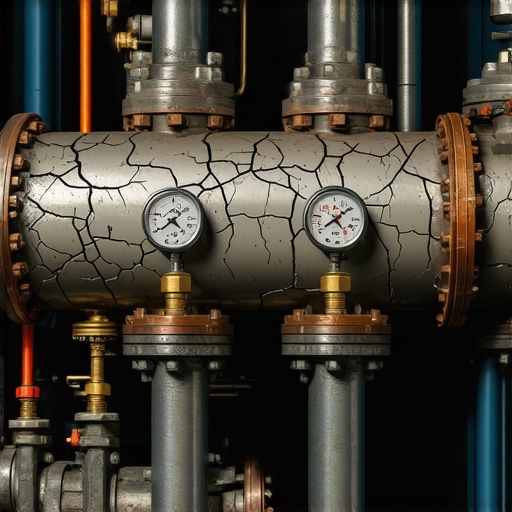
Let’s talk about gas furnace repair from a forensic perspective. Inside your furnace is the heat exchanger—a series of metal tubes or clamshells where the combustion happens. On the other side of that metal is the air you breathe. When your ductwork is undersized, or your ‘high-efficiency’ pleated filter is packed with three months of golden retriever hair, the static pressure spikes. Because the air can’t move through fast enough, the heat exchanger gets glowing red hot. When the cycle ends, it cools down rapidly. This constant, extreme expansion and contraction is like bending a paperclip back and forth. Eventually, the metal fatigues and snaps. That’s when the crack forms, and that’s when carbon monoxide starts leaking into your IAQ improvement services stream. This isn’t just a comfort issue; it’s a safety crisis that requires knowing how to identify when furnace repair is urgent and why.
The North Climate Reality: Polar Vortexes and Flame Rollout
Up here in the cold zones like Chicago or the Northeast, we don’t play games with heating. When it’s -10°F outside, your furnace is running 20 hours a day. If your wall furnace installation or central system is choking on its own static pressure, the heat buildup can cause ‘flame rollout.’ This is where the flames literally reach back out of the combustion chamber because the heat can’t escape forward. I’ve seen rollout switches tripped on modulating furnace repair calls where the homeowner thought they just needed a ‘quick tune-up.’ In reality, their tin knocker (duct guy) thirty years ago undersized the return air drop, and now the new high-efficiency blower is trying to pull a vacuum. This is why steam boiler repair is often seen as more reliable in older homes; they don’t rely on the ‘lungs’ of a duct system, but for those with forced air, the ductwork is your destiny.
“Adequate ventilation and pressure balancing are critical to preventing the accumulation of combustion byproducts within the living space.” – ASHRAE Standard 62.2
The ‘Pookie’ and the Math: Why Mastic Matters More Than Tape
If you want to lower your static pressure and save your heat exchanger, you have to look at the joints. I see ‘sparkies’ and ‘sales techs’ using silver tape on everything. Tape dries out and leaks. Real pros use ‘Pookie’—that thick, gray duct mastic that seals a system tighter than a drum. When we perform an AC installation or a furnace swap, we measure the static pressure on both sides of the coil. If the numbers are north of 0.5 inches of water column, we don’t just walk away. We look for the bottleneck. Is it a crushed flex duct? A transition that’s too sharp? Sometimes the fix is as simple as a humidifier installation that was cut in poorly, blocking half the airflow. For those looking for heating service innovations transforming 2025 climate control, the biggest innovation isn’t a smart thermostat; it’s a properly sized return air plenum.
Modulating vs. Single Stage: The Variable Speed Trap
Modern variable speed furnace services are brilliant, but they can mask static pressure problems until it’s too late. An old-school permanent split capacitor (PSC) motor would just slow down if the pressure got too high. You’d notice the house wasn’t getting warm. But a modern ECM (Electronically Commutated Motor) will ramp up its RPMs to force the air through, consuming massive amounts of electricity and screaming like a jet engine. This ‘hunting’ for CFM eventually fries the contactor repair points or the control board itself. If you’re hearing a whistling sound from your vents, your system is crying for help. Don’t fall for furnace repair myths debunked by industry experts that say a loud furnace is just a ‘powerful’ one. A loud furnace is a dying furnace.
The Final Diagnosis: Comfort is Physics
Whether you are looking at solar thermal heating integration or a standard gas furnace repair, the laws of thermodynamics don’t care about your budget. If the static pressure is high, the heat exchanger is dying. Period. I’ve seen $15,000 systems dead in five years because the installer was too lazy to run a second return line. Don’t let a ‘Sales Tech’ talk you into a new unit without measuring your static pressure first. If the ducts are bad, the new unit will die just as fast as the old one. Real comfort comes from balanced airflow, low resistance, and a system that can breathe. It’s not magic; it’s manometers.