The Sound of Silence: When Your Pool Oasis Goes Cold
There is a specific kind of silence that haunts a backyard in May. It’s not the peaceful kind; it’s the expensive kind. You turn the dial, you wait for that familiar whoosh of the burners or the steady hum of the compressor, and instead, you get… nothing. Or worse, you see that blinking ‘Low Flow’ or ‘Pressure’ light on the control board. As a tech who has spent thirty years diagnosing everything from warehouse heating solutions to residential inverter-driven compressors, I can tell you that pressure is the pulse of your system. If the pulse is weak, the heart—your heat exchanger—is about to stop.
My old mentor, a man who could smell a pilot light relighting issue from three driveways away, used to scream at me, ‘You can’t heat what you can’t touch!’ He wasn’t talking about the water; he was talking about the physics of energy transfer. If you don’t have the right flow, the thermodynamics collapse. This applies whether you are looking at modulating furnace repair or a high-end heat pump. In the world of HVAC and pool heating, we don’t just ‘make things hot.’ We manage the movement of mass. When your pool heater loses pressure, it’s a physical protest against a system that’s losing its ability to breathe.
The Forensic Diagnosis: Why Your Pressure is Bottoming Out
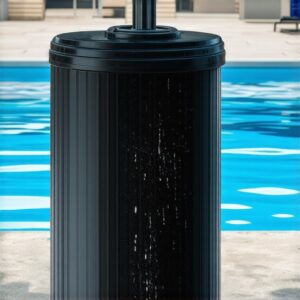
When I’m called out to a job where a heater is tripping the pressure switch, I don’t look at the heater first. I look at the filter. It’s the same logic I use for variable speed furnace services. If your furnace filter is packed with dust, the blower motor works twice as hard for half the result. In a pool system, a dirty sand filter or a clogged cartridge acts like a literal wall. If the water can’t get back to the heater at the required gallons per minute (GPM), the pressure switch—that little plastic gatekeeper inside the cabinet—won’t close. No switch, no fire. No fire, no swimming.
“The most expensive equipment in the world cannot overcome a bad duct system—or in this case, a restricted hydraulic circuit.” – Industry Axiom (Adapted)
If your filter is clean and you’re still seeing that error, we look at the bypass valve. Most guys who call themselves ‘pros’ just crank the valve shut, forcing all the water through the heater. That’s a rookie move. Too much flow can erode the copper headers inside the heat exchanger, turning your expensive heater into a giant sprinkler. You need a balance. If you’re dealing with more complex setups, like those requiring remote thermostat access or WiFi thermostat integration, a pressure drop could even be a software communication error between your automation panel and the heater’s internal sensors. I’ve seen smart thermostat setup jobs where the ‘smart’ part was actually just a bad ground wire causing a phantom pressure reading.
The Mechanical Anatomy: More Than Just Pipes
Let’s talk about the ‘Gas.’ In a pool heat pump, we’re dealing with a sealed refrigeration system. If you have a leak in the evaporator coil, you’re losing your ‘Juice.’ I’ve had customers ask me to just ‘top it off,’ but any tech worth his salt knows that’s a scam. It’s a sealed system; if it’s low, there’s a hole. Finding that hole requires the same precision as a modulating furnace repair. We use electronic sniffers or UV dyes to find the leak. Speaking of UV, many modern homeowners are now opting for UV light installation for HVAC to keep their air clean, but in the pool world, we use similar technology to sanitize water, which can sometimes affect the longevity of your gaskets if not installed correctly by a real Tin Knocker or plumber.
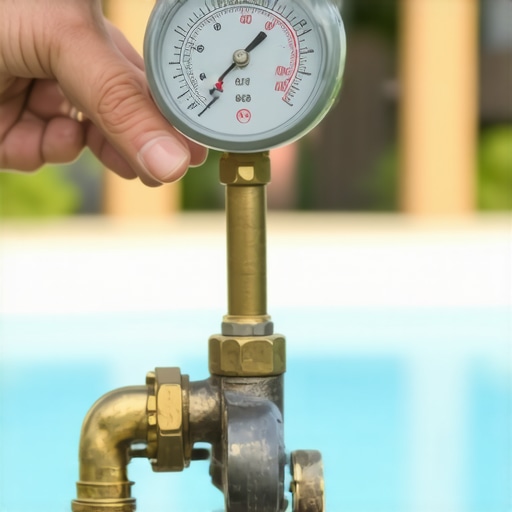
Then there is the heat exchanger itself. If you’ve neglected your chemistry, the water becomes acidic. It eats the copper. You might not see a leak on the ground, but you’ll see the pressure gauge fluctuating as the internal bypass struggles to compensate for the turbulence inside a pitted tube. It’s a slow death. This is why preventative HVAC repair tips for year-round efficiency aren’t just suggestions; they are the difference between a $200 cleaning and a $5,000 replacement.
The Math: Repair ($500) vs. Replace ($8,000)
Is your heater over ten years old? If the heat exchanger is ‘weeping’ or the compressor is screeching like a banshee, you’re likely throwing good money after bad. We call it ‘chasing the ghost.’ You replace a pressure switch today, the ‘Sparky’ has to come out for a wiring issue tomorrow, and by next week, the manifold is cracked. When we look at how to identify when furnace repair is urgent and why, we apply the same ‘Rule of 50.’ If the repair cost is 50% of the value of the unit, and the unit is over 50% of its expected lifespan, it’s time to call it. New units now offer inverter-driven compressors that are whisper-quiet and don’t spike your electric bill every time they kick on. If you’re in a climate where you use heat recovery ventilators to keep your home fresh, you already understand the value of high-efficiency equipment.
“Thermal efficiency and safety are directly proportional to the maintenance of the heat exchange surface.” – ASHRAE Fundamentals
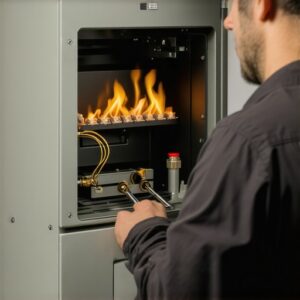
Before you give up, check your pump basket. A single stray leaf can create enough cavitation to drop the pressure below the threshold. If you’ve checked the basket, the filter, and the valves, and that heater still won’t fire, you’re likely dealing with a failed internal pressure switch or a burner manifold issue. If you smell something ‘sour’ or acidic near the unit, that’s a sign of a burnout or a major chemical imbalance that has compromised the internals.
The Airflow Manifesto: Why Comfort is Physics
In the North, where we deal with wild temperature swings, your pool heater is under more stress than a unit in the tropics. It’s fighting the ambient air temp to keep that water at 84°F. This is where warehouse heating solutions logic comes into play—you need high-volume output to overcome the massive heat loss to the cold air. If your heater is sized correctly but losing pressure, it could even be the gas supply. A modulating furnace repair often uncovers that the gas pressure is dipping when the unit tries to ramp up. If the gas pressure drops, the unit shuts down to prevent a dangerous ‘lazy flame’ condition. It’s all about the balance of pressures—water, gas, and air.
If you’re tired of guessing, contact us for a real diagnostic. Don’t let a ‘Sales Tech’ tell you that a little pressure drop means you need a whole new system without checking the $30 switch first. Whether you need a smart thermostat setup to control your pool from your phone or a deep dive into your variable speed furnace services, remember that physics doesn’t lie. Airflow and water flow are the kings of comfort. Keep them moving, keep them clean, and use a little ‘Pookie’ (mastic) if you find a leak in your air-side ducts while you’re at it. Comfort isn’t magic; it’s just well-managed thermodynamics.