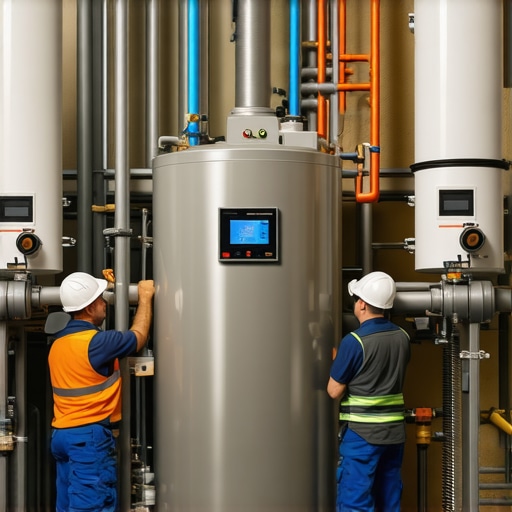
The basement of a 1950s elementary school at 4:00 AM in the middle of a January polar vortex is a place where you learn the truth about mechanical systems. It smells like wet concrete, old oil, and the faint, metallic tang of oxidized iron. I’ve spent thirty years in those trenches, and let me tell you, the rattling echo of a massive cast-iron boiler struggling to hit its set point is a sound that stays with you. My old mentor, a man who could diagnose a bad thermocouple by the color of the pilot flame alone, used to scream at me, ‘You can’t heat a classroom if the BTU can’t find a way out of the pipe! This is why airflow matters more than horsepower, kid!’ He was right then, and he’s right now. Most people think a boiler is just a giant kettle, but in a school setting, it’s the heart of a complex vascular system. If the ‘blood’—whether it’s steam or hot water—can’t move, the school freezes. We aren’t just talking about comfort; we’re talking about preventing burst pipes and school closures that cost the district millions.
The Forensic Diagnosis: Why Your School Boiler is Bleeding Money
When I walk into a boiler room for industrial heater services, I’m not looking at the nameplate first. I’m looking at the peripheral damage. Most school boards want to jump straight to a full replacement, often pushed by some ‘Sales Tech’ who wouldn’t know a pipe wrench from a pogo stick. They quote a quarter-million dollars when the actual problem is a failed thermocouple replacement or a calcified heat exchanger. To understand efficiency, you have to understand the thermodynamic transition. In the cold North, we deal with sensible heat—the heat you actually feel. When that boiler fires, it’s fighting the thermal bridge of uninsulated masonry. If your air handler repair isn’t up to snuff, you’re just cooking the basement while the third-floor math lab is at 55 degrees. You have to look at the warehouse heating solutions logic even in a school; it’s about massive volumes of air and the velocity of the fluid in the loops.
“The most expensive equipment in the world cannot overcome a bad duct system.” – Industry Axiom
This applies to hydronics too. You can have a 98% AFUE condensing boiler, but if your pumps are oversized and your radiators are scaled internally, you might as well be burning $100 bills in the parking lot.
The Retrofit Strategy: Inverters and Occupancy Sensors
Retrofitting isn’t just about slapping a new burner on an old shell. It’s about the new construction heating design philosophy applied to old iron. One of the biggest ‘game-changers’—and I hate that term, but here it fits—is the integration of inverter-driven compressors and variable frequency drives (VFDs) on the pump motors. In the old days, a pump was either on or off. Now, we can modulate the flow based on the actual demand. Combine this with occupancy sensor installation in every classroom, and you stop heating empty gyms at 10:00 PM. This isn’t magic; it’s physics. By reducing the flow rate when demand is low, you reduce the friction loss in the pipes, which saves electricity and keeps the boiler in its ‘sweet spot’ for condensing. If you’re wondering how to handle these upgrades without breaking the bank, heating service hacks for comfort and savings in 2025 provides a solid baseline for incremental improvements. We are also seeing a massive shift toward geofencing temperature control for district-wide management, allowing a single facility manager to prep the buildings before the first bus arrives without needing a guy on-site at midnight.
[image-placeholder]
Modernizing the Perimeter: Snow Melt and Mini-Splits
We can’t talk about school efficiency without talking about the exterior and the ‘problem zones.’ I’ve seen more school budgets wrecked by slip-and-fall lawsuits than by fuel costs. That’s where snow melt systems installation comes in. By tapping into the boiler’s return loop—using heat that would otherwise be wasted—you can keep walkways clear without a shovel. It’s a thermodynamic freebie if designed correctly. For those stubborn corner offices or server rooms that the main boiler loop always misses, ductless mini-split installation is the surgical strike. You don’t need to repipe the whole wing; you just need a localized solution. This is part of choosing the right HVAC fixes for long-term viability.
“Energy audits of educational facilities consistently show that 30% of energy consumed is wasted due to poor control strategies.” – ASHRAE Standards
When I catch a Sales Tech trying to sell a whole new chiller plant for a building with leaky windows and no warehouse heating solutions for the bus garage, I show them the door. You have to fix the envelope first. If you’re dealing with a system that feels like it’s on its last legs, check out how to identify when furnace repair is urgent and why to see if you can squeeze another five years out of that ‘old girl’ in the basement. Proper industrial heater services aren’t about selling boxes; they’re about mastering the gas, the sparky’s wiring, and the tin knocker’s ductwork to ensure every BTU is accounted for.