The Regulatory Wall: Why 2025 is the Year of Reckoning for Multi-Family Heating
If you own or manage a multi-family property, you are currently staring down the barrel of a regulatory shotgun. I have spent thirty years crawling through mechanical rooms and wrestling with rusted 80% AFUE furnaces that should have been retired when Reagan was in office. Most owners think they are saving money by ‘nursing’ these relics along, but they are ignoring the thermodynamic reality of equipment decay and the looming R-454B refrigerant transition services. My old mentor, a man who could diagnose a compressor by the vibration in the liquid line, used to scream at me, ‘You can’t cool what you can’t touch, and you can’t heat what you can’t move!’ This is the absolute truth of airflow. If your ductwork—the ‘arteries’ of your building—is choked with dust or undersized, it doesn’t matter if you install the most expensive high-efficiency furnace installation; you’re just throwing money into the return air.
‘The most expensive equipment in the world cannot overcome a bad duct system.’ – Industry Axiom
The A2L Cliff: R-454B and the Low-GWP Retrofit Reality
We are currently witnessing the death of R-410A. For years, it was the ‘juice’ of choice, but the EPA is mandating a shift to low-GWP refrigerant retrofits. This means if you have twenty-year-old heat pumps in your multi-family units, the cost of repairing them is about to skyrocket as the supply of old refrigerant dries up. The new kids on the block are A2L refrigerants, specifically R-454B. These are ‘mildly flammable,’ which sounds scary to a layman but is just physics to a pro. However, it means your units now need leak-detection sensors and specialized training for the tech. If you ignore a multi-family heating upgrade now, you’re going to be forced into it later at a 40% premium when the old stuff is illegal to manufacture. This isn’t just about ‘being green’; it’s about not being stranded with a building full of unfixable boxes when the polar vortex hits. You can learn more about these shifts in the ultimate guide to ac installation expert tips for 2025 success.
The Anatomy of a Failing System: From Contactors to Heat Exchangers
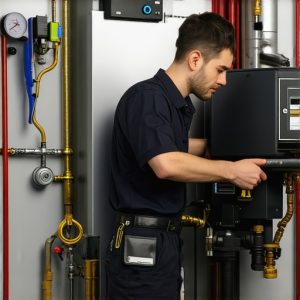
When I walk into a multi-family mechanical room, I’m not looking at the paint; I’m listening for the screech of a failing blower bearing and smelling for the acidic, sour stench of a winding burnout. A common failure point in these high-cycle environments is the contactor. A contactor repair is a simple fix, but if that ‘Sparky’ or ‘Sales Tech’ misses the pitted silver points, the compressor will chatter itself to death. In a cold climate like Chicago or the Northeast, the real killer is the cracked heat exchanger. As the metal expands and contracts thousands of times, microscopic fissures form. This is where carbon monoxide leaks from the combustion side into the airstream. If you aren’t getting annual furnace tune-up services, you aren’t just losing efficiency; you are risking tenant lives. When we talk about high-efficiency furnace installation, we are talking about units that extract latent heat from the flue gases—literally turning the exhaust into water. If that condensate drain isn’t piped right, it’ll rot your floorboards out before the first winter is over.
The Digital Illusion: Why Smart Thermostat Setup Isn’t a Magic Bullet
Management companies love WiFi thermostat integration because they think they can control the bill from an iPhone. But here’s the truth: a smart thermostat is just a switch. If the furnace has a blocked secondary heat exchanger or the ‘Tin Knockers’ didn’t size the return air drops correctly, all that smart thermostat setup is going to do is send you an alert that your building is freezing at 3 AM. Integration only works if the mechanical foundation is solid. When we perform heating service innovations, we look at the static pressure of the system. If the pressure is too high, the blower motor works harder, uses more amps, and dies early. It’s like trying to breathe through a cocktail straw while running a marathon.
‘Properly sized equipment, based on ACCA Manual J, is the only way to ensure both comfort and longevity.’ – HVAC Performance Standard
Fireplace Inserts and Heat Pump Replacement: Modernizing the Multi-Family Experience
Many older multi-family units rely on inefficient electric baseboards or decorative fireplaces that leak heat like a sieve. Fireplace insert services can turn a drafty hole in the wall into a legitimate heat source, but for the heavy lifting, heat pump replacement is the modern gold standard. We’re not talking about the old heat pumps that blew ‘lukewarm’ air in the 80s. Modern cold-climate heat pumps can pull heat out of the air even when it’s sub-zero outside. But you have to watch the ‘Pookie’ (mastic). If the installer didn’t seal the plenum with high-grade mastic and instead used cheap tape, your expensive conditioned air is heating the crawlspace instead of the living room. If you’re ready to stop the bleeding on your utility bills, you should contact us for a real load calculation, not a ‘rule of thumb’ guess from a sales tech. If you wait for the emergency, you’ve already lost. Efficient heating is a game of millimeters and pressures, not just swapping boxes. You can read about more heating service hacks for comfort and savings to get ahead of the curve.