The Sound of a Failing Hydronic System at 3 AM
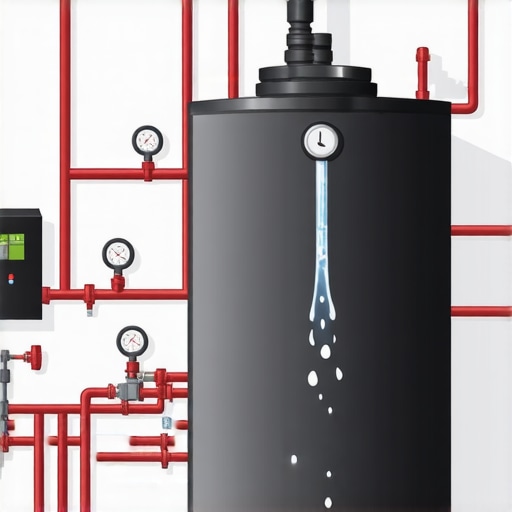
You wake up to a rhythmic drip. It’s not the kitchen sink. It’s coming from the basement or the utility closet. You find a puddle forming under a pipe that points toward the floor—the discharge tube for your boiler’s pressure relief valve. Most homeowners panic and call for an emergency heating repair, fearing their boiler is about to explode like a cartoon steam engine. Some ‘Sales Tech’ arrives, looks at the puddle, and tells you that your 15-year-old cast iron boiler has a ‘compromised vessel’ and you need a $15,000 replacement. He’s lying. Or he’s just incompetent. As a ‘wet-head’ who has spent three decades diagnosing hydronic systems in the frozen Northeast, I can tell you that a leaking relief valve is rarely a death sentence for the boiler itself. It’s usually a symptom of a much simpler, though critical, failure in the system’s anatomy.
The Physics of the ‘Water Bully’
My old mentor used to scream at me during my apprenticeship, ‘You can’t compress water! You can’t cool what you can’t touch, and you can’t squeeze a liquid!’ This is the foundation of all boiler logic. When water heats up from 70°F to 180°F, it expands. It physically takes up more space. In a closed loop system, that expanding water has nowhere to go. This is where HVAC load calculation services come into play during the design phase—you have to account for that volume. If the system has no ‘room’ for that expansion, the pressure rises instantly. Water is a bully; if it doesn’t have a place to go, it will make one by blowing past the spring-loaded seat of your relief valve.
“The most expensive equipment in the world cannot overcome a bad duct system—or in the case of hydronics, a failed expansion strategy.” – Industry Axiom
The Forensic Diagnosis: The Expansion Tank
In 90% of the service calls I run for a leaking relief valve, the culprit is the expansion tank. Think of the expansion tank as the ‘lungs’ of your heating system. Inside that steel can is a rubber diaphragm. One side is filled with the system water; the other side is filled with pressurized air (usually set to 12 PSI). Air is compressible. Water is not. When the water in your boiler heats up and expands, it pushes against that rubber diaphragm, squeezing the air on the other side. This absorbs the pressure increase. If that diaphragm ruptures, or if the tank ‘waterlogs,’ there is no air cushion left. The moment the burner fires and the water temperature climbs, the pressure spikes to 30 PSI, and the relief valve does exactly what it was designed to do: it opens to prevent your boiler from turning into a rocket ship. Identifying this requires more than a glance; you have to check the Schrader valve on the tank. If you poke it and water comes out instead of air, your tank is dead. This is a simple fix, but many techs will try to upsell you on variable speed furnace services or a full system swap instead of just replacing a $100 tank.
The Auto-Feeder and the Pressure Reducing Valve
The second suspect is the Pressure Reducing Valve (PRV). This is the component that takes your street water pressure (usually 60-80 PSI) and drops it down to the 12-15 PSI your boiler needs. If the seat inside this valve gets fouled with minerals or debris, it can ‘creep.’ This means it slowly lets street pressure leak into the boiler loop. Over several hours, the system pressure rises until it hits that 30 PSI limit, and the relief valve starts weeping. I’ve seen cases where a homeowner thought they needed hospital HVAC zoning levels of complexity for their home when all they really needed was a new PRV and a strainer cleaning. This is why choosing the right HVAC fixes is about understanding the physics, not just replacing parts blindly.
The Danger of Ignoring the Drip
If you let that valve drip, you aren’t just wasting water. You are constantly introducing ‘fresh’ oxygenated water into your system via the auto-feeder. Fresh water is the enemy of cast iron and copper. It carries dissolved oxygen which causes internal corrosion. A boiler system should ideally be a ‘dead’ loop where the same water circulates for years, becoming de-oxygenated and inert. Constant leaking leads to transformer replacement needs due to electrical shorts from moisture, or worse, a cracked heat exchanger. This is why identifying when furnace repair is urgent applies to boilers too—a leak is a signal that the chemistry of your system is being compromised.
“Relief valves shall be installed in accordance with the manufacturer’s instructions and must be capable of discharging the maximum rated capacity of the equipment.” – ASME Section IV Boiler Code
Beyond the Boiler: Airflow and Maintenance
While I’m in the basement fixing a boiler, I often see the other ‘forgotten’ systems. I’ve walked past water heaters that were back-drafting because the owner never thought about dryer vent cleaning, which was creating a negative pressure in the house. Or I’ll see a portable heater safety check being ignored while the homeowner uses space heaters because one room is cold—a classic sign that they need duct design services or HVAC duct sealing for their separate forced-air system. People forget that HVAC is a holistic environment. You can’t just look at the boiler in a vacuum. If your home has high-occupancy areas, maybe you need an occupancy sensor installation to manage the load, but you definitely need to ensure the primary heat source isn’t literally bleeding out through a relief valve. Regular preventative HVAC repair is the only way to catch a failing expansion tank before it causes a flood.
Repair vs. Replace: The Cold Hard Math
Should you fix it? If the boiler block itself isn’t leaking (the ‘vessel’), and the heat exchanger isn’t cracked, then yes, fix the relief valve and its root cause. A relief valve, expansion tank, and PRV replacement might cost you $500 to $800 depending on the ‘juice’ (electricity) and plumbing complexity involved. Compare that to $10,000+ for a new high-efficiency modulating-condensing unit. Those ‘Mod-Cons’ are great, but they are finicky. My old ‘tin knocker’ buddies and I always say: a cast iron boiler is a tank that will last 40 years if you keep the oxygen out of it. If you’re looking for strategies to extend your system’s life, start by respecting the relief valve. It is a safety device, not a drain.
Conclusion: Don’t Let ‘Sales Techs’ Scare You
The next time you see water on the floor, don’t let a guy in a crisp white shirt who hasn’t seen an attic in five years tell you the sky is falling. Check the pressure gauge. If it’s near 30 PSI, look at your expansion tank. Tap it—it should sound hollow on the bottom and dull on the top. If it sounds ‘full’ everywhere, you’ve found your problem. HVAC isn’t magic; it’s thermodynamics. Whether you are dealing with HVAC load calculation services for a new build or just trying to survive a polar vortex, remember that airflow and pressure management are the two pillars of a working home. Keep your ‘Pookie’ (mastic) on the ducts and your air cushion in the tank, and you’ll stay warm without the ‘Sales Tech’ tax. For more technical deep dives, check out our heating service hacks for 2025. If you need a pro who actually knows how to use a manometer, you know where to contact us.