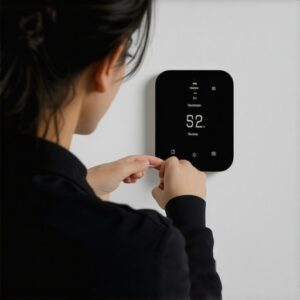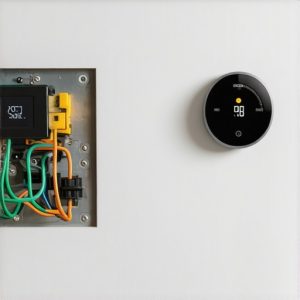
My old mentor, a grizzly veteran who smelled like tobacco and sulfur, used to scream at me until his face turned the color of a cherry-red furnace igniter: ‘You can’t heat what you can’t touch!’ He was a ‘Tin Knocker’ from the old school, and he understood something that today’s gadget-obsessed homeowners forget. Airflow is the soul of the machine. You can slap a $300 glowing glass rectangle on your wall and spend hours on programmable thermostat programming, but if the physics behind the drywall is broken, you’re just staring at an expensive lie. I’ve spent thirty years crawling through spider-infested crawlspaces and balancing on ice-slicked roofs in the Northeast, and I can tell you that the friction between high-tech software and low-tech sheet metal is where your comfort goes to die.
“The most expensive equipment in the world cannot overcome a bad duct system.” – Industry Axiom
In our cold Northern climate, we aren’t just fighting the temperature; we are fighting the laws of thermodynamics in a house that’s likely leaking heat like a sieve. When you’re dealing with cold climate heat pumps or a 100,000 BTU burner, the thermostat is just a switch. It doesn’t know that your return air duct is undersized or that some ‘Sparky’ ran a wire through your supply plenum, creating a vortex of turbulence. This is why modulating furnace repair has become such a headache lately. These high-efficiency units are designed to ramp up and down with surgical precision, but they require perfect static pressure. If your ductwork is restricted, the furnace hits its high-limit switch and shuts down before the room ever gets warm, leaving your smart thermostat wondering why the temperature hasn’t moved a degree.
Think about the heat pump installation process. People think it’s about the ‘Juice’ (that’s the refrigerant for the uninitiated) or the outdoor compressor. But it’s really about the delta-T—the temperature difference across the coil. If your heat exchanger cleaning hasn’t been performed in five years, you’ve got a layer of soot and dust acting as an insulator. The heat can’t transfer. You can set that Nest or Ecobee to 75 degrees all you want, but if the heat is staying inside the metal and going up the flue, you’re just burning money. In fact, many calls for gas furnace repair are actually just cries for help from a suffocating system. If you haven’t looked at your furnace repair myths debunked by industry experts, you might be surprised to find that your ‘broken’ furnace is just a victim of a $5 dirty filter.
Let’s talk about the oil to gas conversion wave. It’s a smart move for efficiency, but it requires a chimney liner installation to handle the acidic condensation of modern high-efficiency exhaust. If that liner isn’t sized right, your furnace won’t draft. The pressure switch won’t close. Your smart thermostat will show ‘Heating,’ but the only thing happening is your circulator blower moving cold air around. It’s a sensory nightmare: the screech of a dry bearing, the smell of unburnt gas, and the feeling of 55-degree air blowing on your neck in January. This is why heating service hacks for comfort and savings in 2025 emphasize the mechanical basics over the digital bells and whistles.
“A heating or cooling system shall be sized to satisfy the calculated load.” – ACCA Manual J
Thermodynamically zooming in, consider the latent heat. In the summer, even in the North, we deal with humidity. While evaporative cooler services work in the desert, up here we need the evaporator coil to drop below the dew point. If your system is oversized—a classic ‘Sales Tech’ move—it ‘short cycles.’ It satisfies the sensible heat (the temperature on the wall) in ten minutes but never stays on long enough to pull the moisture out of the air. You end up in a ‘cold swamp.’ The thermostat says 70, but you’re sweating because the relative humidity is 75%. This is a fundamental failure of airflow architecture, not electronics. This is why preventative maintenance contracts are the only way to ensure your static pressure and refrigerant charge are balanced for the actual load of your home.
If you find yourself constantly nudging the temp up and down, stop looking at the screen and start looking at the vents. Are they blocked by a sofa? Is there ‘Pookie’ (mastic) leaking out of the joints in the basement? A gap the size of a quarter can drop your CFM (cubic feet per minute) enough to kill the efficiency of a heat pump installation. Comfort isn’t a setting; it’s a state of equilibrium. If you need a pro who knows the difference between a software glitch and a cracked heat exchanger, it’s time to reach out. Don’t let a ‘Sales Tech’ talk you into a $20,000 replacement when a thorough gas furnace repair or duct sealing could solve the problem. You can always contact us for a real diagnosis from someone who actually knows how to use a manometer, not just an iPad.