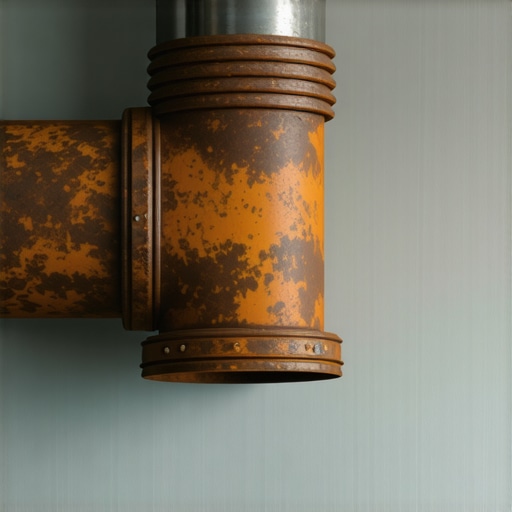
I’ve spent three decades crawling through crawlspaces and dragging my tool bag across ice-slicked roofs in the dead of winter, and if there is one thing I’ve learned, it is that metal doesn’t lie. Most homeowners see a little orange flake on a pipe and think it is ‘just age.’ I see a ticking clock. Last February, I followed one of those ‘Sales Techs’—you know the ones, the guys who carry a clipboard instead of a manometer—into a basement where he’d just quoted a family $18,000 for a dual fuel heat pump system because the furnace ‘smelled funny.’ He didn’t even pull the door off the cabinet. I walked in, saw a galvanized flue pipe with white phosphoric crusting and a hole the size of a nickel near the draft inducer, and I shut the gas off immediately. He was trying to hit a commission; I was trying to make sure they woke up the next morning. That rusting pipe isn’t just an eyesore; it is a breach in the most important safety barrier in your home.
The Chemistry of Decay: Why Flue Pipes Fail
When you are dealing with a gas furnace repair, you have to understand the physics of combustion. Every time your burner ignites, it creates heat, but it also creates a nasty cocktail of water vapor, carbon dioxide, and sulfur dioxide. In an ideal world, the draft inducer or the natural buoyancy of hot air carries those gasses out of the house before they can cool down. But if your system is oversized or if your venting is poorly designed by some ‘tin knocker’ who didn’t know his math, those gasses hit their dew point inside the pipe. The water vapor condenses, mixes with the sulfur, and creates a mild sulfuric acid. This acid eats the zinc coating off your galvanized pipe, leading to what we call ‘pitting.’ Once that pipe is compromised, Carbon Monoxide (CO) isn’t going out the roof; it’s lingering in your mechanical room. This is why identifying when furnace repair is urgent is a matter of life and death, not just comfort.
“Products of combustion shall be vented to the outdoors in accordance with the manufacturer’s instructions and the National Fuel Gas Code.” – Standard Safety Protocol
The Forensic Diagnosis: Anatomy of a Failing Vent
If you have a modulating furnace repair on your hands, the complexity increases. These units are efficient because they vary the flame size, but lower flame temperatures mean lower flue gas temperatures. If the ‘Sparky’ or the installer didn’t line the chimney or use the correct diameter B-vent, you are practically begging for condensation. Look at the base of the flue. Do you see white powder? That’s the precursor to rust. Is there a brownish streak running down the side of the furnace cabinet? That is acidic condensate leaking back through the flue joints because the pipe wasn’t pitched correctly. This often happens in school boiler maintenance as well, where massive systems create enormous amounts of moisture that can rot out a header in a single season. Whether it is a residential unit or a steam boiler repair, the physics remain the same: if the gas cools before it exits, the metal dies.
Thermodynamic Zooming: Latent Heat and the Dew Point
In cold climates, we deal with the ‘Cold Wall’ effect. When it is -10°F outside, that flue pipe is freezing. As the hot exhaust hits that cold metal, the latent heat is stripped away instantly. This is why we are seeing a massive shift toward cold climate heat pumps and geothermal heat pump systems in the Northeast. These systems eliminate the combustion risk entirely. However, if you are sticking with gas, you need to ensure your furnace flame sensor cleaning and thermocouple replacement are done annually. A dirty flame sensor causes ‘short cycling’—the unit turns on and off rapidly. This never allows the flue pipe to reach a temperature high enough to stay dry, accelerating the rust process. You are essentially water-boarding your own furnace every time it cycles.
“The most expensive equipment in the world cannot overcome a bad duct system or a compromised vent.” – Industry Axiom
Beyond the Pipe: Boilers and Specialty Systems
It’s not just furnaces. If you are looking at steam boiler repair, the flue issues are even more pronounced because of the sheer volume of BTU output. I’ve seen 80-year-old boilers where the flue was so choked with rust flakes that the CO was backing up into the basement rafters. Even your outdoor amenities aren’t safe; spa heater services often reveal rusted-out heat exchangers because the chemicals in the water accelerate the oxidation of the vent stacks. If you see rust, the structural integrity of the pressure vessel or the vent is gone. There is no ‘patching’ a flue pipe with duct tape or ‘pookie’ (mastic). You replace it with the correct gauge of metal, or you face the consequences.
The Math of Repair vs. Replacement in 2025
We are entering a weird era in HVAC. With the R-410A refrigerant phase-out and the rise of A2L refrigerants, everyone is panicked. But the flue pipe is ‘low tech’ compared to a variable-speed compressor, and that’s why it gets ignored. Replacing a flue section might cost you a few hundred dollars during a standard gas furnace repair. Ignoring it until it rots through and trips your high-limit switch or, worse, your CO detector, could lead to a full system replacement. If you’re tired of the gas headache, exploring heating service innovations for 2025 might lead you toward dual fuel heat pump systems, which use the gas furnace only as a backup during extreme polar vortex events, drastically reducing the wear and tear on your venting system. For more technical insights, check out furnace repair myths debunked to see what else the ‘Sales Techs’ are lying to you about.
Final Verdict: Don’t Ignore the Orange Flakes
Airflow isn’t just about the air you feel coming out of the registers; it’s about the air you DON’T want to feel—the exhaust. A rusted flue is a sign of a system that is struggling with its own internal environment. Whether you need a thermocouple replacement to keep the pilot steady or a full-scale modulating furnace repair, getting a set of eyes on that vent is priority number one. Don’t let a $50 piece of pipe turn into a tragedy. Keep your coils washed, your filters changed, and for heaven’s sake, if you see rust on the vent, call a real technician, not a salesman. Learn more about top HVAC repair strategies to keep your rig running until the wheels fall off.